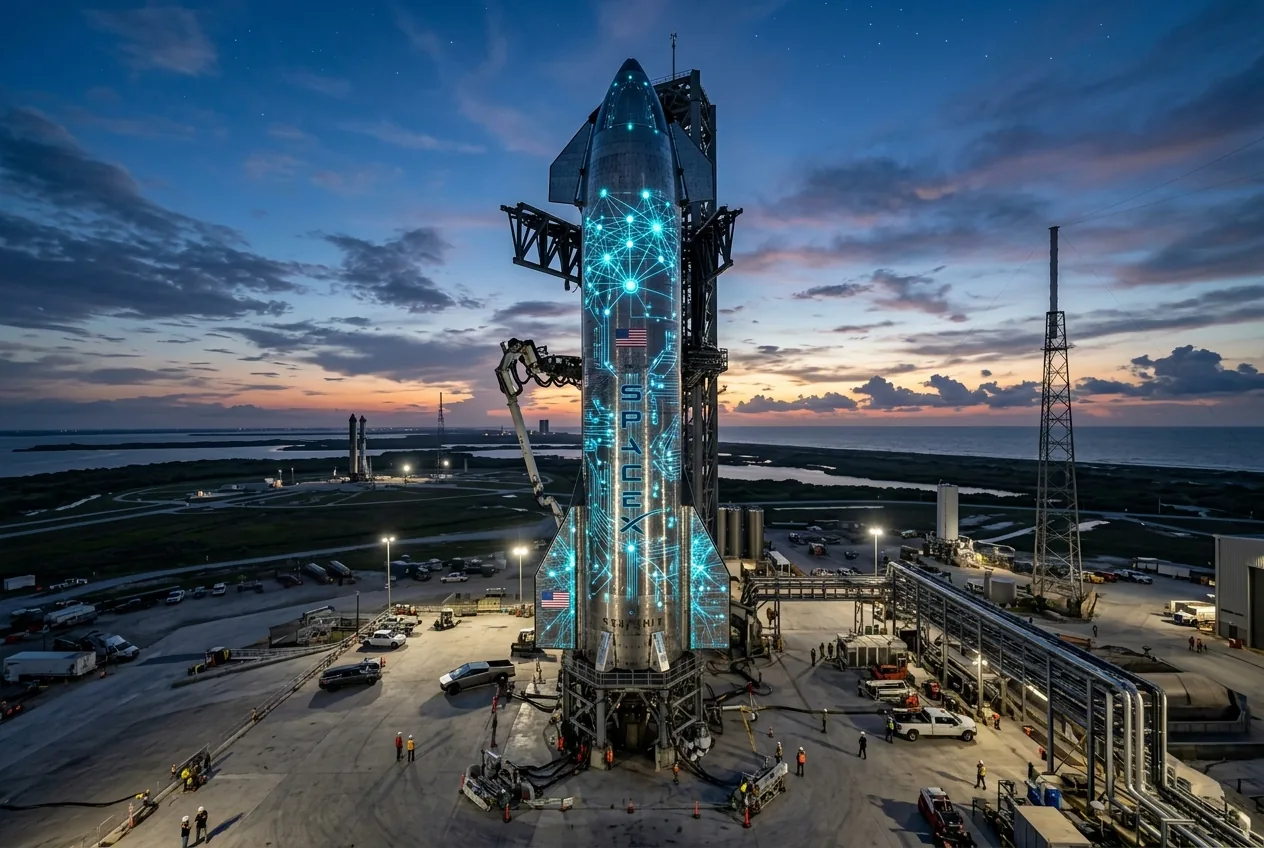
The Mechanical Integration of AI and Aerospace
From an engineering perspective, the synergy between a rocket manufacturer and an AI lab is rooted in the optimization of complex systems. SpaceX has built its reputation on iterative design and rapid prototyping—a philosophy that requires processing immense datasets from static fire tests and orbital launches. xAI’s infrastructure, including the massive Colossus supercomputer cluster, offers the specialized hardware required to run multi-physics simulations at a scale previously reserved for national laboratories. This compute capability is essential for the Starship program, where thermal protection systems and fluid dynamics of cryogenic propellants present non-linear challenges that traditional modeling struggles to predict.
Furthermore, the Starlink satellite constellation represents the world’s largest decentralized network of physical nodes in low Earth orbit. Managing a mesh network of thousands of satellites, each moving at 17,000 miles per hour while maintaining laser inter-links and ground-station handoffs, is a task uniquely suited for the large-scale transformer models and reinforcement learning techniques developed by xAI. By bringing these two worlds under one roof, SpaceX is building a closed-loop system where hardware performance data directly informs the training of the AI models that control the hardware.
Breaking Down the $1.75 Trillion Benchmarking
To understand the magnitude of the impending IPO, one must look at the capital structure. While the combined valuation sits at $1.25 trillion following the merger, the IPO target of $1.75 trillion would place the company in the same echelon as Microsoft, Apple, and Nvidia. However, it is important for investors to distinguish between a company’s market capitalization and the actual capital raised during an IPO. Unlike Saudi Aramco, which currently holds the record for the largest IPO after raising $25.6 billion in 2019, SpaceX is expected to offer a float between $40 billion and $80 billion. This would comfortably shatter previous records and provide the company with a massive war chest for its Mars-bound ambitions.
The valuation reflects a shift in how the market views SpaceX. It is no longer just a delivery service for NASA and commercial satellite operators. With xAI integrated, the company is being priced as a multi-sector utility. It is an internet service provider (Starlink), a logistics firm (Starship), and now, an AI infrastructure provider. This diversification is critical for maintaining high multiples in a public market that can be volatile toward pure-play space companies. By tethering the capital-intensive nature of rocketry to the high-margin scalability of AI software, the merger creates a more resilient financial profile for the public debut.
Is the $1.75 Trillion Valuation Justified?
Whether a company that builds rockets and trains AI models is truly worth nearly two trillion dollars is a subject of intense debate among industrial analysts. Critics point to the immense capital expenditures (CapEx) required to sustain SpaceX’s operations. Unlike software companies that enjoy 80% gross margins, SpaceX deals in high-grade alloys, specialized labor, and high-risk launch environments where a single hardware failure can result in hundreds of millions of dollars in losses. The xAI component, while software-based, is equally hungry for capital, requiring billions of dollars in Nvidia H100 or Blackwell GPUs and massive amounts of energy to remain competitive with the likes of OpenAI or Google.
The justification for the valuation lies in the concept of “total addressable market capture.” If SpaceX successfully dominates the global satellite internet market while simultaneously reducing the cost of orbital transport to a fraction of its current price, it effectively becomes the sole gatekeeper of the space economy. Adding a proprietary AI layer ensures that the data moving through these systems is also monetizable. For many institutional investors, the $1.75 trillion figure is not a reflection of current earnings, but a discounted cash flow projection of a future where SpaceX controls both the medium (space) and the intelligence (AI) of global communications.
Navigating the SEC and Regulatory Hurdles
The path to the stock exchange is paved with rigorous regulatory requirements. Following the merger, the company must enter a period of confidential filing with the U.S. Securities and Exchange Commission (SEC). During this stage, the S-1 prospectus is reviewed by regulators who scrutinize everything from financial disclosures to risk factors. This process typically takes several months, as the SEC may issue multiple rounds of comments requiring amendments. Only after these hurdles are cleared will the prospectus become public, offering the first granular look at the combined company’s P&L (profit and loss) statements and its internal valuation of xAI assets.
The transition from a private company to a public one will also force a level of transparency that Elon Musk has historically found restrictive. Quarterly earnings calls and mandatory disclosures regarding launch failures or satellite de-orbiting events will provide a level of oversight that could impact the company’s agility. For the engineering teams at SpaceX, the pressure to meet quarterly financial targets must be balanced against the technical rigor required for human spaceflight. This tension is a known variable for Tesla shareholders, and it will undoubtedly be a primary concern for those looking to invest in the SpaceX IPO.
The Economic Viability of the Combined Entity
From a pragmatic standpoint, the merger solves a significant problem for both entities: capital efficiency. xAI requires massive compute clusters to stay relevant, and SpaceX requires sophisticated automation to manage its growing fleet. By merging, the two can share the costs of power infrastructure, facility management, and high-level technical talent. We are seeing a move toward “synthetic intelligence” applied to physical systems, where the goal is not just a chatbot, but an operating system for the physical world. This is where the real economic value lies.
If the IPO proceeds as expected, the influx of $40 billion to $80 billion in fresh capital will likely be funneled directly into the manufacturing of Starship v3 and the expansion of xAI’s training clusters. This creates a feedback loop: cheaper launches allow for more compute nodes in orbit, which in turn allows for more powerful AI, which then optimizes the next generation of rockets. For the broader market, this IPO represents a rare opportunity to invest in a foundational technology shift. While the risks associated with such a high-valuation, high-complexity enterprise are significant, the potential for a $1.75 trillion SpaceX-xAI entity to dictate the terms of both the digital and physical frontiers is a prospect few investors will ignore.




Comments
No comments yet. Be the first!