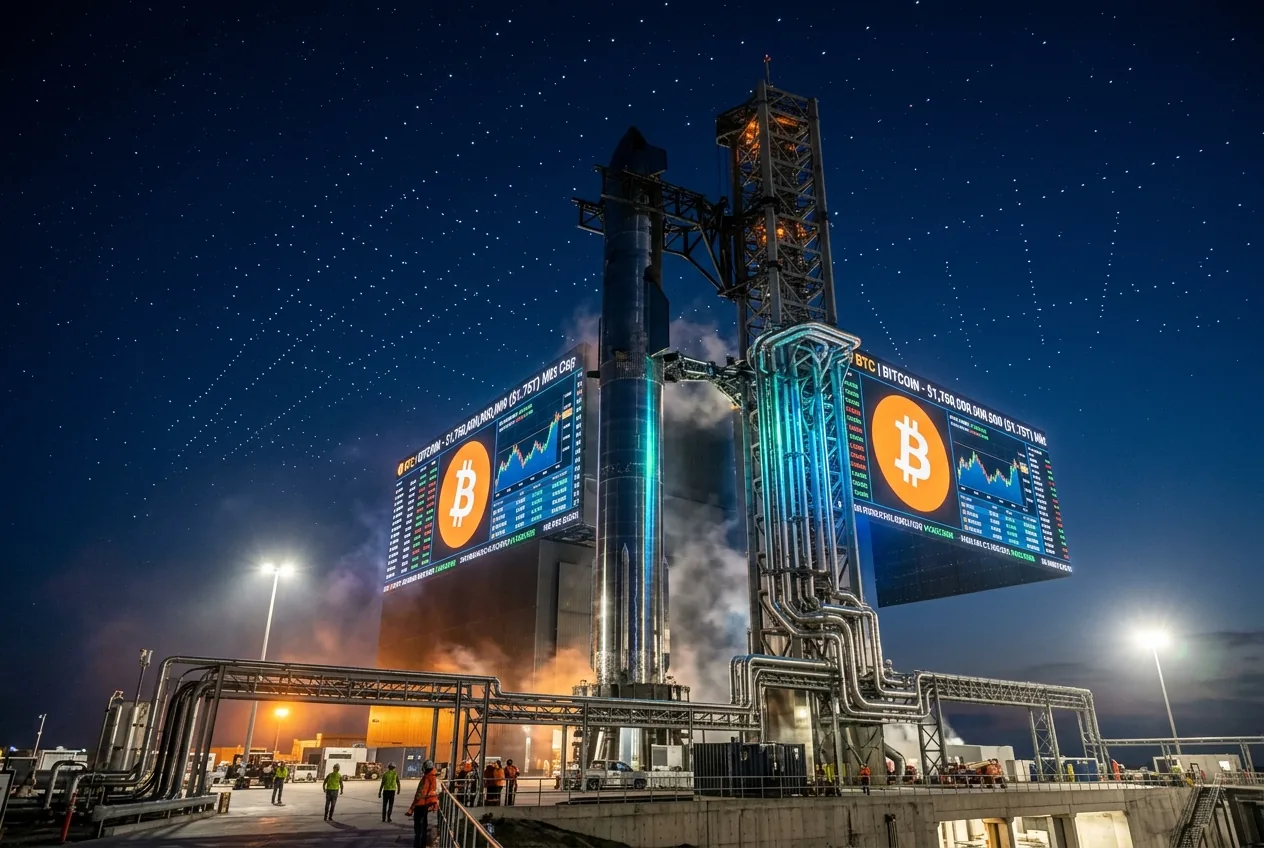
In the history of industrial capital, few events have promised the sheer scale of the upcoming initial public offering (IPO) of Space Exploration Technologies Corp., better known as SpaceX. Scheduled for June 2026, the move represents far more than a liquidity event for early investors; it is a calculated bet on the vertical integration of aerospace, artificial intelligence, and decentralized finance. Following its recent strategic merger with xAI, SpaceX has emerged as a $1.75 trillion behemoth, aiming to raise a record-shattering $75 billion in fresh capital. This public debut is poised to dwarf previous market records, including the $29.4 billion raised by Saudi Aramco, signaling a shift in the global economic center of gravity toward the stars.
The Mechanics of a $1.75 Trillion Valuation
How AI and Orbital Hardware Converge
From an engineering perspective, the synergy between xAI and Starlink addresses a critical bottleneck in modern computing: heat dissipation and data sovereignty. Terrestrial data centers face increasing energy costs and environmental regulations regarding cooling. In the vacuum of space, while heat management is a challenge solved by large-scale radiator arrays, the lack of atmospheric interference and the ability to utilize direct solar energy provide a compelling alternative for AI training clusters. SpaceX intends to deploy orbital AI data centers that utilize the low-latency backhaul of the Starlink network to process data closer to the point of collection—be it from satellites, maritime sensors, or remote industrial sites.
The integration of Grok into the Starlink ecosystem also facilitates autonomous operations in deep space. As SpaceX pushes toward Mars, the communication lag between Earth and the Red Planet—ranging from three to twenty-two minutes—makes real-time human control impossible. By embedding advanced LLMs and decision-making algorithms directly into the avionics of Starship and its auxiliary probes, SpaceX is creating a self-correcting industrial fleet. This is not just AI for the sake of software; it is AI as a mechanical necessity for interplanetary logistics.
The Bitcoin Strategic Reserve: A New Interstellar Treasury
Perhaps the most unconventional aspect of the SpaceX S-1 filing is the transparency regarding its digital asset holdings. As of March 2026, SpaceX maintains a strategic reserve of 8,285 Bitcoin, valued at approximately $580 million. The company’s relationship with the digital asset began in earnest in 2021, and despite market fluctuations and a strategic write-down in 2022, the core position remained intact. In preparation for the IPO and the attendant regulatory scrutiny, SpaceX consolidated its holdings into a single, audit-compliant custody solution via Coinbase Prime.
The engineering rationale for Bitcoin on the balance sheet centers on the need for a non-sovereign, programmable currency that can operate across borders—and eventually across planets. For a company building infrastructure for Mars, traditional fiat currencies tied to Earth-bound central banks present significant logistical hurdles. Bitcoin provides a common ledger that is independent of terrestrial geopolitical shifts. For the public markets, this creates a "Trojan Horse" effect. As major indices like the Nasdaq 100 incorporate SpaceX stock, thousands of pension funds and ETFs will gain indirect exposure to Bitcoin, potentially creating a permanent price floor for the asset and further legitimizing it as an institutional-grade treasury reserve.
Is the Starship Program Operationally Ready for the Public Market?
While the financial figures are impressive, the technical viability of the Starship program remains the ultimate arbiter of SpaceX’s long-term value. Unlike the Falcon 9, which has become the workhorse of the commercial satellite industry, Starship represents a paradigm shift in lift capacity and reusability. The goal of making life multi-planetary requires a vehicle capable of carrying 100 tons of cargo or 100 passengers to orbit with the frequency of a commercial airliner. Critics have often pointed to the inherent risks of such a massive hardware project, citing potential launch failures and the environmental impact of frequent heavy-lift launches.
However, the 2025 flight cadence demonstrated a level of reliability that has largely silenced the skeptics. SpaceX has refined its automated landing sequences and heat-shield management, reducing the turnaround time between launches from months to weeks. The IPO capital is specifically earmarked to build a dedicated fleet of Starships, allowing for a permanent orbital presence. This is where the industrial logic of the $1.75 trillion valuation becomes clear: SpaceX is not selling rocket rides; it is selling the infrastructure for the next industrial revolution. This includes orbital manufacturing, where the absence of gravity allows for the creation of unique alloys and pharmaceuticals that are impossible to produce on Earth.
The Risks of Orbital Congestion and Regulation
No investment of this magnitude is without significant risks, and the SpaceX S-1 filing acknowledges several. Chief among them is the issue of orbital debris, often referred to as the Kessler Syndrome. As Starlink grows to tens of thousands of satellites, the probability of collisions increases, which could potentially render certain orbits unusable for decades. SpaceX has mitigated this by equipping satellites with autonomous collision-avoidance systems and ensuring they are designed to de-orbit and burn up in the atmosphere at the end of their lifecycle. Nevertheless, the physical reality of a crowded Low Earth Orbit remains a persistent engineering challenge.
Furthermore, the merger with xAI brings the company under the lens of evolving AI regulations. Governments are increasingly concerned with the security implications of advanced LLMs, especially when those models are housed on orbital platforms that are difficult to inspect or seize. SpaceX will have to navigate a complex web of international space law and data privacy regulations, balancing its decentralized ethos with the requirements of national security contracts. For an expert in mechanical engineering and industrial automation, these are not just legal hurdles; they are system constraints that must be built into the product design from day one.
A Shift in the Global Financial Narrative
The SpaceX IPO marks the end of an era for the private aerospace sector and the beginning of a new chapter in public industrial tech. For years, retail investors were locked out of the space economy, with exposure limited to legacy defense contractors or high-risk startups. SpaceX’s debut changes that, offering a chance to own a piece of the primary mover in both space and AI. The sheer volume of the $75 billion raise suggests that institutional appetite for hard-tech assets is at an all-time high, even as traditional software-as-a-service models face saturation.




Comments
No comments yet. Be the first!