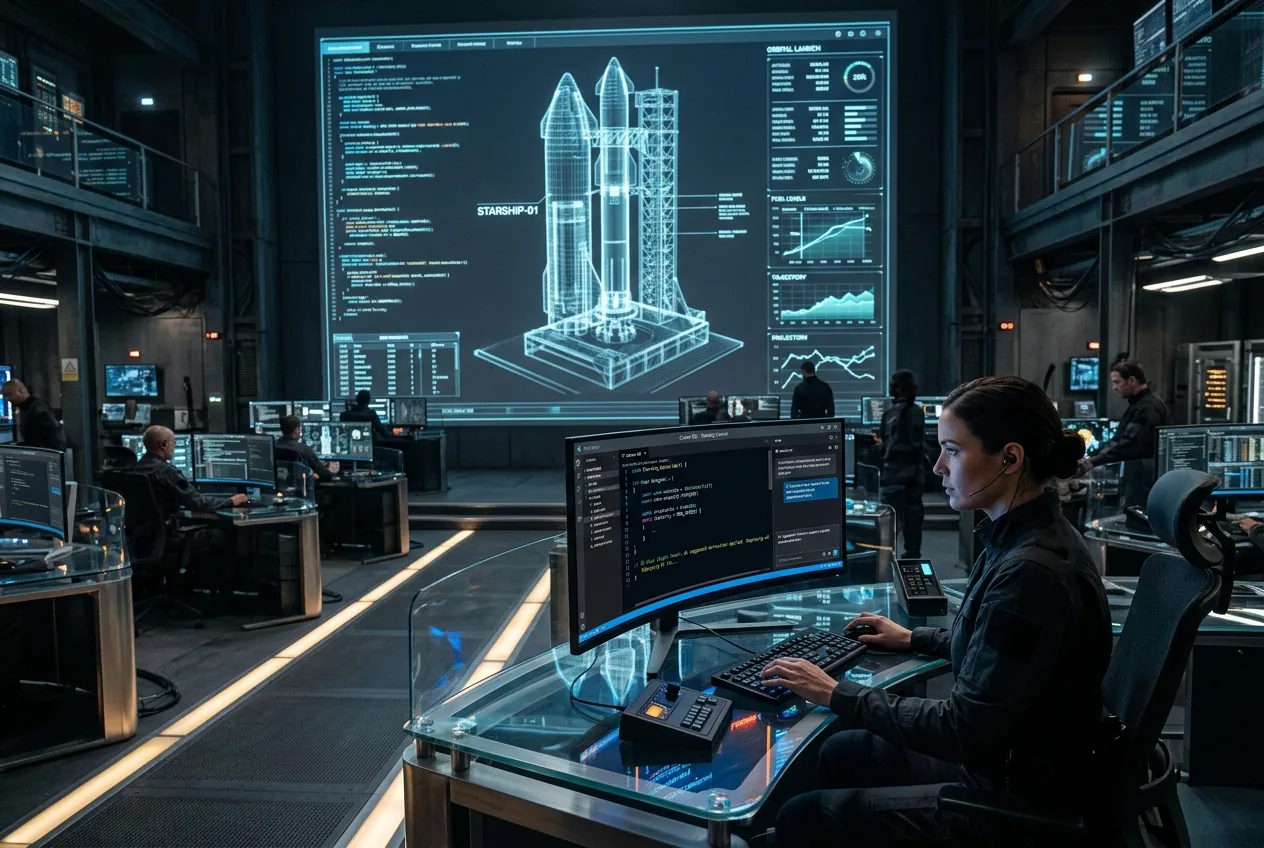
In a move that fundamentally redefines the boundaries between aerospace engineering and artificial intelligence, SpaceX has announced a structured agreement with Anysphere, the developer of the AI-native coding editor Cursor. The deal, valued at a staggering $60 billion for an outright acquisition or a $10 billion performance fee for collaborative development, represents a massive bet on the role of automated software synthesis in heavy industry. Coming on the heels of the February merger between SpaceX and Elon Musk’s xAI, the agreement underscores a strategic pivot: the future of orbital logistics is no longer just about propellant and metallurgy, but the speed at which safe, complex code can be deployed to hardware.
The deal is structured as an option, giving SpaceX the right to acquire Cursor later this year. This framework allows SpaceX to integrate Cursor’s intelligence layer into its internal engineering workflows while assessing the startup's performance under the stress of high-stakes aerospace projects. For Cursor, which has already established a footprint among elite software engineers, the partnership provides unprecedented access to the Colossus supercomputer—a training cluster now estimated to possess the power of one million H100 equivalent GPUs. This compute-to-software synergy is designed to create a closed-loop system where hardware telemetry informs AI-driven code generation, potentially slashing the development cycles for Starship and the Starlink satellite constellation.
Can AI coding tools solve the complexity of modern aerospace?
From a mechanical engineering perspective, the bottleneck in modern aerospace is rarely the physical fabrication of parts; rather, it is the verification and validation of the millions of lines of code that govern flight control, life support, and sensor fusion. As rockets transition from rigid systems to software-defined vehicles, the complexity of the onboard software grows exponentially. Cursor’s integration into the SpaceX ecosystem aims to address this by moving away from traditional IDEs toward a paradigm where the editor understands the entire codebase’s context. By leveraging large language models (LLMs) tuned on SpaceX’s proprietary flight data and hardware specifications, Cursor could theoretically assist engineers in refactoring flight software or identifying edge-case bugs that would otherwise require weeks of manual code review.
The technical utility here is centered on the concept of 'knowledge work' efficiency. In an industrial environment like the Starbase facility in Boca Chica, the ability to rapidly iterate on ground control software or autonomous landing algorithms is a force multiplier. If Cursor can automate even 20% of the rote plumbing in software engineering, the engineering throughput of the company increases without the proportional overhead of hiring thousands of additional developers. This is particularly critical as SpaceX prepares for the high cadence of launches required for the HLS (Human Landing System) missions and the eventual colonization of Mars, where remote debugging and autonomous system resilience are non-negotiable.
The Colossus factor and the compute arms race
This vertical integration mirrors the broader trend in the tech industry, where companies like Amazon are investing billions into startups like Anthropic to secure a pipeline for their own proprietary silicon, such as Trainium chips. However, the SpaceX-Cursor deal is distinct in its industrial application. While Amazon seeks to improve consumer-facing cloud services, SpaceX is aiming to build an autonomous engineering stack. The goal is a system where a mechanical engineer can describe a desired telemetry output, and the AI assists in generating the necessary driver code and testing protocols, bridging the gap between hardware intent and software execution.
Why is SpaceX targeting a $1.8 trillion valuation?
The financial underpinnings of this deal are as ambitious as the technology. SpaceX is currently targeting an IPO in June with a valuation range of $1.75 trillion to $1.8 trillion. To justify such a valuation—which would place it among the most valuable companies on the planet—SpaceX must prove that it is more than a launch provider. It must demonstrate that it is a platform company. By incorporating a $60 billion AI software asset, Musk is signaling to the market that SpaceX is a technology conglomerate with a dominant position in the two most important sectors of the next decade: orbital infrastructure and artificial general intelligence (AGI) applied to robotics.
Is this a move toward automated rocket manufacturing?
One of the most intriguing aspects of the deal is the potential for Cursor to interact with the robotics used in SpaceX’s manufacturing lines. Modern rocket production involves high degrees of automation, from friction-stir welding to automated composite layup. These robotic systems are governed by complex PLC (Programmable Logic Controller) code and industrial software. If the AI models behind Cursor are trained on the mechanical constraints of aerospace manufacturing, they could potentially optimize the code that drives the factory floor, identifying efficiencies in the manufacturing process that are invisible to human overseers.
This brings us to the core of the 'SpaceXAI' vision: the synthesis of software and physical reality. In the past, software was an afterthought to the mechanical design of a rocket. Today, the code is what allows the Falcon 9 to land on a drone ship and Starship to execute its complex 'flip' maneuver. By owning the tool that creates the code, SpaceX is attempting to control the entire stack of innovation. The $10 billion 'collaboration fee' option serves as a safeguard, allowing the companies to remain separate entities if the full acquisition faces regulatory hurdles or if the cultural integration of a software startup into a hardware-heavy culture proves too friction-filled.
As the June IPO approaches, the industry will be watching to see how this 'compute-plus-code' strategy manifests in launch cadences and reliability. For now, the SpaceX-Cursor agreement serves as a loud declaration that the age of the siloed aerospace engineer is over. The next era of exploration will be built on a foundation of millions of H100s, training models that can code as fast as the rockets can fly. It is a high-stakes gamble on the idea that the most important part of a rocket isn't the engine—it's the intelligence that tells the engine exactly when to fire.




Comments
No comments yet. Be the first!