The long-anticipated transition of SpaceX from a private aerospace disruptor to a public industrial titan has begun. On Wednesday, May 20, 2026, Space Exploration Technologies Corp. officially disclosed its filing for an initial public offering (IPO) with the Securities and Exchange Commission (SEC). The move, which follows a confidential filing earlier this spring, offers the first comprehensive look into the complex financial and technical machinery of Elon Musk’s primary enterprise. While the filing confirms SpaceX as a revenue powerhouse, it also reveals a staggering $13 billion in losses since early 2023—a deficit driven by a radical pivot toward integrating artificial intelligence into the very fabric of orbital infrastructure.
For those of us tracking the mechanical and industrial evolution of the space sector, this IPO is more than a financial event; it is a manifesto for the next decade of heavy industry. SpaceX is no longer just a rocket company that occasionally launches satellites. Following its recent acquisition of xAI and the subsequent merger with the platform formerly known as Twitter, the company has repositioned itself as a vertically integrated provider of orbital compute, global connectivity, and deep-space logistics. The filing details a vision where the vacuum of space serves as the ultimate heat sink for the world’s most demanding AI models, fundamentally changing how we think about data center architecture and thermal management.
The Financial Reality of Rapid Iteration
From an engineering perspective, the losses represent the price of hardware maturity. SpaceX has moved away from the artisanal manufacturing of rockets and toward the mass production of the Starship launch system. The Starship factory in Starbase, Texas, is now utilizing high-degree-of-freedom robotic welding and automated assembly lines that mimic automotive mass production rather than traditional aerospace clean rooms. This shift requires immense upfront investment in industrial automation, but the goal is to drive the marginal cost of a launch to the floor. The filing confirms that SpaceX is betting its public future on the belief that launch capacity will soon be a commodity, and the real value will lie in what you put into orbit.
Why Orbital Data Centers?
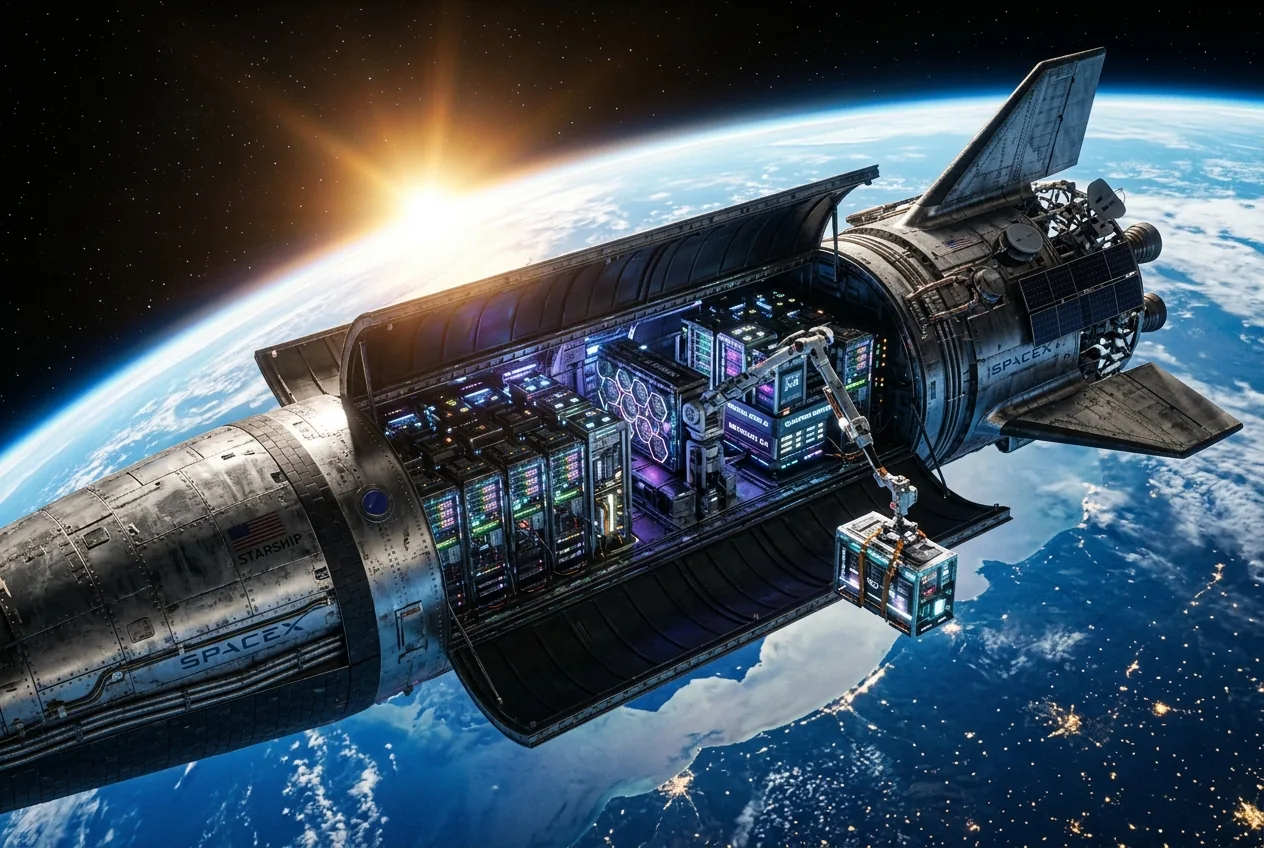
A significant portion of the IPO filing is dedicated to the integration of xAI’s frontier models into the Starlink satellite architecture. This is where the pragmatic utility of the merger becomes clear. Terrestrial data centers are currently facing a crisis of power and cooling. The massive GPU clusters required to train and run generative AI models generate heat at a density that is increasingly difficult to manage using traditional water-cooled or air-cooled systems on Earth. SpaceX’s proposed solution is the deployment of dedicated AI server modules in Low Earth Orbit (LEO).
The technical challenges here are non-trivial. In the vacuum of space, you cannot rely on convection for cooling. Everything must be handled through radiative cooling. The filing outlines a new class of Starlink satellites—internally referred to as "Compute Nodes"—that feature oversized deployable radiators and high-efficiency solar arrays. By placing AI processing in orbit, SpaceX can bypass the land-use and power-grid constraints that are currently throttling the expansion of AI on the ground. These orbital data centers would communicate via laser cross-links, creating a low-latency, high-bandwidth mesh network that processes data where it is collected, rather than sending it back to Earth for every computation.
The Starship Logistics Engine
None of this—the data centers, the AI integration, or the Mars mission—is possible without the Starship vehicle. The IPO filing provides the most detailed technical specifications of the Starship Block 2 to date. The vehicle is designed for a payload capacity of over 150 metric tons to LEO in a fully reusable configuration. More importantly, the filing details the progress of the "Mechazilla" launch and catch towers, which are central to the company’s plan for rapid turnaround. To achieve the economic viability required for a public company, SpaceX needs to transition from launching once a week to launching multiple times per day.
The industrial scale of this ambition is difficult to overstate. The filing indicates that SpaceX is currently commissioning its third and fourth Starship production lines. This is not just about exploring the moon or Mars; it is about creating a logistics pipeline for the entire orbital economy. If SpaceX can maintain its lead in reusability, it will effectively own the toll road to space. For investors, the value proposition is that SpaceX is the only company with the hardware to build the next generation of global infrastructure. While competitors like Blue Origin and ArianeGroup are working on their own heavy-lift vehicles, SpaceX has already achieved a level of vertical integration and flight heritage that creates a massive competitive moat.
The Governance of a Trillion-Dollar Entity
One of the more controversial aspects of the filing is the disclosure of the dual-class stock structure. Elon Musk holds 85.1% of the voting power in SpaceX, ensuring that he retains absolute control over the company’s strategic direction even after it goes public. This structure is common in the tech world, but it takes on a different dimension when applied to a company with the geopolitical and industrial weight of SpaceX. The filing makes it clear that while SpaceX will be a public company, its primary mission remains the colonization of Mars—a goal that may not always align with short-term quarterly earnings.
This raises a fundamental question for potential shareholders: Are they investing in a satellite internet and AI company, or are they funding a multi-planetary civilizational project? The filing attempts to reconcile these two goals by framing the Mars mission as the ultimate testbed for the technologies being commercialized today. The life support systems, power generation, and autonomous manufacturing required for a Mars colony are the same technologies that will drive the orbital economy in the 2030s. From an engineering standpoint, this is a sound argument. The constraints of space travel force a level of efficiency and reliability that terrestrial industries rarely achieve.
Industrial Automation and the Supply Chain
As a mechanical engineer, I find the sections of the filing dealing with the internal supply chain to be the most revealing. SpaceX has brought an unprecedented amount of manufacturing in-house. From the Raptor engine’s 3D-printed manifolds to the silicon in the Starlink user terminals, SpaceX controls its components. This reduces reliance on external vendors and allows for the rapid iterative design cycles that have become the company’s hallmark. If a part fails during a test flight, the engineering team can redesign it, print a new prototype, and have it on the test stand within days.
The IPO filing indicates that this "move fast and break things" philosophy is now being applied to AI hardware. The company is developing its own proprietary ASIC (Application-Specific Integrated Circuit) chips for the orbital compute nodes, optimized for the specific radiation environments of LEO. This level of specialization is only possible because SpaceX has the scale to justify the R&D costs. By controlling the silicon, the rocket, and the satellite, they can optimize the entire system for energy efficiency—the most critical metric in space-based operations.
The market debut of SpaceX, expected next month, is likely to be the largest in Wall Street history. It will almost certainly make Elon Musk the world’s first trillionaire, but the real impact will be on the industrial landscape. We are witnessing the birth of a new kind of conglomerate—one that treats space not as a destination, but as a manufacturing and processing floor. The $13 billion in losses are not just a sign of high spending; they are the foundation stones of a new industrial era. For the broad audience interested in the future of technology, the message is clear: the bridge between robotics, AI, and aerospace is now open, and it is being built at a scale we have never seen before.




Comments
No comments yet. Be the first!