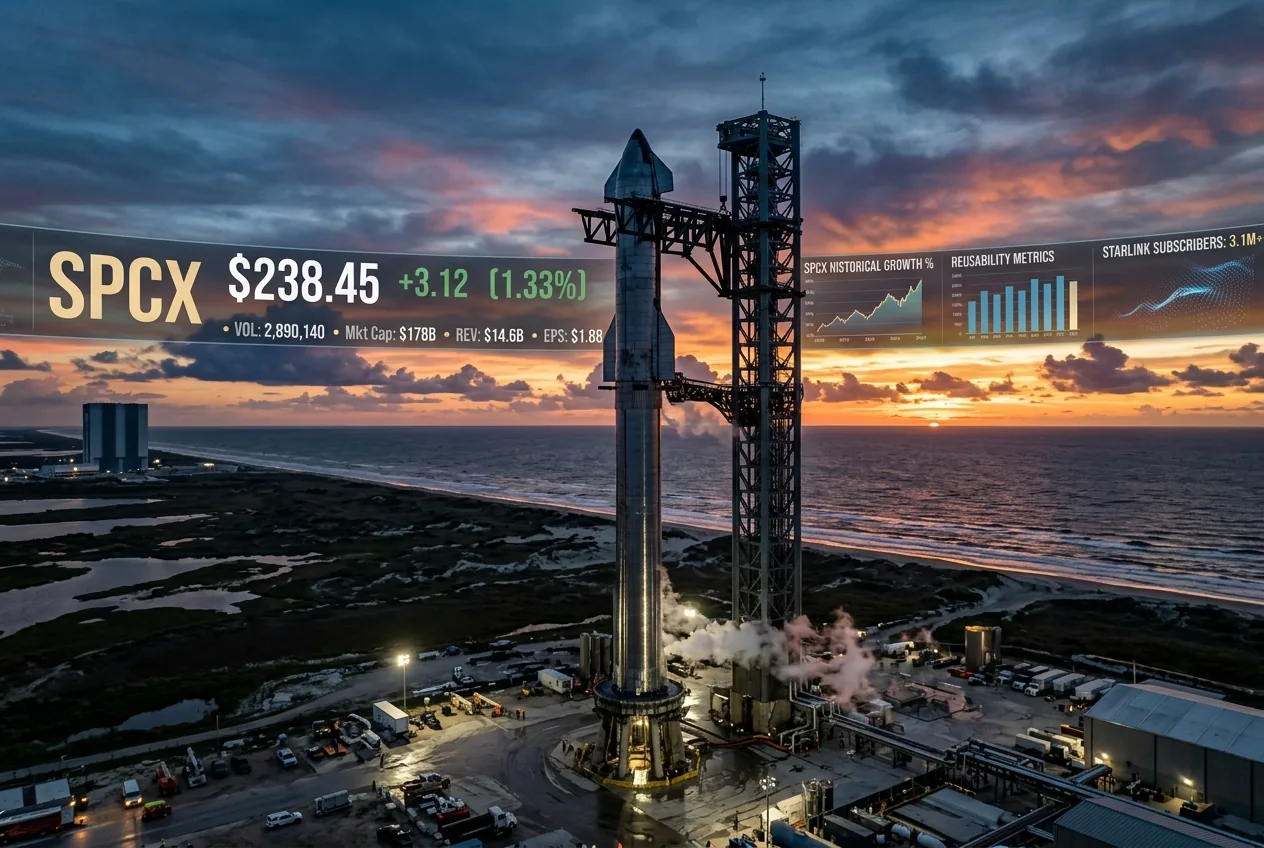
In a move that fundamentally alters the landscape of both the aerospace and technology sectors, SpaceX has officially filed its S-1 paperwork with the Securities and Exchange Commission (SEC) for an initial public offering. Trading under the ticker symbol SPCX, the company is not merely seeking a public listing for its rocket business; the filing reveals a sweeping corporate restructuring that folds Elon Musk’s artificial intelligence venture, xAI, and the social media platform X (formerly Twitter) into the SpaceX corporate umbrella. The filing positions SpaceX with an internal valuation of $1.25 trillion, though the company is reportedly targeting a market capitalization closer to $2 trillion once shares begin trading, a milestone that would likely make Elon Musk the world’s first trillionaire.
The Financial Engine Behind the Launch
The financial disclosures within the S-1 paint a picture of a company with massive scale but significant burn rates associated with its research and development. In the previous fiscal year, Space Exploration Technologies Corp. reported $18.6 billion in total revenue. Despite this top-line growth, the company realized a net loss of $4.9 billion, a figure largely attributed to the iterative testing of the Starship program and the rapid deployment of the Starlink satellite constellation. The first quarter of the current year showed a similar trend, with $4.7 billion in sales offset by a $4.3 billion net loss.
From an engineering and industrial perspective, the balance sheet reflects the heavy capital expenditure required for orbital infrastructure. SpaceX reports $102 billion in total assets, including its fleet of reusable Falcon 9 boosters, the Starbase facility in Boca Chica, Texas, and the growing Starlink constellation. However, this is balanced against $60.5 billion in debt. For prospective investors, the question of economic viability hinges on whether the diminishing costs of orbital delivery—driven by Starship’s full reusability—can eventually outpace the debt service and maintenance costs of the network. The filing suggests that SpaceX is betting on its monopoly over heavy-lift capacity to dictate market pricing for the next decade.
Consolidating the Musk Portfolio
The filing also clarifies the relationship between Musk’s AI ambitions and his competitors. SpaceX has disclosed a $15 billion annual deal with Anthropic, the developer of the Claude AI model. Under the terms of this agreement, Anthropic will pay SpaceX for access to a massive network of data centers located in the American South, which were originally developed for xAI. This creates a unique revenue stream where SpaceX acts as both a primary AI developer and a landlord for the compute infrastructure that powers its rivals. This industrial synergy suggests that Musk views the physical infrastructure of AI—the servers, power, and cooling—as being as vital as the rockets themselves.
Why Starlink is the Key to Trillion-Dollar Valuation?
While the rockets capture the headlines, the S-1 makes it clear that Starlink is the primary engine of the company’s valuation. As of the filing, Starlink has achieved a comfortable lead over terrestrial and satellite competitors, providing high-speed internet to millions of users across every continent. The technical specs of the V2 Mini satellites currently being deployed offer significantly higher throughput and direct-to-cell capabilities, which SpaceX plans to monetize through partnerships with global telecommunications carriers.
Addressing the Risks and the Musk Effect
Furthermore, the filing discloses the legal fallout of Musk’s failed lawsuit against OpenAI and its CEO, Sam Altman. A jury recently threw out Musk’s claims that OpenAI breached a non-profit contract, finding that the timeframe for his claims had expired. For investors, this highlights the potential for distraction and legal costs that stem from Musk’s personal rivalries within the tech industry. There is also the matter of worker safety; the S-1 includes disclosures regarding regulatory scrutiny of safety protocols at SpaceX’s manufacturing and launch facilities, a recurring point of contention for federal labor regulators.
The Role of Starship in Post-IPO Growth
Technically, the future of SPCX shares rests on the success of Starship. The megarocket, which is scheduled for its next major flight test this week, is designed to be the first fully reusable launch system capable of carrying over 100 metric tons to Low Earth Orbit (LEO). If Starship achieves reliable operational status, it will reduce the cost per kilogram to orbit by an order of magnitude. This is not just a scientific achievement; it is an economic reset for the entire space industry.
With Starship, SpaceX can deploy the full-sized Starlink V2 satellites, which are too large for the Falcon 9’s fairing. This would dramatically increase the bandwidth and profitability of the Starlink network. Additionally, Starship is the primary vehicle for NASA’s Artemis program, specifically the Human Landing System (HLS) contract. The IPO filing suggests that the revenue from these government contracts, combined with a potential monopoly on lunar logistics, provides the long-term floor for the company's $2 trillion target valuation. The engineering challenge remains immense, but for the first time, the public will have the opportunity to buy into the success or failure of the hardware that aims to make humanity multi-planetary.
What Does This Mean for the Global Market?
Ultimately, this filing represents the end of an era for SpaceX as a private, insulated experiment and the beginning of its life as a transparent, public-facing conglomerate. While the potential for Musk to reach trillionaire status is the headline, the real story lies in the technical and economic consolidation of his various ventures. By linking the fate of X, xAI, and Starlink to the success of his rockets, Musk has created a singular entity that sits at the intersection of communication, intelligence, and exploration. Whether the market will tolerate the inherent risks of such a massive, personality-driven enterprise remains to be seen, but the era of the private space race is officially over—the age of the orbital economy has begun.




Comments
No comments yet. Be the first!