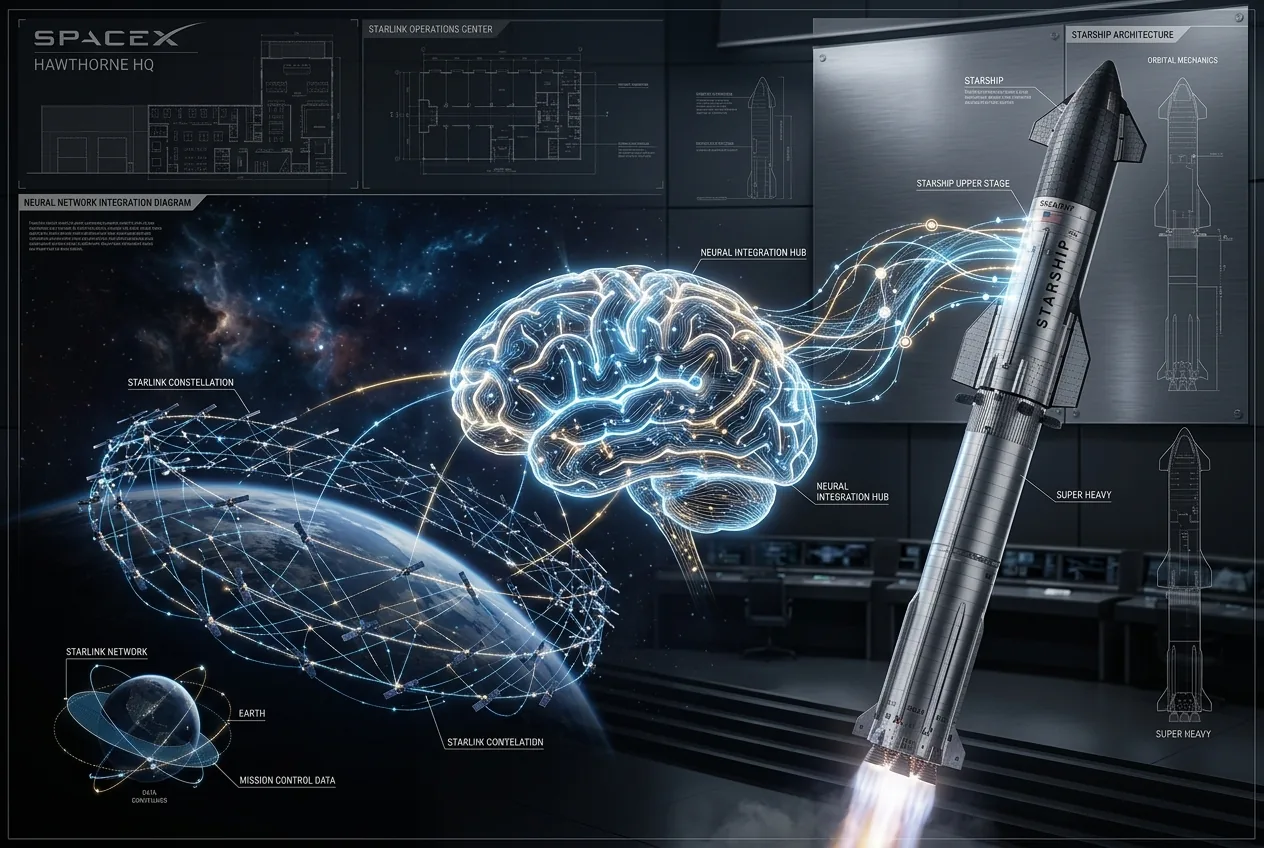
The long-anticipated transition of SpaceX from a private aerospace powerhouse to a public market titan has finally begun. According to recent filings, Space Exploration Technologies Corp. has initiated the paperwork for an Initial Public Offering (IPO) that seeks to list the company under the ticker symbol “SPCX.” The move represents more than just a liquidity event for early investors; it is a fundamental shift in the industrial landscape of the 21st century. At a projected valuation of nearly $1.25 trillion, SpaceX is not merely being priced as a rocket company, but as a vertically integrated infrastructure giant spanning telecommunications, orbital logistics, and high-performance artificial intelligence.
For those of us tracking the mechanical and economic viability of heavy industry, the financial disclosures accompanying the filing offer a rare, unvarnished look at the cost of building a multi-planetary infrastructure. The figures are staggering. SpaceX reported revenue of $18.6 billion last year, yet posted a net loss of $4.9 billion. In the first quarter of the current fiscal year alone, the company recorded $4.7 billion in sales against a loss of $4.3 billion. To a traditional analyst, these numbers might suggest a burning ship; to a mechanical engineer, they represent the massive capital expenditure (CapEx) required to iterate on the most complex machine ever built: Starship.
The Starship Architecture and the Cost of Innovation
The core of SpaceX’s valuation is not its past successes with the Falcon 9, but the pending dominance of the Starship launch system. From a technical standpoint, Starship is designed to achieve full and rapid reusability, a feat that would drop the cost per kilogram to orbit by orders of magnitude. However, the development of the Raptor engines—using a complex full-flow staged combustion cycle—and the construction of the “Starbase” production facility in Texas require billions in upfront investment. The $102 billion in assets listed in the IPO filing reflects this massive accumulation of physical hardware, launch systems, and orbital infrastructure.
Starlink as a Global Infrastructure Backbone
While the rockets capture the headlines, Starlink is the engine of the company’s current $18.6 billion revenue stream. The satellite internet constellation has evolved from a speculative project into a strategic asset of global importance. With over 6,000 satellites in low Earth orbit (LEO), SpaceX has essentially built a proprietary global internet service provider (ISP) that bypasses traditional terrestrial fiber-optic limitations. The filing highlights Starlink’s role as a primary revenue driver, particularly as it expands into maritime, aviation, and government sectors.
The technical brilliance of Starlink lies in its vertical integration. Because SpaceX owns the launch vehicle, the cost of deploying its own network is significantly lower than that of any competitor, such as Amazon’s Project Kuiper. This creates a feedback loop: Starlink generates the cash flow required to fund Starship development, and Starship, once operational, will allow for the deployment of larger, more powerful Starlink V3 satellites at a fraction of the current cost. This synergy is what justifies a trillion-dollar valuation in an industry where companies historically struggle to maintain 10% margins.
Is SpaceX Now an Artificial Intelligence Company?
Perhaps the most surprising revelation in the IPO filing is the consolidation of xAI under the SpaceX corporate umbrella. Historically, Musk’s ventures have been distinct entities, but the filing suggests a strategic merging of aerospace and artificial intelligence. The move makes sense when viewed through the lens of compute requirements and data center infrastructure. xAI, the developer of the Grok chatbot, has reportedly entered into a massive agreement with Anthropic, another major AI player. Under this arrangement, Anthropic will pay an estimated $15 billion annually to access data center infrastructure linked to Musk’s operations.
This $15 billion deal shifts the narrative of SpaceX from a launch provider to a compute provider. The integration of xAI suggests that SpaceX intends to use its Starlink network as a global backhaul for AI services, potentially hosting edge computing nodes in orbit or using its massive power and cooling infrastructure on the ground to support LLM (Large Language Model) training. For an engineer, this is a play for energy and data sovereignty. By controlling the launch, the satellites, and the AI models, Musk is building a closed-loop ecosystem that is resilient to terrestrial regulatory or physical bottlenecks.
The Path to the World’s First Trillionaire
The financial implications for Elon Musk himself are unprecedented. Musk currently maintains a majority ownership stake in SpaceX. If the company achieves its $1.25 trillion valuation upon listing, his personal stake could exceed $600 billion. Combined with his holdings in Tesla, X (formerly Twitter), and other ventures, this IPO likely serves as the catalyst that will push his net worth past the $1 trillion mark. This isn't just a milestone for wealth; it represents a concentration of industrial power that has not been seen since the era of the Gilded Age industrialists like Rockefeller or Carnegie.
However, the road to a trillion-dollar valuation is paved with significant legal and regulatory risks. The filing acknowledges over half a billion dollars in anticipated legal costs. These stem from a variety of sources: copyright disputes over AI training data, regulatory scrutiny regarding Starlink’s dominance in conflict zones, and controversies surrounding content generated by the Grok AI. Furthermore, the recent legal setback Musk faced in his lawsuit against OpenAI and Sam Altman highlights the volatile nature of his battle for AI supremacy. The jury’s dismissal of his claims serves as a reminder that even the world’s wealthiest individuals are subject to the friction of the legal system.
Engineering the Future of Public Markets
The “SPCX” IPO will be a litmus test for the public market’s appetite for high-risk, high-reward industrial technology. Unlike software-as-a-service (SaaS) companies that have dominated the last decade of IPOs, SpaceX is a “hardware-first” company. It deals with cryogenic fuels, orbital mechanics, and silicon-level hardware integration. Investors are being asked to look past the $4.9 billion annual loss and see the $102 billion in assets as the foundation of a new orbital economy.
From my perspective as a mechanical engineer, the “how” of SpaceX’s success remains its relentless focus on manufacturing efficiency. Whether it is the casting of the stainless-steel hulls for Starship or the automated assembly lines for Starlink terminals, the company is an exercise in applied physics and industrial scale. If the IPO succeeds, it will validate a model where massive, long-term engineering projects can be sustained through a combination of visionary leadership and the aggressive pursuit of vertical integration. The launch of “SPCX” next month will not just be a financial event; it will be the starting gun for the industrialization of the solar system.




Comments
No comments yet. Be the first!