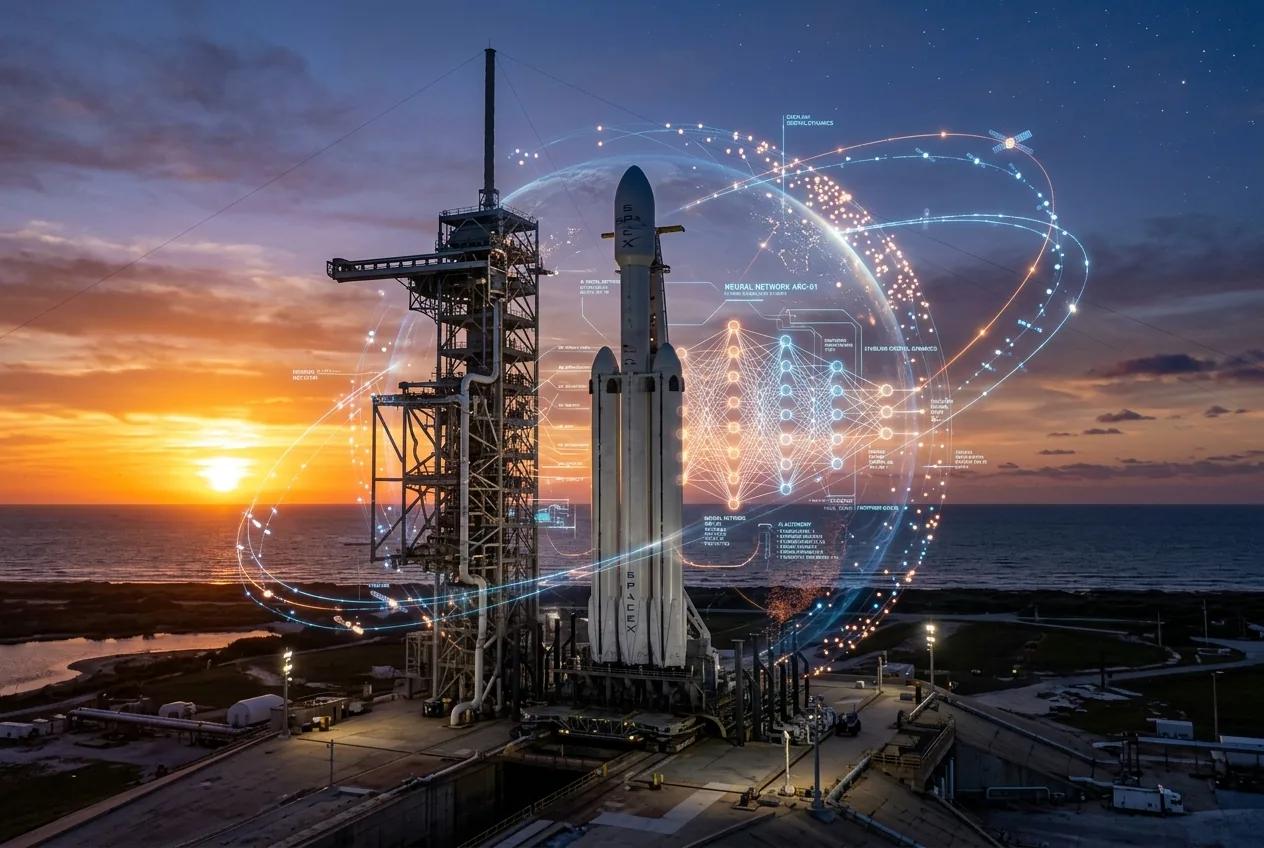
The long-anticipated public debut of SpaceX has finally moved from rumor to regulatory reality. In a filing that serves as a manifesto for the next era of industrial technology, Elon Musk’s aerospace giant has submitted its S-1 prospectus to the Securities and Exchange Commission. The document, targeting a valuation of roughly $1.75 trillion, does more than just detail rocket launch cadence; it pulls back the curtain on a massive consolidation of Musk’s technology empire, specifically the integration of xAI into the SpaceX balance sheet. For those of us tracking the intersection of heavy industry and automation, this filing represents the formalization of a new category: the vertically integrated intelligence and connectivity utility.
Listing on the Nasdaq under the ticker SPCX, the offering aims to raise up to $75 billion, making it the largest initial public offering in history. However, the true significance of the S-1 lies in its internal mechanics. SpaceX is no longer just a transportation firm moving payloads to Low Earth Orbit (LEO). It has evolved into a capital-intensive infrastructure play where orbital connectivity funds the development of frontier-model artificial intelligence. The financials revealed in the filing are staggering, showing a company that generated $18.7 billion in revenue in 2025 but remains deeply entrenched in a cycle of aggressive reinvestment and significant net losses.
The Industrialization of Compute
Perhaps the most polarizing revelation in the prospectus is the scale of xAI’s integration. In a move that surprised some traditional aerospace analysts, SpaceX completed an all-stock merger with xAI prior to the filing. This integration has fundamentally altered the company’s capital expenditure (capex) profile. In the first quarter of 2026, SpaceX reported total capital expenditures of $10.1 billion. Of that total, a massive $7.72 billion was attributed directly to AI. This isn’t just software development; it is the physical construction of massive GPU clusters and data center infrastructure, such as the Colossus facility.
From a mechanical engineering and industrial perspective, the logic is clear even if the financials appear strained. xAI’s losses are accelerating as it races to build the physical capacity required to train next-generation autonomous agents. The AI segment alone lost $2.5 billion in Q1 2026, following a $6.4 billion loss in 2025. Critics have described these numbers as reckless, but from a strategic standpoint, SpaceX is betting that the transition to physical AI agents—robotics that can navigate and interact with the real world—requires a level of compute and connectivity that only a combined satellite-AI entity can provide. The goal isn't just a better chatbot; it's the infrastructure for a global, autonomous labor force.
Starlink as the Economic Engine
If xAI is the high-risk, high-reward bet, Starlink is the reliable engine providing the necessary fuel. The S-1 reveals that Starlink accounted for nearly 70% of SpaceX’s revenue in 2025. With approximately 10.3 million subscribers across 164 countries and over 9,600 satellites currently in orbit, Starlink has reached a level of scale that effectively subsidizes the company’s more experimental ventures. The satellite broadband arm is no longer a pilot program; it is a global utility with a subscriber base that provides predictable, recurring cash flow.
However, the filing also highlights the immense cost of maintaining this lead. The logistics of launching, de-orbiting, and replacing thousands of satellites requires a constant launch cadence. SpaceX’s launch services continue to dominate the market, but the internal demand from Starlink and now the compute-heavy requirements of xAI mean that the company is its own biggest customer. This circular economy of technology—where rockets launch satellites that provide the data and revenue to build AI—is unprecedented in the industrial sector. It creates a moat that is nearly impossible for competitors to cross, given the capital requirements involved.
The $20 Billion Refinancing Play
The debt structure disclosed in the filing provides a masterclass in aggressive corporate finance. Prior to the merger, xAI had been borrowing heavily to fund its GPU acquisitions, taking on $16 billion in new debt in 2025. In March 2026, SpaceX executed a strategic move by taking out a $20 billion bridge loan. These proceeds were used to pay off xAI’s higher-interest debt, effectively moving the AI startup’s liabilities onto the much more stable and asset-rich balance sheet of SpaceX. This refinancing reduced the interest burden and allowed xAI to continue its burn rate under the protective umbrella of SpaceX’s $15.85 billion cash reserve.
Does the Compute-as-a-Service Model Work?
One of the bright spots for the xAI segment is its emerging revenue stream from third-party compute deals. The prospectus notes that Anthropic, a major competitor in the AI space, agreed to pay xAI $1.25 billion per month to access compute power via the Colossus data center. This indicates that even before xAI’s Grok models reach full maturity, the physical infrastructure SpaceX is building has immediate market value. SpaceX intends to pursue similar deals with other firms, effectively becoming a 'wholesaler' of intelligence infrastructure.
This 'Compute-as-a-Service' model mirrors the early days of Amazon Web Services (AWS), but with a hardware-heavy twist. Unlike traditional cloud providers that rely on terrestrial fiber, the SpaceX-xAI entity can potentially leverage Starlink to provide low-latency AI processing to remote industrial sites, maritime fleets, or even off-planet missions. From my perspective in robotics and supply chain technology, the ability to deploy high-level inference at the 'edge' of the world's most remote locations is a game-changer for automated mining, agriculture, and shipping.
Can the Public Markets Handle the Volatility?
The transition from a private to a public company will impose a new level of scrutiny on SpaceX. Under the Nasdaq’s 'fast-entry' rule, the stock will likely join the Nasdaq-100 just 15 days after its debut. This will trigger massive, non-discretionary buying from ETFs and index funds. While this ensures liquidity, it also means that the volatility of SpaceX's R&D-heavy financials will be felt across the broader market. Musk will maintain 85.1% of the voting power through dual-class stock, ensuring that while the public provides the capital, he retains absolute control over the strategic direction.
For the engineering community, the IPO marks a shift in how we view the 'aerospace' industry. SpaceX is successfully arguing that the rocket is merely the delivery vehicle for a much more valuable cargo: the infrastructure of the digital age. The $1.75 trillion valuation isn't based on how many Falcons can land in a year; it's based on the belief that SpaceX can own the entire stack of human connectivity and intelligence. As we analyze the 2026 Q1 financials, the 'how' and 'why' of this venture are now laid bare. It is a high-velocity, capital-intensive push toward a future where robotics, space, and AI are no longer separate industries, but a single, integrated platform.




Comments
No comments yet. Be the first!