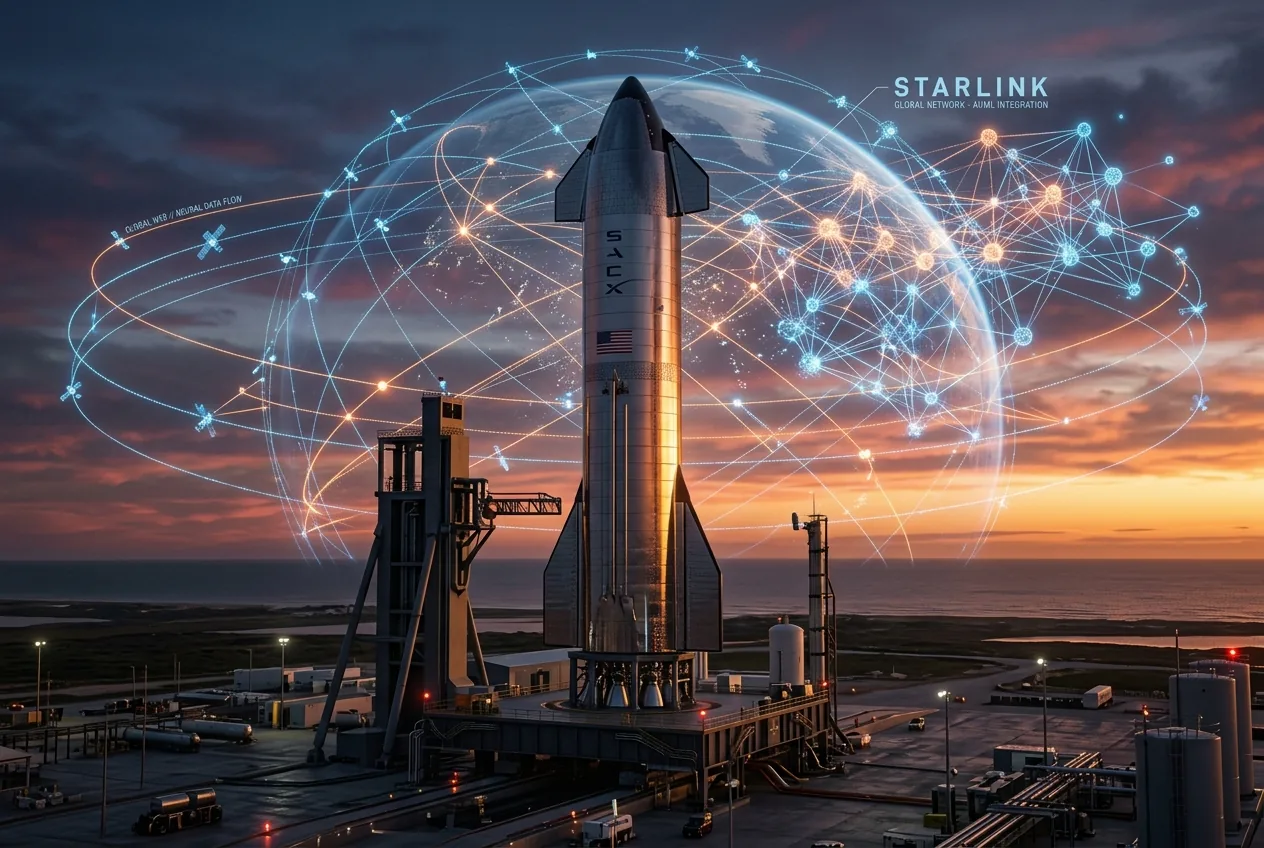
After years of speculation that often felt more like financial folklore than corporate strategy, the gates to the most anticipated public offering in modern history have finally swung open. Space Exploration Technologies Corp., better known as SpaceX, has officially filed its Form S-1 prospectus with the Securities and Exchange Commission. The 308-page document provides a rare, granular look into the financial machinery of Elon Musk’s aerospace empire, revealing a company that has moved far beyond the scope of a mere launch provider.
The filing marks the beginning of a formal roadshow period set to commence in June 2026. SpaceX is slated to list on the Nasdaq exchange under the ticker symbol SPCX. While early rumors suggested a valuation in the hundreds of billions, the S-1 confirms that institutional underwriters, led by Goldman Sachs and Morgan Stanley, are targeting a valuation between $1 trillion and $2 trillion. This figure would not only make SpaceX one of the most valuable companies on Earth but would also cement it as the first true “trillion-dollar aerospace and infrastructure” entity in history.
The Financial Engine: High CapEx and the AI Pivot
For decades, the primary critique of SpaceX from a traditional investment perspective was its ravenous appetite for capital. The S-1 reveals that this appetite has only grown, but the nature of the spending has fundamentally shifted. In the first quarter of 2026 alone, SpaceX reported revenue of $4.7 billion. However, it posted a net loss of $4.3 billion. This deficit was driven by a staggering $10.1 billion quarterly capital expenditure (CapEx) push.
The engineering logic behind this spend is the most significant revelation of the filing. Of that $10.1 billion, roughly $7.7 billion was directed specifically into high-end artificial intelligence infrastructure. This follows the strategic merger of xAI, Musk’s artificial intelligence startup, into SpaceX. Now operating as the "SpaceXAI" subdivision, the unit is headquartered in Palo Alto, California, and is focused on vertically integrating AI compute with SpaceX’s massive orbital network. From a mechanical and systems engineering standpoint, this move is a hedge against the limitations of terrestrial data centers, which are increasingly constrained by power grid access and cooling requirements.
The revenue strategy for this AI pivot is already bearing fruit. The prospectus highlights a landmark agreement with AI lab Anthropic, which has committed to paying SpaceX $1.25 billion per month through May 2029. This is essentially a "Compute-as-a-Service" model. SpaceX is leveraging its ability to build and power massive data centers—backed by a 1-gigawatt cluster—to provide raw compute capacity for large language models. Musk has hinted that the long-term roadmap involves orbital data centers, utilizing the vacuum of space for passive thermal management and Starlink for low-latency data transit.
Starlink as the Reliable Cash Generator
While the AI division represents the high-growth frontier, the Starlink connectivity segment provides the foundational cash flow that makes the company’s ambitious CapEx possible. As of the filing, Starlink has scaled to 10.3 million active paid subscribers across 164 countries. In Q1 2026, the satellite constellation generated $1.18 billion in operating income, a testament to the economies of scale that SpaceX has achieved through reusable rocket technology.
The S-1 also sheds light on the rapid expansion of Starlink’s enterprise and aviation sectors. United Airlines, for instance, has already activated Starlink hardware on 344 aircraft. The technical specs for these installations are particularly telling of SpaceX's industrial efficiency: an average Starlink terminal installation on a commercial jet takes only eight hours. This is an order of magnitude faster than legacy satellite providers, whose installation processes often require days of grounded downtime. By treating the satellite dish as a modular, plug-and-play component of the aircraft's avionics, SpaceX has effectively monopolized the high-speed transit connectivity market.
Beyond terrestrial and aviation connectivity, the S-1 identifies a "Total Addressable Market" (TAM) of $28.5 trillion. This figure includes speculative but technically feasible future markets such as in-orbit manufacturing, asteroid mining, and point-to-point terrestrial Starship transport. While these remain long-term goals, the current dominance of the Falcon 9 and Falcon Heavy launch cadence provides a moat that no competitor—be it Blue Origin or Arianespace—has yet been able to breach.
Is the 'Muskonomy' Intertwined Beyond Recovery?
For investors, one of the most critical aspects of the S-1 is the disclosure of "related party transactions." The document confirms that Tesla, Inc. now owns 18,990,195 Class A common shares of SpaceX. This equity stake was a direct result of the xAI merger, creating a cross-ownership structure that tightly links the fortunes of the world’s most valuable automaker with the world’s most valuable aerospace firm. This "Muskonomy" is further bolstered by SpaceX's treasury holdings; the company currently holds 18,712 Bitcoins, valued at approximately $1.45 billion, serving as a liquid hedge against fiat volatility.
The IPO structure itself is designed to maintain Musk’s ironclad control over the mission. Despite going public, the S-1 reveals that Musk retains 85.1% of the total voting power. To prevent the “pump and dump” volatility often seen in tech IPOs, the underwriters have implemented a staggered lock-up schedule. Unlike the traditional six-month block where insiders can sell all at once, SpaceX shares will unlock progressively following the Q2 and Q3 2026 earnings reports. Furthermore, certain tiers of shares will only become liquid if the stock maintains a price 30% above the initial offering for a sustained period. Notably, Musk’s personal shares are excluded from these early-release terms, ensuring he remains the ultimate captain of the ship.
Why This IPO is Different for Retail Investors
In a departure from the usual Wall Street gatekeeping, SpaceX has confirmed that public shares will be made available to retail investors through consumer platforms like Robinhood, Fidelity, and Charles Schwab. These shares will be offered at the same time and the same price as those offered to institutional giants. This move is likely intended to cultivate a loyal base of individual shareholders who are aligned with the company’s long-term multi-planetary vision, rather than short-term quarterly gains.
The timing of the filing is also symbolic. As the S-1 hit the public domain, SpaceX launch teams in Boca Chica, Texas, were preparing for the first launch of Starship V3. The V3 represents a significant mechanical upgrade over previous iterations, featuring a stretched chassis for increased propellant capacity and a refined Raptor 3 engine assembly that simplifies the cooling loops and eliminates the need for complex heat shielding in certain engine bays. Success with Starship V3 is intrinsic to the company’s financial projections; the S-1’s valuation targets assume that Starship will eventually reduce the cost of putting mass into orbit by another 90% compared to Falcon 9.
The Long-Term Engineering Bet
From the perspective of a mechanical engineer, the SpaceX S-1 is less a financial document and more a manifesto on industrial scaling. The company is betting that the same principles of rapid iteration and vertical integration that allowed them to dominate the launch market can be applied to AI compute and global telecommunications. By owning the launch vehicle (Starship), the delivery mechanism (Starlink), and the hardware (the 1GW data centers), SpaceX is creating a closed-loop ecosystem that is nearly impossible for a specialized competitor to disrupt.
However, the risks detailed in the prospectus are just as massive as the ambitions. The company notes that any significant delay in the Starship V3 program or a catastrophic failure of the Starlink Gen 2 constellation could result in a liquidity crunch. The $10.1 billion quarterly CapEx is only sustainable if the company continues to hit its technical milestones with robotic precision. For the public, the SPCX ticker offers a chance to bet on the colonization of Mars and the future of artificial intelligence under one roof. For the industry, it represents the moment that space transitioned from a government-funded curiosity into the backbone of the global digital economy.




Comments
No comments yet. Be the first!