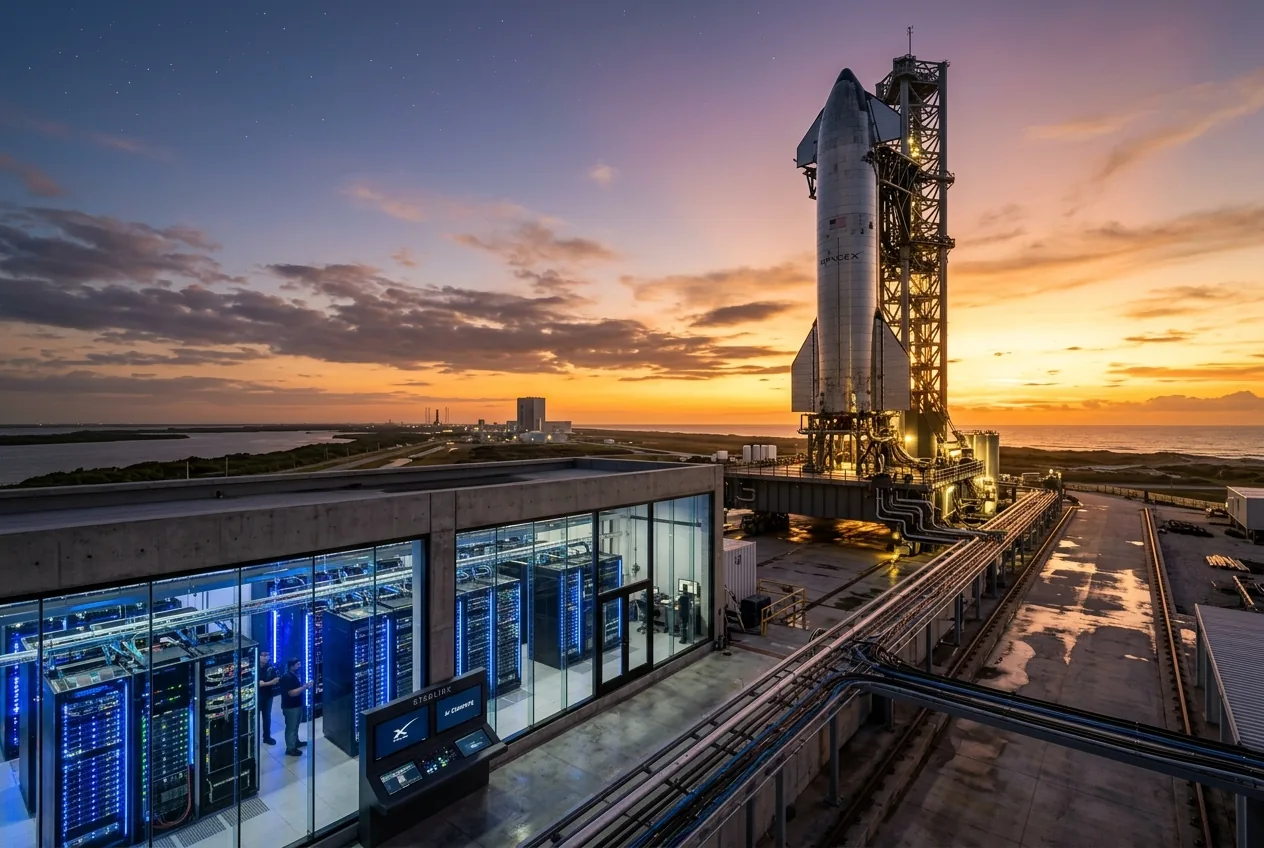
In the high-stakes theater of global finance and frontier technology, the narrative of wealth has often been tied to software or retail dominance. However, a seismic shift is occurring where the physical constraints of aerospace engineering and the brute-force requirements of artificial intelligence are merging to create a new category of industrial titan. Recent reports regarding SpaceX’s potential trajectory toward a massive public offering, combined with the rapid scaling of xAI, suggest that Elon Musk’s net worth is no longer just a reflection of market sentiment, but a byproduct of a strategic monopoly on orbital infrastructure and high-density compute.
To understand the mechanics of this wealth accumulation, one must look past the headlines of trillion-dollar valuations and examine the underlying hardware. The valuation of SpaceX, currently estimated at nearly $210 billion in secondary market sales, is predicated on its total dominance of the launch sector. But the whispers of an Initial Public Offering (IPO)—potentially the largest in Wall Street history—signal a transition from a venture-backed disruptor to a cornerstone of the global economy. This isn't merely about putting satellites into orbit; it is about the commoditization of space through reusability and the vertical integration of the telecommunications supply chain via Starlink.
The Engineering Logic of Starship as a Wealth Generator
The primary driver behind the skyrocketing valuation of SpaceX is Starship, a fully reusable transportation system designed to carry both crew and cargo to Earth orbit, the Moon, and Mars. From a mechanical engineering perspective, Starship represents a departure from traditional expendable rocket philosophy. By utilizing stainless steel alloys (300-series) and the methane-fueled Raptor engine, SpaceX has optimized for rapid reusability and low propellant costs. Methane, unlike the refined kerosene (RP-1) used in the Falcon 9, is cleaner-burning and facilitates easier engine refurbishment.
The economic implications of this technical choice are profound. If SpaceX can achieve its goal of reducing the cost per kilogram to orbit to under $100, it effectively invalidates the business models of every other launch provider on the planet. This technical moat is what underpins the IPO rumors. Investors are not just betting on a rocket; they are betting on the only gateway to the burgeoning space economy. For Musk, whose ownership stake remains significant, the successful operationalization of Starship translates directly into an exponential increase in personal equity, potentially pushing him into the trillionaire bracket as the company’s valuation climbs toward the half-trillion mark.
xAI and the Compute Industrial Complex
While SpaceX provides the physical infrastructure for the stars, xAI—Musk’s newest venture—is building the cognitive infrastructure for the next industrial revolution. The recent deployment of the Colossus supercomputer cluster in Memphis, Tennessee, serves as a testament to the scale of this ambition. Featuring 100,000 NVIDIA H100 GPUs, Colossus is currently the most powerful AI training system in the world. From a systems engineering standpoint, the achievement lies not just in the silicon, but in the power delivery and cooling requirements necessary to keep such a massive array functional.
The synergy between xAI and Musk’s other ventures, particularly Tesla and SpaceX, creates a closed-loop ecosystem of data and application. xAI’s Grok model benefits from the real-world data generated by Tesla’s Full Self-Driving (FSD) fleet and the Optimus robotics program. Conversely, the insights gained from xAI’s large language models (LLMs) and reasoning capabilities are being fed back into the manufacturing and autonomous systems of his hardware companies. This cross-pollination ensures that xAI is not an isolated software play, but an intelligence layer that enhances the value of every physical asset in the Musk portfolio.
Can the Market Sustain a Trillion-Dollar Individual?
The prospect of a trillionaire often invites skepticism regarding market bubbles and irrational exuberance. However, an analytical view of the current industrial landscape suggests that this wealth is being built on tangible assets rather than speculative digital tokens. Tesla, despite its fluctuations, remains a leader in battery chemistry and high-volume automotive manufacturing. SpaceX owns the hardware that provides internet to the most remote corners of the globe. xAI owns the compute power that every major corporation is currently desperate to lease.
A SpaceX IPO would provide the liquidity necessary to fund the next phase of these projects. For decades, space was a government-funded endeavor with little hope of a commercial return on investment. SpaceX changed that by treating orbital flight as a logistical problem rather than a scientific one. By applying the principles of mass production to rocketry, the company has created a cash-flow-positive entity that can support the heavy R&D required for Starship. The IPO would likely focus on Starlink, the satellite constellation arm, which operates with high margins once the initial launch costs are amortized. As Starlink expands into maritime, aviation, and military sectors, its revenue becomes a stable bedrock for Musk’s broader financial empire.
The Risks of Technical and Regulatory Friction
No path to a trillion-dollar valuation is without its friction points. For SpaceX, the primary bottleneck remains the regulatory environment. The Federal Aviation Administration (FAA) and environmental agencies have a complex relationship with the rapid-fire testing schedule at Starbase in Boca Chica, Texas. Delays in launch licenses can stall the technical progress of Starship, which in turn delays the deployment of the v2 Starlink satellites necessary for direct-to-cell capabilities.
Furthermore, the energy demands of xAI’s Colossus cluster present a significant infrastructure challenge. Running 100,000 GPUs requires hundreds of megawatts of power, necessitating close cooperation with local utilities and the development of dedicated power generation solutions. The 'how' of achieving a trillion-dollar status involves solving these granular, localized engineering problems just as much as it involves high-level financial maneuvering. If Musk can continue to navigate these technical and regulatory hurdles, the math for his trillion-dollar milestone becomes increasingly feasible by 2027 or 2028.
The Integration of Robotics and Intelligence
Finally, we must consider the role of Tesla’s Optimus. While often dismissed as a prototype, the humanoid robot represents the ultimate application of the sensors, actuators, and AI compute developed across the Musk ecosystem. If xAI provides the brain and Tesla provides the manufacturing scale, Optimus could become the most significant industrial tool since the steam engine. The ability to automate labor in unstructured environments is the final piece of the puzzle.




Comments
No comments yet. Be the first!