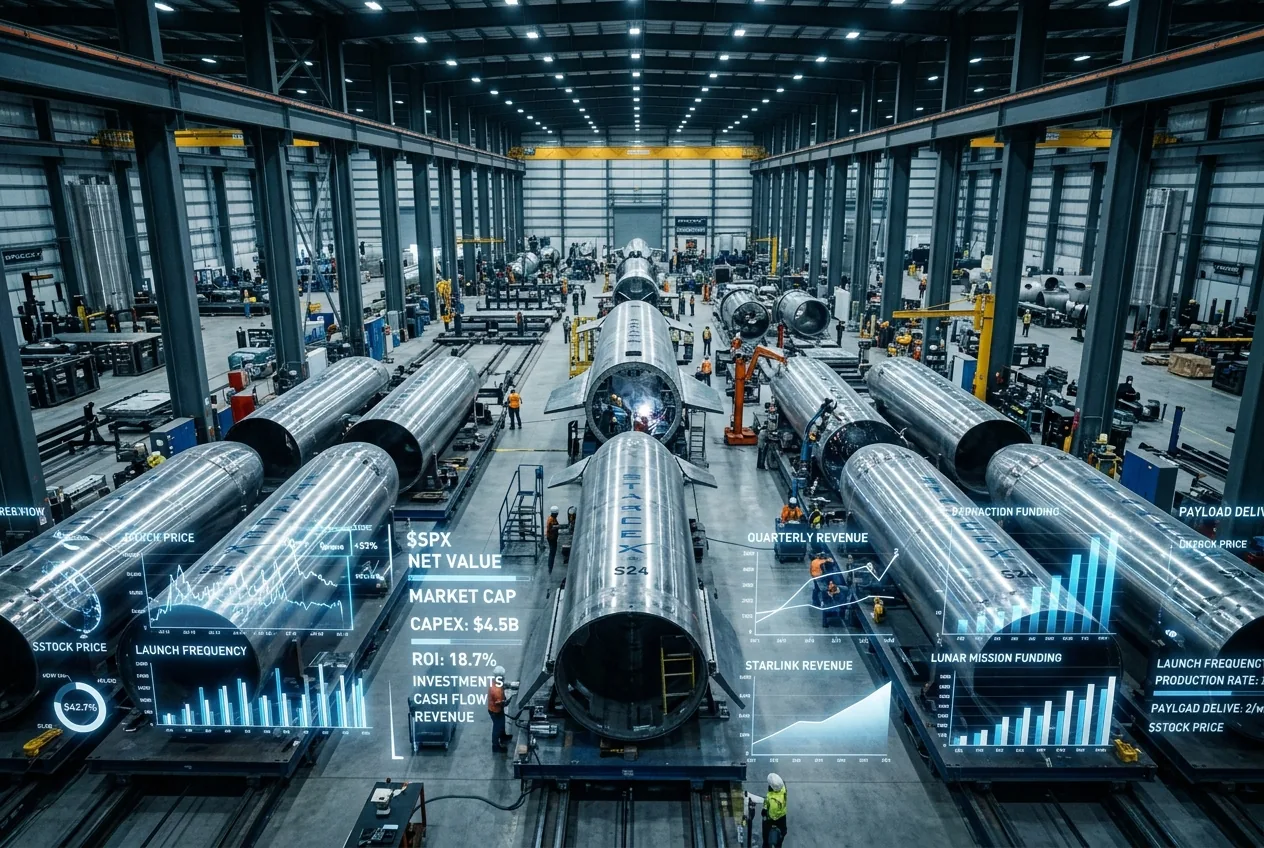
Space Exploration Technologies Corp., the aerospace juggernaut more commonly known as SpaceX, has formally submitted its confidential filing for an initial public offering (IPO) with the U.S. Securities and Exchange Commission (SEC). This move marks a definitive shift for the company, transitioning from a private venture fueled by venture capital and government contracts to a public entity expected to trade under the ticker symbol SPCX. With a valuation hovering between $1.25 trillion and $1.75 trillion, the offering is positioned to be the largest in Wall Street history, dwarfing Saudi Aramco’s 2019 debut. For the first time, the filing provides a granular look at the mechanics of Elon Musk’s industrial complex, revealing a company that is as much a data and AI powerhouse as it is a rocket manufacturer.
The timing of the IPO, projected for mid-June, follows a series of aggressive moves to consolidate Musk’s various technological interests under a single corporate umbrella. Most notably, the filing confirms the total integration of xAI, the artificial intelligence startup, into the SpaceX organizational structure. This vertical integration suggests a strategic pivot: utilizing the reliable launch cadence and Starlink’s global connectivity to provide the physical and digital infrastructure required for large-scale AI compute. As a mechanical engineer looking at the balance sheet, the move appears to be a calculated effort to leverage SpaceX’s hardware dominance to subsidize the high-burn requirements of frontier AI development.
The Ledger: Balancing Massive Assets Against Significant Debt
The financial disclosures within the prospectus paint a picture of a company in the midst of a massive capital expenditure cycle. In the 2025 fiscal year, SpaceX reported revenue of $18.6 billion, yet it sustained a net loss of $4.9 billion. This trend continued into the first quarter of the current year, with $4.7 billion in sales resulting in a $4.3 billion loss. While these figures might unsettle traditional investors, they are characteristic of a firm prioritizing infrastructure build-out over immediate profitability. The company’s balance sheet reflects $102 billion in assets—predominantly its fleet of reusable Falcon 9 boosters, Starship prototypes, and the Starlink satellite constellation—offset by $60.5 billion in debt.
The high debt load is largely a result of the rapid scaling of Starship, the massive stainless-steel launch system designed for full reusability. From an engineering perspective, Starship represents the ultimate economy of scale; by reducing the cost of mass-to-orbit by orders of magnitude, SpaceX intends to commoditize space access. However, the R&D costs for such a system are astronomical. The IPO is clearly designed to inject roughly $80 billion in fresh capital, providing the runway necessary to move Starship from the testing phase to a high-cadence commercial operation that can service both NASA’s Artemis program and the company’s internal requirements.
Starlink: The Cash-Flow Engine of LEO
If the rocket business is the company’s heart, Starlink is its primary circulatory system. The filing reveals that the Low Earth Orbit (LEO) satellite constellation is already generating substantial cash flow. In the first quarter of this year alone, Starlink brought in $3.2 billion in revenue, yielding an operating profit of $1.2 billion. Projections suggest that by 2026, Starlink will account for more than 70% of the total revenue for the consolidated SpaceX entity. This is a critical metric for potential shareholders, as it demonstrates that the company has successfully transitioned a speculative technology into a utility-grade service with a global customer base.
The mechanical reliability of the Falcon 9 launch platform has allowed SpaceX to deploy satellites at a rate no competitor can currently match. This has created a self-reinforcing loop: SpaceX uses its own rockets to build a global ISP, and the profits from that ISP fund the development of even larger rockets. The integration of Starlink’s high-speed, low-latency data backhaul with terrestrial data centers creates a unique value proposition for military and industrial clients who require secure, global connectivity for autonomous systems and remote operations.
Integrating xAI: Synergy or Financial Shelter?
One of the more controversial aspects of the filing is the formal acquisition and subsequent planned dissolution of the xAI brand into SpaceX. Analysts have debated whether this is a genuine search for synergy or a move to mask the significant losses associated with AI development. xAI reportedly lost $6.4 billion in 2025, largely due to the immense cost of H100 and B200 GPU clusters and the electricity required to run them. By folding xAI into SpaceX, Musk is betting that the AI’s "reasoning" capabilities will eventually optimize everything from orbital mechanics to the automated manufacturing of Merlin and Raptor engines.
The prospectus argues that AI is "integral to making life multi-planetary," but the immediate industrial application is more pragmatic. SpaceX is building massive data centers in the American South—specifically in areas with access to cheap, high-voltage power. These centers will not only train the Grok LLM but will also offer compute-as-a-service. The filing reveals a blockbuster deal with Anthropic, the developer of the Claude AI model, which has agreed to pay SpaceX $15 billion annually for access to these specialized data centers. This transforms SpaceX into a major player in the AI infrastructure market, competing directly with the likes of Microsoft Azure and Amazon Web Services, but with the added advantage of proprietary satellite-linked connectivity.
The Starship Economic Model: Mass to Orbit as a Commodity
The success of the SPCX stock will ultimately hinge on the operationalization of Starship. Currently, the Falcon 9 is the workhorse of the industry, but its capacity is limited compared to the 100-plus-ton payload capability of Starship. From a technical standpoint, the shift from aluminum-lithium alloys to 304L stainless steel for the Starship airframe was a masterstroke in cost reduction and thermal management for reentry. If SpaceX can achieve the rapid reusability it promises—turning around a booster in hours rather than weeks—the cost per kilogram to LEO could drop below $100.
This level of efficiency would not only make the Mars missions viable but would also enable new industrial sectors, such as orbital manufacturing and large-scale space-based solar power. The IPO capital is specifically earmarked for the completion of the "Starfactory" in Texas and the construction of multiple launch towers at Cape Canaveral. These facilities are designed to support a launch cadence of hundreds of flights per year, a volume that would fundamentally alter the global aerospace market and cement SpaceX’s position as the sole provider of heavy-lift logistics.
Governance and the Trillionaire Threshold
The IPO structure ensures that while the public provides the capital, Elon Musk retains absolute control. Through a dual-class share structure, Musk will hold approximately 42% of the equity but over 85% of the voting power. This arrangement is common in the tech sector, but the scale here is unprecedented. If the offering goes through at the targeted valuation, Musk’s personal net worth could exceed $1 trillion, making him the first individual in history to reach that milestone. This concentration of power is listed as a risk factor in the prospectus, noting the company’s heavy dependence on its founder’s strategic vision and public reputation.
Beyond the executive leadership, the company faces significant regulatory and legal headwinds. The filing discloses over half a billion dollars in anticipated legal costs. These include patent infringement claims, disputes over music copyright used in promotional materials, and complex litigation regarding the use of AI-generated content. Specifically, multiple lawsuits allege that xAI’s Grok chatbot has been used to create unauthorized deepfakes, raising questions about the company’s moderation and safety protocols in its new AI division. These legal challenges represent the friction of a company moving faster than the current regulatory frameworks can adapt.
Can SpaceX Sustain Its Trajectory as a Public Firm?
The transition to a public company brings a level of transparency and quarterly scrutiny that SpaceX has successfully avoided for two decades. The pressure to show narrowing losses and eventual profitability could conflict with the long-term, high-risk goals of Martian colonization. However, by tethering the speculative AI and Mars ventures to the robust, profit-generating Starlink business, SpaceX has created a diversified industrial giant that is difficult to bet against.
Investors participating in the SPCX IPO are not just buying into a rocket company; they are buying into a vertically integrated infrastructure provider that controls the means of launch, the network of connectivity, and the compute power of the future. The engineering reality is that SpaceX has already achieved what most deemed impossible: a reliable, reusable rocket fleet. Whether it can now achieve the same reliability in the volatile markets of Wall Street remains the multi-trillion-dollar question. As the June 12th trading date approaches, the global financial community and the aerospace industry alike are watching the launchpad, waiting to see if this massive financial vehicle will reach escape velocity.




Comments
No comments yet. Be the first!