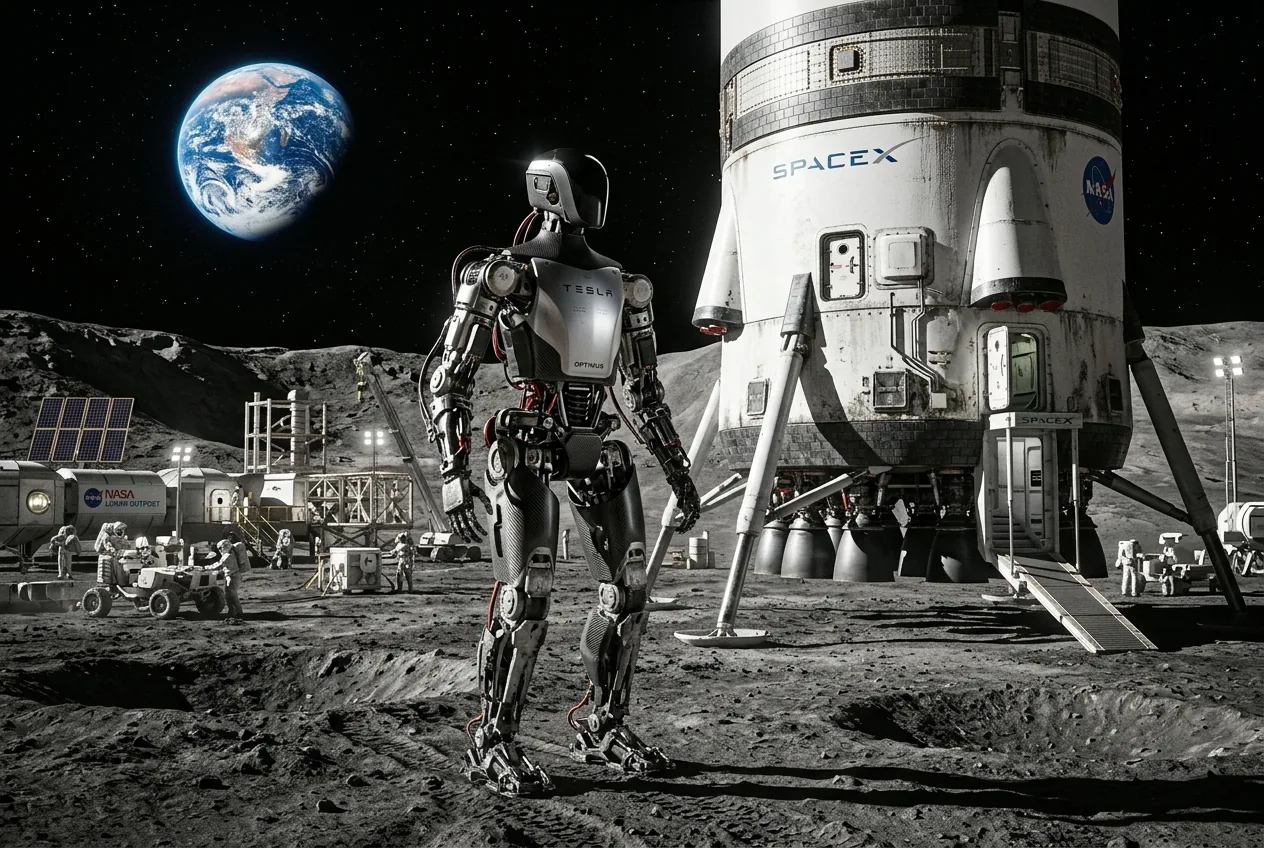
The Convergence of the Musk Ecosystem
Shares of Tesla, Inc. are currently tracking toward their most significant monthly gain since late 2023. While the automotive sector typically dictates the company’s valuation, the current rally is decoupled from traditional vehicle delivery metrics. Instead, the market is reacting to a complex convergence of aerospace policy, artificial intelligence scaling, and a renewed federal focus on lunar colonization. As NASA unveils specific details regarding its $20 billion Moon Base initiative, the narrative surrounding Tesla has shifted from that of a manufacturer to a foundational component of a nascent extraterrestrial industrial stack.
The catalyst for this shift is twofold: the intensifying logistical requirements for NASA’s 2032 permanent lunar presence and persistent internal speculation regarding a merger between Tesla, SpaceX, and xAI. Under the rumored internal branding of "SpaceXAI," the three entities are increasingly viewed by institutional investors not as disparate ventures, but as a vertically integrated ecosystem designed to solve the challenges of remote environment operations. For Tesla, this represents a pivot toward providing the mechanical and intelligent labor necessary for lunar infrastructure, leveraging its advancements in robotics and autonomous systems.
NASA’s 2032 Timeline and the Industrial Opportunity
From a mechanical engineering perspective, the lunar environment presents extreme challenges: temperature fluctuations from 127°C to -173°C, abrasive regolith, and high radiation levels. Tesla’s work on thermal management systems for its EV battery packs and the structural efficiency of its castings are directly applicable to lunar rover and habitat design. Investors are increasingly betting that the R&D conducted at Tesla’s Gigafactories will be the basis for the mechanical hardware used on the Moon, effectively making Tesla a silent partner in every SpaceX lunar mission.
Furthermore, the development of the Optimus humanoid robot has moved from a speculative laboratory project to a potential solution for lunar labor. On the Moon, human labor is prohibitively expensive and dangerous. An autonomous or teleoperated robot capable of performing basic maintenance and assembly tasks would be the primary workforce for a $20 billion base. By integrating xAI’s large-scale reasoning models with Tesla’s actuator and sensor hardware, the Musk ecosystem is positioning itself as the only entity capable of delivering a turnkey robotic workforce for NASA’s requirements.
The Technical Viability of 'SpaceXAI'
The term "SpaceXAI" has begun to circulate within the financial community, following reports of internal discussions regarding a formal or informal merger of Musk’s three primary technology pillars. While a full legal merger between a publicly traded Tesla and the private SpaceX presents significant regulatory and fiduciary hurdles, the operational integration is already well underway. Tesla’s Dojo supercomputer and xAI’s Grok are being leveraged to solve complex physics simulations that benefit both rocket telemetry and Full Self-Driving (FSD) neural networks.
The argument for a merger is rooted in technical synergy. SpaceX provides the transport (the "how" of getting to space), xAI provides the intelligence (the "what" to do once there), and Tesla provides the hardware and robotics (the "agent" that performs the work). For a lunar base to function, these three components must be flawlessly integrated. Using disparate vendors for the brain, the body, and the transport vehicle introduces interface risks that could be fatal in a space environment. A unified "SpaceXAI" entity would theoretically eliminate these friction points, creating a closed-loop system for planetary colonization.
Macroeconomic Headwinds and IPO Speculation
Beyond the lunar base, the financial structure of the Musk empire is undergoing a transformation. The FTSE has reportedly cleared a "fast lane" for a potential SpaceX IPO, a move that would provide the necessary liquidity to facilitate a massive corporate restructuring. If SpaceX becomes a public entity, the path toward a merger with Tesla becomes significantly clearer, albeit still fraught with antitrust scrutiny. Retail investors have largely shrugged off recent share sales in private equity vehicles like Destiny Tech100, focusing instead on the direct equity of Tesla as the most accessible proxy for Musk’s space ambitions.
Politics also plays a role in the current valuation surge. The $20 billion lunar push mentioned in recent federal discourse suggests a shift toward a more aggressive, commercially led space policy. This environment favors companies that can move faster than traditional defense contractors. SpaceX’s proven track record of reducing the cost per kilogram to orbit, combined with Tesla’s ability to mass-produce complex hardware, makes the combined entities the preferred partners for a cash-strapped but ambitious NASA.
Future Outlook for the Musk Conglomerate
Is the current surge in Tesla’s stock price a speculative bubble or a rational repricing of an industrial titan? If one views Tesla solely as an automotive company, the current valuation appears disconnected from reality. However, if Tesla is viewed as the manufacturing and robotics arm of a multi-planetary infrastructure project, the valuation begins to align with the scale of the opportunity. The 2032 NASA deadline provides a hard target that will force these companies to either integrate or fall behind.
The coming months will likely bring more clarity regarding the formal relationship between Tesla, SpaceX, and xAI. Whether through a merger or a series of deep-tech licensing agreements, the integration of these entities seems inevitable given the overlap in their engineering goals. For Noah Brooks and the team at Apollo Thirteen, the focus remains on the hardware: how these machines will be built, how they will be powered, and how they will operate autonomously on a world 238,000 miles away. For now, the market is betting that Elon Musk has the only viable blueprint for that future.



Comments
No comments yet. Be the first!