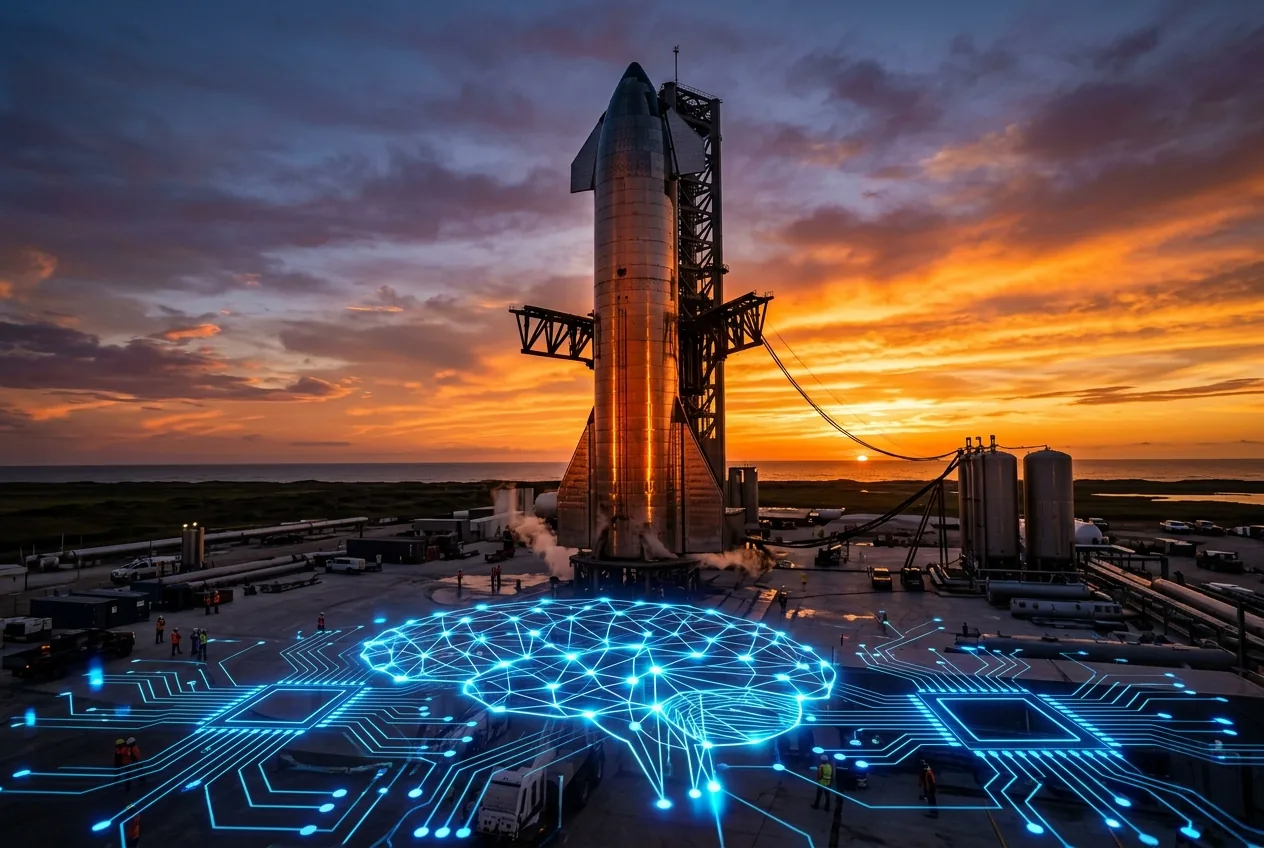
Elon Musk has spent the better part of two decades convincing the world that the future of humanity lies among the stars. But according to a 300-page S-1 regulatory filing, the financial future of his primary vehicle, SpaceX, actually lies in the silicon and neural networks of terrestrial artificial intelligence. The company is preparing for a historic Nasdaq debut on June 12, 2026, under the ticker SPCX, targeting a valuation of $1.75 trillion. If successful, this would represent the largest public offering in history, yet the document reveals a company in deep transition, shifting its capital from rocket plumes to compute clusters.
From a mechanical and systems engineering perspective, the filing is more than a pitch for capital; it is a blueprint for a vertically integrated industrial titan. SpaceX is no longer just a launch provider or an internet service provider. With its recent absorption of xAI and the development of in-house chip manufacturing, the company is attempting to build an autonomous loop where Starlink provides the data pipe, xAI provides the intelligence, and the launch business provides the infrastructure to scale both globally and beyond. However, this ambition comes with a staggering price tag that has already begun to swallow the profits of its most successful divisions.
The Financial Reality of the xAI Integration
The most jarring revelation in the S-1 filing is the sheer scale of the losses attributed to the company’s AI ambitions. In February 2026, SpaceX formally absorbed xAI, the research lab Musk founded to compete with OpenAI and Anthropic. While the move was framed as a strategic alignment, the numbers tell a story of high-stakes burning of capital. The xAI unit posted an operating loss of $6.4 billion in 2025 alone, a massive jump from the $1.6 billion lost the previous year. These losses were significant enough to wipe out the healthy profits generated by Starlink, leading SpaceX to end the 2025 fiscal year with a net loss of $4.9 billion.
Capital expenditure (CapEx) trends further emphasize this shift in priority. Of the $20.7 billion SpaceX spent on capital projects in 2025, a whopping $12.7 billion was directed toward AI infrastructure. To put that in perspective, the company spent more on servers, chips, and AI development than it did on its entire rocket and satellite connectivity business combined. This indicates that the core of SpaceX’s physical growth is now revolving around compute density rather than just orbital mass. For investors, the question is no longer about how many rockets can launch per year, but how quickly those investments in silicon can turn into high-margin software revenue.
The strategy for recouping these costs relies on a pivot to enterprise AI. SpaceX claims a theoretical Total Addressable Market (TAM) of $28.5 trillion, with $22.7 trillion of that coming specifically from selling AI services to large-scale corporations. While TAM figures are often aspirational ceilings, the company’s approach to capturing this market is distinctly industrial. They intend to deploy "forward deployed engineers"—a model popularized by firms like Palantir—to live within client operations and integrate AI tools directly into heavy industry, manufacturing, and global logistics. This isn't just about chatbots; it’s about agentic AI controlling complex supply chains.
Vertical Integration and In-House GPU Manufacturing
One of the most technically significant details buried in the filing is SpaceX’s plan to manufacture its own graphics processing units (GPUs). In the current market, the reliance on third-party vendors like Nvidia represents both a bottleneck and a massive margin drain. By bringing chip design and production in-house, SpaceX is following the playbook Musk established at Tesla with the FSD (Full Self-Driving) chips and the Dojo supercomputer. The goal is to create hardware specifically optimized for the "Macrohard" platform—an agentic AI system developed in collaboration with Tesla to manage complex, multi-modal industrial tasks.
This move toward hardware autonomy is a necessity for the scale SpaceX envisions. If the company is to manage tens of thousands of Starlink satellites while simultaneously running enterprise-grade AI for global corporations, the energy and compute efficiency of their hardware must be far beyond off-the-shelf solutions. The S-1 indicates that these in-house chips will be the backbone of Grok Enterprise, the commercialized version of xAI’s large language model. By controlling the stack from the silicon to the satellite to the software, SpaceX aims to insulate itself from the supply chain volatility that has plagued the tech sector over the last three years.
However, engineering a chip is not the same as scaling a foundry. The capital requirements for semiconductor manufacturing are notorious for their ability to drain even the deepest pockets. The $75 billion SpaceX aims to raise in the IPO is likely earmarked for this massive industrial scaling. It is a gamble that the market will value SpaceX as a high-growth AI firm rather than a traditional aerospace company, which typically trades at much lower multiples. The $1.75 trillion target suggests that Musk is confident the market will accept this new identity.
Starship V3 as a Logistics Backbone
While AI dominates the financial headlines, the physical machinery of SpaceX remains a critical component of the IPO story. The recent launch of Starship V3 serves as the logistical proof of concept for the company’s broader goals. Starship is the only vehicle capable of deploying the massive v3 Starlink satellites, which are required to provide the low-latency, high-bandwidth connections that enterprise AI agents need to operate in remote or industrial environments. Without Starship’s ability to lower the cost per kilogram to orbit, the infrastructure for a global AI network becomes economically unviable.
This synergy between heavy lift and high compute is the central pillar of the $1.75 trillion valuation. If SpaceX can prove that Starship enables an AI network that is faster, more resilient, and more global than anything built by Amazon or Google, the valuation begins to look less like a fantasy and more like a projection of a new industrial era. But the engineering challenges of Starship V3—ranging from heat shield reliability to Raptor engine longevity—remain a significant risk factor that could delay the rollout of the very infrastructure the AI business depends on.
Governance and the Musk-ocracy
For potential shareholders, the IPO comes with a unique set of governance hurdles. The filing confirms that Elon Musk will maintain 83.8% voting control over the company, effectively making SpaceX a private entity in public clothing. Furthermore, the company has utilized Texas law to implement forced arbitration for shareholders, a move designed to block the kind of class-action investor pushback that has occurred at Tesla. This structure ensures that Musk’s vision—and his alone—will dictate the company's trajectory, regardless of quarterly earnings or public sentiment.
This centralized control is particularly relevant given the recent internal turmoil at xAI. Reports indicate that 9 of the 12 original co-founders of xAI have departed the company since its inception, raising questions about the stability of the talent pool during the acquisition by SpaceX. In the high-stakes world of AI research, the loss of core talent is often a precursor to technical stagnation. Musk’s response appears to be a double-down on automation and a reliance on his existing engineering teams at Tesla and SpaceX to bridge the gap, but the brain drain remains a red flag for those looking at the long-term viability of the AI unit.




Comments
No comments yet. Be the first!