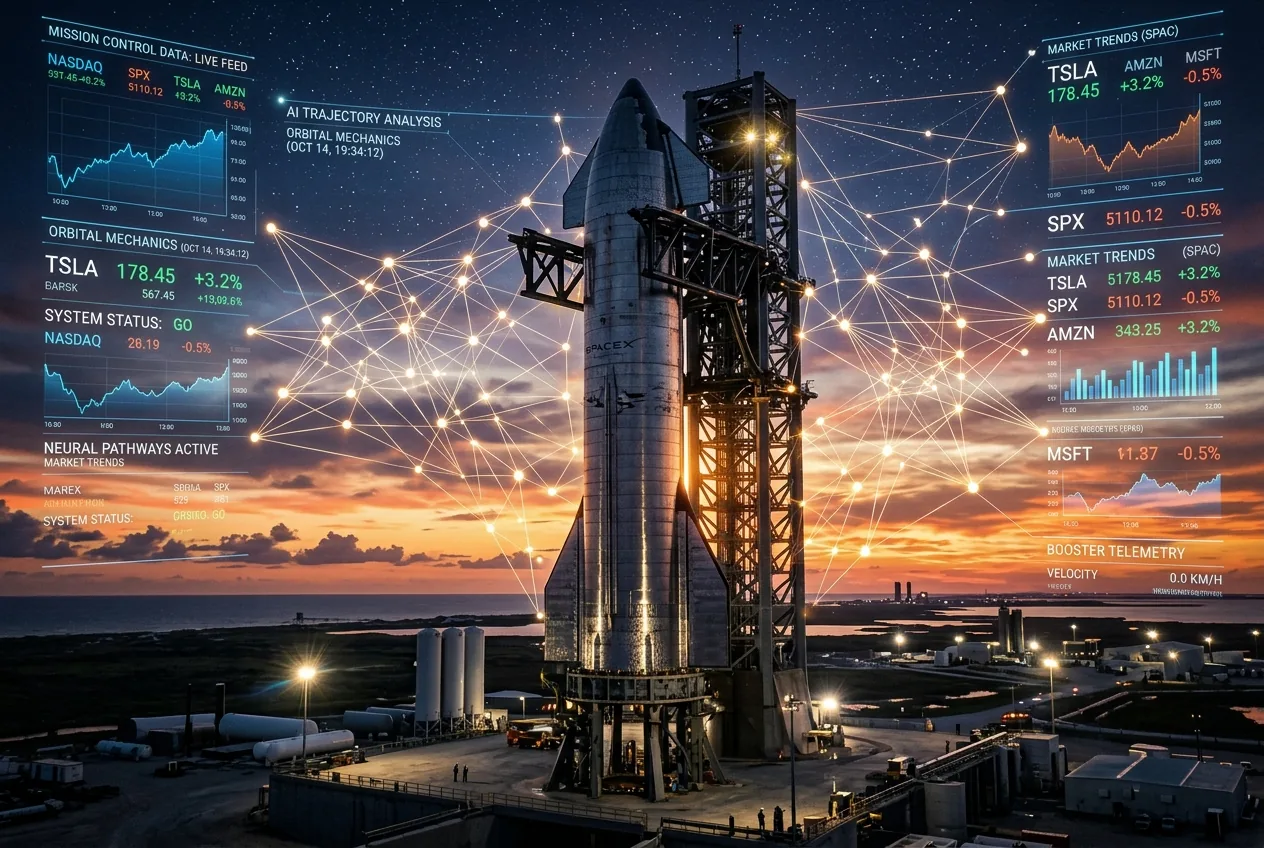
The aerospace industry is on the precipice of its most significant financial transformation to date. SpaceX, the private behemoth that has effectively monopolized the Western launch market, is reportedly finalizing plans for an initial public offering (IPO) on June 12. With a target valuation ranging between $1.5 trillion and $1.8 trillion, the move represents more than just a liquidity event for early investors; it is a fundamental shift in the economics of space exploration and industrial automation. For the first time, retail investors will have the opportunity to secure a direct stake in a company that is increasingly viewed not just as a rocket manufacturer, but as a vertically integrated infrastructure and artificial intelligence powerhouse.
From an engineering and industrial standpoint, the timing of this IPO is meticulously calculated. The valuation reflects a synthesis of three core pillars: the proven reliability of the Falcon 9 workhorse, the logistical potential of the Starship architecture, and the recent, high-profile merger with xAI. This integration of Elon Musk’s AI venture into the SpaceX ecosystem suggests a future where autonomous systems and aerospace hardware are inseparable. As the company moves toward this public debut, the market must grapple with the technical realities and economic viability of a company valued at nearly double the current market cap of traditional industrial giants.
The Economic Viability of a $1.8 Trillion Aerospace Giant
To understand the $1.8 trillion figure, one must look beyond the spectacle of rocket launches and analyze the unit economics of SpaceX’s most consistent revenue stream: Starlink. While the media often focuses on the heavy-lift capabilities of the Starship program, the financial backbone of the company is the massive constellation of Low Earth Orbit (LEO) satellites currently providing high-speed internet to millions. Starlink has transitioned from a speculative capital expenditure to a cash-flow-positive utility. By leveraging its own launch vehicles, SpaceX has achieved a cost-per-kilogram to orbit that competitors simply cannot match, creating a moat built on mechanical efficiency and reusable hardware.
How Does the xAI Merger Change the Engineering Roadmap?
The integration of xAI into SpaceX is perhaps the most pragmatic move in the company's recent history, despite its surface-level complexity. In the realm of industrial robotics and automation, the challenge has always been the lag between data collection and actionable decision-making. In the vacuum of space, where communication delays are a physical certainty, edge computing and autonomous decision-making are not luxuries; they are requirements for the next phase of Martian and lunar logistics.
As SpaceX prepares for the IPO, technical analysts are focusing on how xAI’s large language models and reinforcement learning algorithms will be applied to the Starship’s flight control systems. We are looking at a future where the rocket is essentially a massive, autonomous robot capable of real-time trajectory optimization without relying on ground control for every minor adjustment. This reduction in operational overhead directly impacts the bottom line, turning the "how" of space travel into a streamlined industrial process. For investors, this represents a shift from a high-risk aerospace play to a high-growth technology platform.
Democratizing the Space Economy for Retail Investors
Historically, the aerospace sector has been the playground of institutional investors and government agencies. The June 12 IPO changes that dynamic, offering a rare entry point for retail participants into a sector that has been largely walled off. Major investment platforms are expected to facilitate access to the offering, though the mechanisms for allocation remain a point of discussion among brokerage firms. For the retail investor, the appeal lies in the rare opportunity to own a piece of the "final frontier" at a stage where the technology is maturing but the market for orbital services is still expanding.
Risk Assessment: Technical Failures and Market Volatility
No industrial venture of this scale is without significant risk. In aerospace, a single catastrophic failure on the pad or during a high-profile mission can erase billions in market value overnight. Execution risk is at an all-time high as SpaceX moves from the testing phase of Starship into full-scale orbital operations. The mechanical complexity of the Raptor engines and the heat-shielding technology required for re-entry remain some of the most difficult engineering challenges in human history. If the company fails to meet its aggressive launch cadences, the $1.8 trillion valuation could face a sharp correction.
Furthermore, the "Elon Musk risk" remains a factor. Many current stakeholders, who have held private shares for years through various funding rounds, may see the IPO as their primary opportunity to liquidate. A mass sell-off by insiders could lead to a flooded market, putting downward pressure on the stock price in the months following the June 12 launch. Investors must also consider the broader macroeconomic environment; while the market is currently trending bullish, the capital-intensive nature of aerospace means that SpaceX is sensitive to shifts in interest rates and global supply chain stability.
The Future of Orbital Manufacturing and Supply Chains
With xAI providing the brainpower and SpaceX providing the heavy-lift hardware, the company is positioned to dominate the entire value chain of the space economy. From the raw robotics required for lunar mining to the automated supply ships that will sustain future habitats, the industrial infrastructure of the 2030s is being funded by the IPO of 2026. This isn't just about stocks; it’s about the mechanical and computational foundation of a multi-planetary civilization. For those of us focused on the interface of robotics and human industry, June 12 isn't just a date on the financial calendar—it is the day the space-industrial complex goes mainstream.




Comments
No comments yet. Be the first!