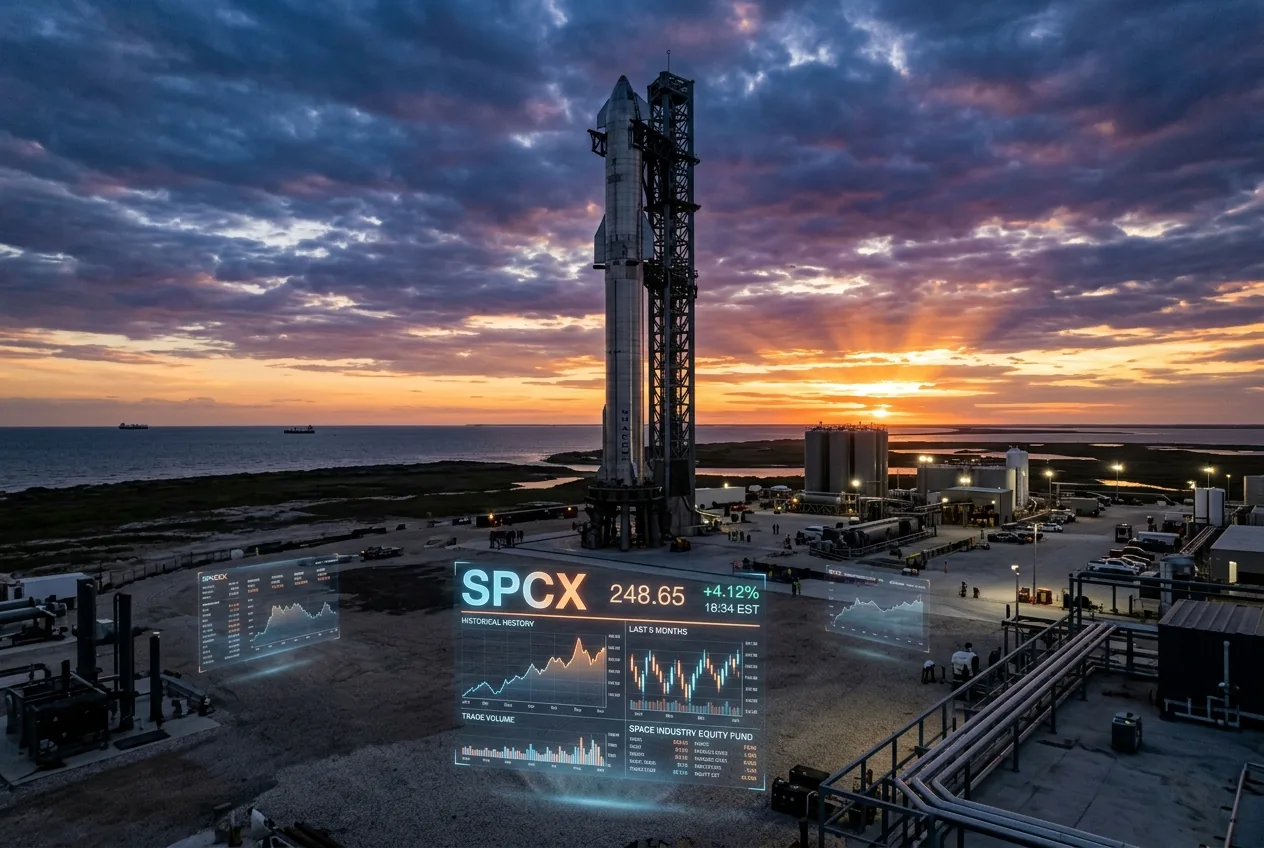
In a move that bypasses the traditional uncertainty of price-range discovery, SpaceX has entered the final stretch of its public debut with a fixed offer price of $135 per share. As the investor roadshow officially commences today, June 4, the aerospace giant is targeting an implied valuation of approximately $1.75 trillion. This figure represents a slight calibration from earlier market whispers of a $1.8 trillion floor, yet it remains a staggering benchmark that positions the company as a singular force in both the aerospace and infrastructure sectors. Under the ticker SPCX, the company is preparing for a Nasdaq debut scheduled for June 12, marking what will likely be the most significant industrial listing of the decade.
The Industrial Logic of an Infrastructure Conglomerate
To understand the $1.75 trillion valuation, one must look past the spectacle of rocket launches and toward the cold reality of industrial infrastructure. SpaceX is no longer just a launch provider; it is a vertically integrated utility and intelligence firm. The core of the valuation rests on three distinct but interconnected pillars: the Starlink broadband constellation, the Starship heavy-lift platform, and the recently consolidated xAI operations. This synergy creates a closed-loop system where orbital logistics support massive terrestrial compute requirements.
Starlink remains the primary revenue engine for the firm. With over 10 million subscribers and 2025 revenues hitting approximately $10.6 billion, the low-Earth orbit (LEO) network has proven it can scale beyond consumer internet. The IPO filings are expected to provide deeper clarity on enterprise service-level agreements (SLAs) and the economics of government contracts. From a mechanical and logistical perspective, the ability to maintain and refresh a constellation of thousands of satellites requires a launch cadence that only SpaceX can provide for itself. This internal efficiency is what separates SpaceX from traditional telecommunications providers, who must pay third-party vendors for every kilogram of payload delivered to orbit.
However, the financial picture is not without its complexities. Despite the robust revenue growth, the company reported a net loss of $4.94 billion in 2025. This deficit is largely attributed to the consolidation of xAI into the SpaceX balance sheet. The burn rate associated with training frontier artificial intelligence models—primarily the massive capital expenditure required for GPU clusters and specialized data center cooling systems—is now tethered to the aerospace operation. Investors are being asked to bet on a future where orbital cash flow fuels the next generation of artificial intelligence, a strategy that aligns with Musk’s broader vision of a unified technology stack.
Engineering the $75 Billion Primary Raise
The decision to pursue an all-primary offering is a pragmatic one. In a secondary offering, proceeds go to existing shareholders; in a primary offering, every dollar raised (minus fees) goes directly into the company’s coffers. SpaceX requires this $75 billion influx of liquidity to fund the aggressive expansion of its Starship production facilities and the deployment of the v3 Starlink satellites. Starship, in particular, represents a massive engineering and financial hurdle. Transitioning from experimental flights to a reliable, high-cadence freight system requires the kind of capital that private markets, even at SpaceX's scale, can no longer provide efficiently.
The sheer scale of the raise also necessitates a broad investor base. Reports indicate that up to 30% of the IPO tranche will be reserved for retail investors. This is an unusually high allocation for a mega-cap tech offering, which typically prioritizes large institutional blocks. This strategy serves two purposes: it capitalizes on the immense public interest in the SpaceX brand and ensures a diversified shareholder base that may be more resilient to the long-term, high-risk nature of space exploration compared to hedge funds focused on quarterly performance.
Comparison of IPO Key Metrics
| Metric | Specification |
|---|---|
| Fixed Offer Price | $135 per share |
| Total Shares Issued | 555.6 million (Primary) |
| Gross Proceeds | $75 billion |
| Target Valuation | $1.75 trillion |
| Reporting Period Loss (2025) | $4.94 billion |
| Retail Allocation | ~30% |
Does the xAI Consolidation Create a Conflict of Interest?
The inclusion of xAI within the SpaceX entity is perhaps the most debated aspect of the IPO. Critics argue that consolidating a high-burn AI startup with a maturing aerospace utility muddies the investment thesis. From a pragmatic engineering standpoint, however, there is a clear argument for the merger. Modern orbital constellations are increasingly reliant on edge computing and automated traffic management. As the number of satellites in orbit grows from thousands to tens of thousands, the task of collision avoidance and data routing becomes a problem that only a specialized AI stack can solve.
Furthermore, the physical infrastructure for xAI—gigawatt-scale data centers—requires the same power management and thermal engineering expertise that SpaceX has developed for its spacecraft and launch sites. By housing these operations under one roof, the company can leverage a single engineering talent pool to solve hardware problems across both domains. Nevertheless, the consolidated loss of nearly $5 billion demonstrates the cost of this integration. Investors must decide if the long-term utility of a proprietary AI stack justifies the immediate drag on the company’s path to GAAP profitability.
The Road to June 12: Pricing and Nasdaq Debut
Following the roadshow, the official pricing is expected on June 11, with the stock beginning to trade on the Nasdaq the following morning. The choice of the SPCX ticker is a deliberate nod to the company’s identity, distinguishing it from the broader aerospace sector and positioning it alongside other high-growth technology titans. At a $1.75 trillion valuation, SpaceX will likely enter the market with a larger capitalization than Tesla, Musk’s other major public venture. This shift reflects a market reality where the potential of the "space economy" is being priced with the same fervor once reserved for the electric vehicle revolution.
The technical requirements for this IPO have been years in the making. The shift from a private, employee-heavy stock program to a public security requires a level of transparency that SpaceX has previously avoided. The amended S-1 filings reveal a company that is bracing for the scrutiny of public markets while maintaining a tight grip on its long-term objectives. Musk’s 366-day lockup period is a vital signal to the market, ensuring that the company’s founder remains financially committed during the critical first year of public trading.
As the roadshow progresses through the week, the focus will likely remain on the sustainability of the Starship program and the eventual profitability of the Starlink-xAI hybrid. For those in the engineering and industrial sectors, the success of this IPO is more than just a financial milestone; it is a validation of the "move fast and break things" philosophy applied to the most difficult hardware problems in existence. If SpaceX can successfully navigate its debut at this price point, it will secure the capital necessary to make orbital transit a routine industrial process, effectively ending the era of government-funded space exploration as the primary driver of extraterrestrial progress.




Comments
No comments yet. Be the first!