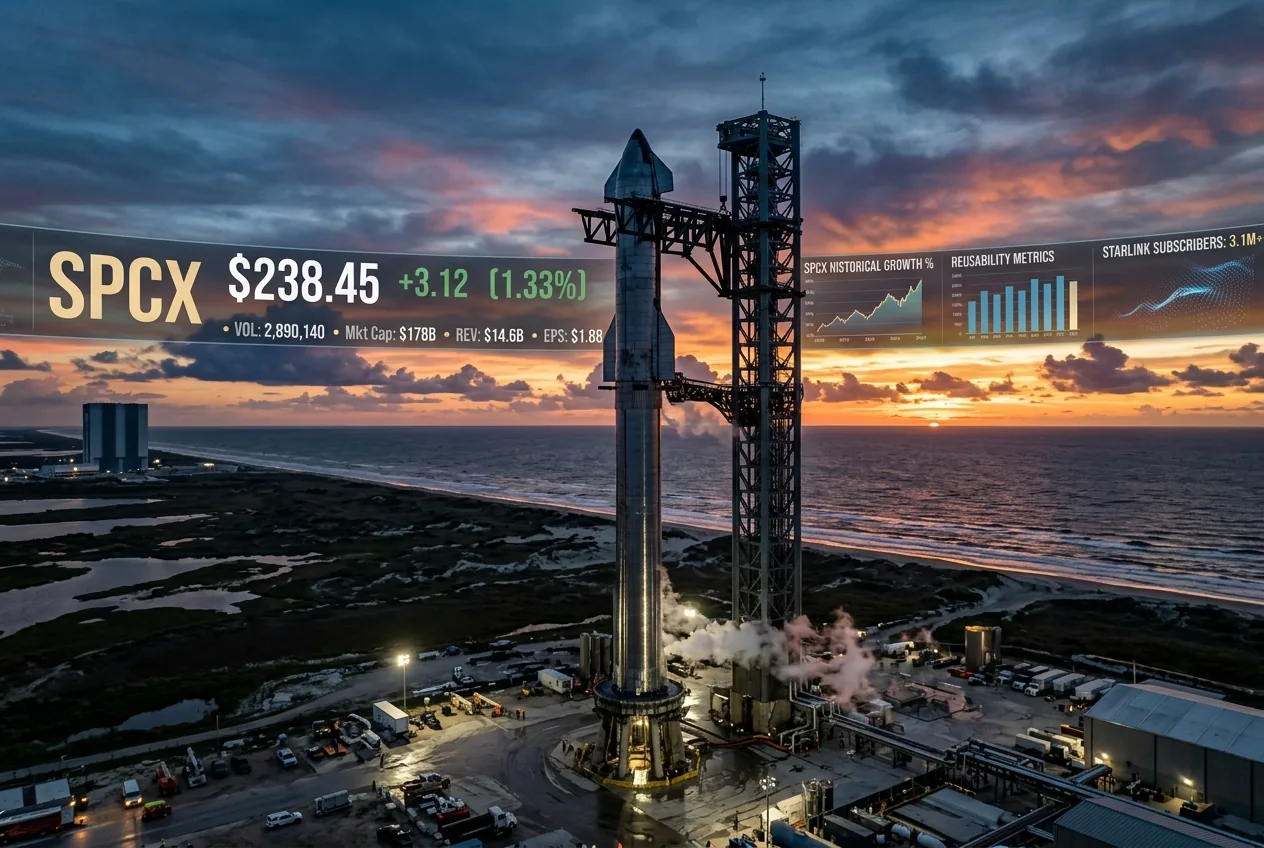
The landscape of global finance and industrial engineering is approaching a singular point of convergence. With the recent filing of an S-1 document with the Securities and Exchange Commission, SpaceX has officially set the stage for an initial public offering (IPO) that promises to be the largest in Wall Street history. Under the projected ticker symbol SPCX, the aerospace giant is targeting a valuation between $1.75 trillion and $2 trillion. If successful, this move will not only shatter the IPO record previously held by Saudi Aramco but will also propel Elon Musk into a financial tier occupied by no other individual in modern history: the world’s first trillionaire.
As a mechanical engineer, I view this transition through the lens of industrial infrastructure rather than mere speculative wealth. The IPO represents the financial crystallization of a vertically integrated empire that spans orbital delivery, global telecommunications, and high-performance computing. By synthesizing Musk’s holdings in SpaceX, Tesla, and xAI, we are witnessing the emergence of a multi-sector conglomerate that functions more like a sovereign state's industrial ministry than a traditional publicly traded company.
The Mechanics of a $2 Trillion Valuation
To understand the sheer scale of the SpaceX IPO, one must look past the headline figures and into the company's asset sheet. According to the filing, SpaceX currently holds approximately $102 billion in physical assets, including its fleet of reusable Falcon 9 boosters, the rapidly expanding Starlink satellite constellation, and the burgeoning infrastructure at Starbase in Boca Chica, Texas. However, the $2 trillion valuation target is not based solely on current hardware; it is a bet on the total capture of the orbital economy.
While the company reported a net loss of $4.3 billion in 2025 on revenues of $18.6 billion, the market appears willing to overlook short-term deficits in favor of long-term dominance. This capital-intensive phase is driven by the development of Starship, the fully reusable heavy-lift launch vehicle designed to reduce the cost per kilogram to orbit by orders of magnitude. For investors, the value proposition lies in the monopoly SpaceX currently holds over Western launch capabilities and the recurring revenue of Starlink, which provides a high-margin cash flow to fund Musk's more speculative ventures.
Musk’s personal stake in SpaceX is estimated at nearly 40%. At a $1.75 trillion valuation, his equity in the rocket company alone would be worth $700 billion. When combined with his holdings in Tesla—currently valued at approximately $1.6 trillion—and his control over xAI, Musk’s total net worth is projected to surge past $1.4 trillion. This concentration of wealth is unprecedented, but from a technical perspective, it reflects the consolidation of the tools of future industry: transport, energy, and intelligence.
The xAI Acquisition and Orbital Intelligence
One of the most critical, yet under-analyzed, aspects of the SpaceX IPO is the company’s recent absorption of xAI. In February 2026, SpaceX acquired Musk’s AI startup for $33 billion, a move that effectively transformed the aerospace company into a compute-heavy technology firm. This was not a random diversification; it was a pragmatic engineering decision to pair AI training requirements with orbital infrastructure and Tesla’s energy solutions.
The Looming Prospect of 'One Ball of Elon'
Wall Street analysts, most notably Dan Ives of Wedbush Securities, have begun to speculate that the SpaceX IPO is merely a precursor to a total merger between Tesla and SpaceX. Ives has placed the odds of such a tie-up at 80% by 2027. The rationale is simple: the technological overlap between the two companies has reached a point where maintaining separate corporate structures may be inefficient. From an engineering standpoint, the battery technology in a Model S, the motors in a Cybertruck, and the life-support systems on a Crew Dragon share a common lineage of power electronics and thermal management.
The IPO filing even highlighted the depth of this cross-pollination, noting that SpaceX purchased $131 million worth of Cybertrucks in 2025 for use as fleet vehicles at its various launch and manufacturing sites. The move toward a single parent company—often referred to as "X Holdings" or colloquially as "One Ball of Elon"—would allow for the seamless transfer of talent and resources. However, this potential merger also raises significant questions about corporate governance. Post-IPO, Musk is set to retain 85% voting control over SpaceX. If Tesla and SpaceX merge, Musk would essentially command a multi-trillion-dollar entity with minimal oversight from traditional shareholders.
Risks of the 'Musk Effect' and Legal Headwinds
Perhaps more pressing is the fallout from Musk's legal battle with OpenAI and Sam Altman. The recent dismissal of Musk's lawsuit against his former colleagues, in which he accused them of abandoning their non-profit mission, highlights the aggressive competitive environment in the AI sector. Musk told jurors that xAI was a "small" player compared to OpenAI, but the financial structure of the SpaceX IPO suggests he is building a war chest to change that dynamic. The risk for SPCX investors is that the company’s capital may be diverted to fuel Musk's personal rivalries rather than advancing its core mission of multi-planetary life.
Furthermore, the high debt load of $60.5 billion listed in the filing cannot be ignored. While the $102 billion in assets provides a cushion, the company remains in a state of hyper-expansion. Any significant failure of the Starship program or a prolonged downturn in the satellite internet market could strain SpaceX's ability to service that debt, even with the infusion of public capital.
The Future of Industrial Automation and Supply Chains
From my perspective in Atlanta, observing the global supply chain, the SpaceX IPO is a signal that the frontier of robotics and automation is shifting from the factory floor to the vacuum of space. The technical specifications of SpaceX's manufacturing process—utilizing high-degree-of-freedom robotic arms for rocket assembly and proprietary alloys for engine bells—represent the peak of mechanical engineering today. By going public, SpaceX is inviting the world to fund the transition from terrestrial automation to a space-based industrial economy.
The trillionaire status of Elon Musk is a byproduct of this transition, but the real story is the consolidation of the infrastructure required to sustain it. Whether through the direct deployment of Starlink to bridge the global digital divide or the use of xAI to optimize logistical routes for Tesla's semi-trucks, the goal is a unified system of automated production and transport. The IPO is the mechanism that provides the liquidity to finalize this vision, turning a series of ambitious startups into a permanent, self-sustaining industrial titan. As we look toward the June 12 pricing on the Nasdaq, the question is no longer whether Musk will become a trillionaire, but what a world dominated by a single, trillion-dollar individual will mean for the future of technological competition.




Comments
No comments yet. Be the first!