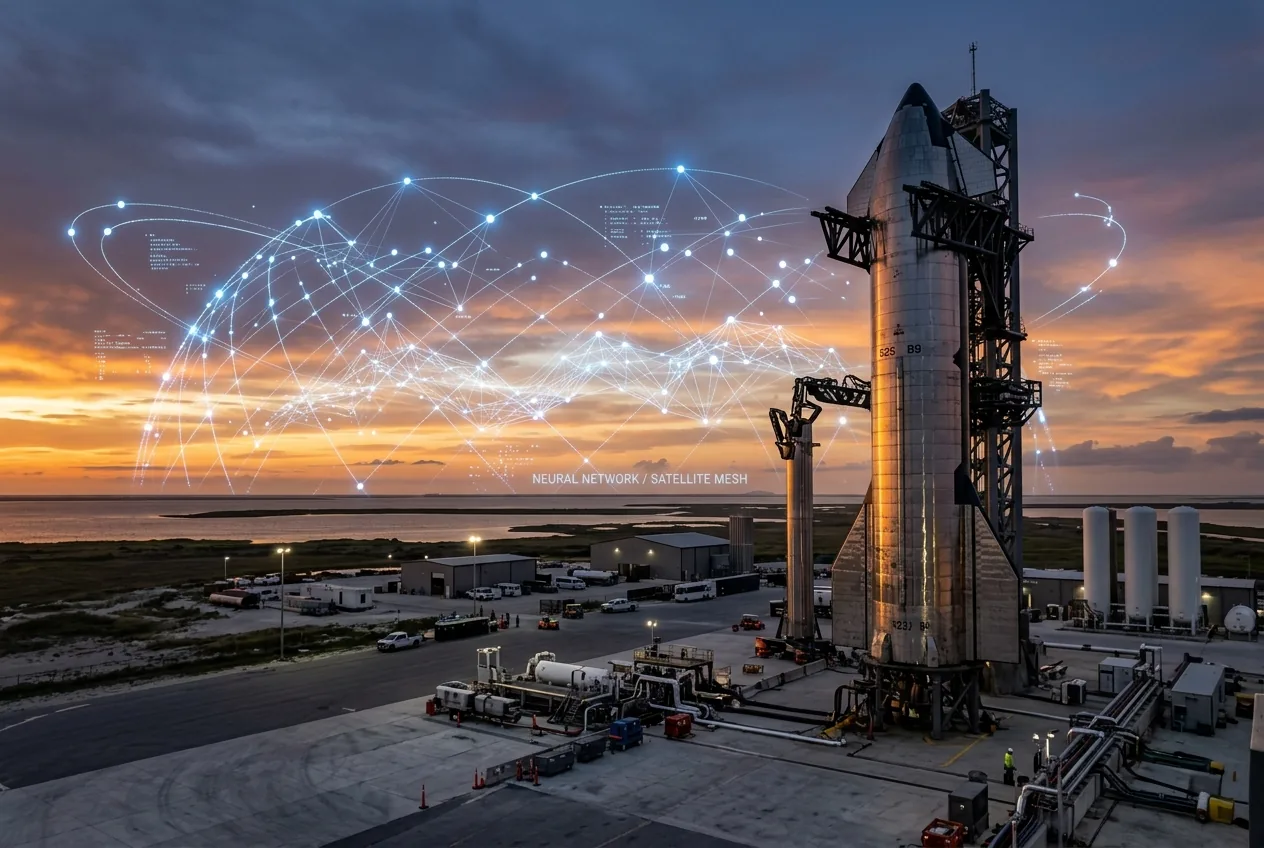
In what is poised to be the most significant shift in the industrial landscape since the dawn of the digital age, SpaceX has officially signaled its intent to go public. According to recent filings and insider reports, the company is targeting a record-setting $75 billion capital raise through an initial public offering (IPO) on the Nasdaq and Nasdaq Texas under the symbol SPCX. This isn’t merely a financial milestone; it is a fundamental restructuring of how we value the intersection of heavy lifting and high-speed computation.
The Mechanics of the Merger: Why xAI and SpaceX are Inseparable
To understand the trillion-dollar valuation, one must look beyond the spectacle of rocket launches. Earlier this year, SpaceX completed a strategic merger with xAI, Musk’s artificial intelligence venture responsible for the Grok chatbot. This move, which valued the combined entity at over $1.2 trillion in the private markets, was the catalyst for the current IPO strategy. The logic is grounded in a pragmatic assessment of industrial constraints: terrestrial AI development is currently hitting a wall of energy consumption and cooling requirements.
The integration of xAI into the SpaceX portfolio transforms the company from a launch services provider into an infrastructure conglomerate. The goal is the deployment of "orbital compute at scale." By leveraging the Starlink satellite constellation and the massive payload capacity of the Starship launch system, SpaceX intends to build solar-powered data centers in low Earth orbit (LEO). This technical pivot addresses two of the most expensive aspects of modern AI: electricity and thermal management. In space, solar energy is abundant and constant, while the vacuum of space offers a unique—albeit challenging—environment for radiating heat away from high-performance GPU clusters.
The Economic Viability of Space-Based Compute
From a mechanical engineering perspective, the hardware required to sustain space-based AI is formidable. However, the economic utility is becoming increasingly clear. SpaceX recently signed a contract with AI firm Anthropic to provide AI compute services for $1.25 billion per month. This single agreement provides a glimpse into the massive revenue potential of the "Space Data Center" model. While traditional data centers are limited by local power grids and land use permits, an orbital cluster can operate autonomously, beaming processed data back to Earth via Starlink’s laser cross-links.
The IPO proceeds—projected at $75 billion—are earmarked for the rapid expansion of these AI computing resources and the finalization of the Starship fleet. Starship is the critical industrial lever here. If the company can maintain its current cadence of test flights and achieve full reusability, the cost per kilogram to orbit will drop to a level that makes large-scale hardware deployment in LEO not just possible, but highly profitable. We are no longer talking about scientific research; we are talking about a $28.5 trillion total addressable market for space-based infrastructure.
Financial Realities and the Cost of Innovation
Despite the astronomical valuation, the company’s balance sheet reflects the brutal reality of capital-intensive engineering. In 2025, SpaceX reported a net loss of $4.94 billion on $18.7 billion in revenue. This is a significant swing from the $791 million profit recorded in 2024. The widening losses are primarily attributed to the massive R&D expenditures for the Starship program and the aggressive build-out of xAI’s compute clusters. In the three months ended March 31, 2026, losses widened to $1.27 per share, compared to just 18 cents per share the previous year.
However, analysts focusing on the P/E ratio are likely missing the broader industrial play. SpaceX’s connectivity segment, Starlink, remains a cash cow, generating consistent profits that subsidize the higher-risk divisions. The $75 billion raise is designed to bridge the gap between Starlink’s current profitability and the future profitability of the orbital compute network. By going public now, SpaceX is securing the liquidity needed to outpace any potential competitors in the aerospace or AI sectors.
The Unconventional IPO Structure
Musk’s approach to the SPCX listing is as disruptive as his engineering. The decision to fix the price at $135—rather than a range—indicates a high level of confidence in retail and institutional demand. Reports suggest that up to 30% of the offering may be allocated to individual investors, tapping into a dedicated following that has historically buoyed Tesla’s market cap during periods of volatility. Furthermore, the IPO is structured as an all-primary offering, meaning every dollar raised goes directly into the company’s coffers rather than lining the pockets of existing shareholders.
Governance also remains a key factor. The filing indicates a structure that preserves strong founder control, ensuring that Musk can pursue long-term goals—such as the colonization of Mars—without the quarterly pressure often associated with public markets. To further signal commitment, Musk will be required to hold his shares for 366 days after the IPO, a longer lock-up period than the standard 180 days seen in most tech listings.
Can SpaceX Transition from Launch Provider to AI Sovereign?
The success of the SPCX IPO hinges on whether investors view SpaceX as a transportation company or a technology utility. In the industrial world, transportation is often a race to the bottom in terms of margins. However, utilities that provide essential infrastructure—like power, water, or in this case, compute and connectivity—tend to command premium valuations. By merging with xAI, SpaceX is positioning itself as the latter.
The technical synergy between the Starship booster and the xAI software stack is the "how" behind the $1.75 trillion target. Each Starship launch can theoretically deploy hundreds of specialized compute nodes that integrate directly into the Starlink mesh. This creates a global, decentralized supercomputer that is physically beyond the reach of terrestrial geopolitical constraints or infrastructure failures. For a world increasingly dependent on AI, this level of redundancy and scale is worth the record-breaking price tag.
The Broader Impact on the Industrial Sector
SpaceX’s move is expected to trigger a cascade of similar listings. If the market absorbs a $75 billion raise at a $1.75 trillion valuation, it clears the path for other giants like OpenAI and Anthropic to test the public markets. We are witnessing the birth of a new sector: the Orbital Industrial Complex. This sector is characterized by heavy mechanical engineering, high-level robotics for satellite servicing, and the massive deployment of silicon in extreme environments.
As the roadshow begins this Thursday, the focus will not be on the next rocket launch, but on the capacity of the Starbase and Starlink systems to support a trillion-dollar AI economy. For those of us focused on the mechanical and economic viability of robotics and automation, the message is clear: the most valuable real estate for the future of industry is no longer on the ground. SpaceX is building the foundation for a logistical and computational network that operates above the atmosphere, and the price of entry has just been set.




Comments
No comments yet. Be the first!