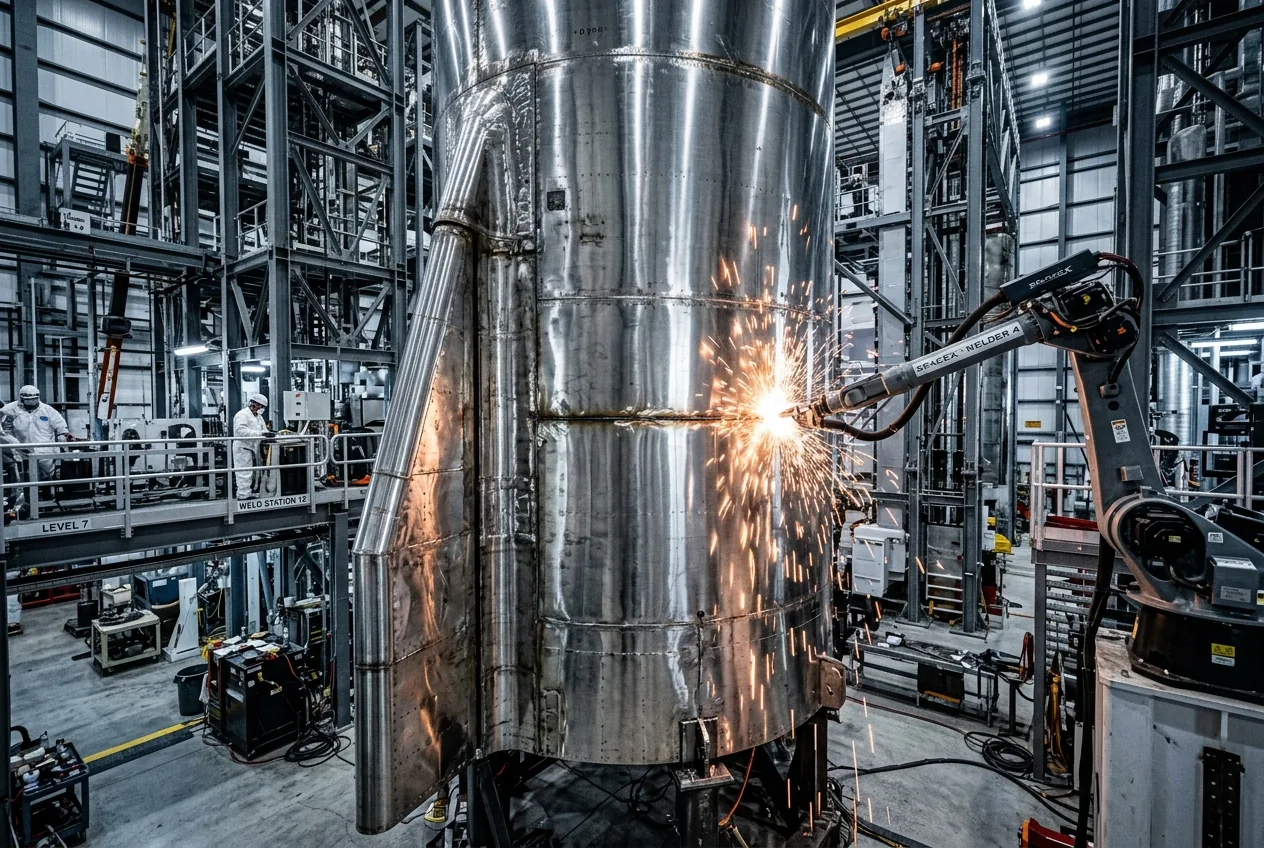
The recent financial maneuvers surrounding SpaceX, culminating in a staggering $75 billion capital milestone, represent more than just a vote of confidence from the private equity sector; they signal a fundamental shift in the industrialization of Low Earth Orbit (LEO). To the casual observer, the numbers are astronomical. To an engineer, they are a direct reflection of a maturing manufacturing pipeline and the successful mitigation of launch-related risk. As the company continues to iterate on its Starship architecture and expand its Starlink constellation, the capital influx provides the necessary thermal mass to absorb the high-cost R&D phases of deep-space logistics.
The Starship Architecture as an Economic Catalyst
The primary driver of the current $75 billion valuation is the projected capability of the Starship launch system. Unlike the Falcon 9, which requires a new second stage for every mission and significant refurbishment for its boosters, Starship is designed for full and rapid reusability. From a technical perspective, this necessitates a shift from the aerospace-grade aluminum-lithium alloys typically found in rocket fuselages to 300-series stainless steel. While heavier, stainless steel offers superior fracture toughness at cryogenic temperatures and maintains structural integrity at high reentry temperatures, significantly reducing the mass of the thermal protection system required for recovery.
For investors, the appeal of Starship lies in its payload capacity. Designed to loft over 100 metric tons to LEO, the vehicle effectively crashes the price per kilogram of reaching space. When the cost of launch drops below the threshold of $100 per kilogram, industries that were previously economically non-viable—such as orbital manufacturing of high-purity pharmaceuticals or the assembly of large-scale solar power arrays—become feasible. This isn't just about launching satellites; it’s about creating the infrastructure for an entirely new orbital economy. The massive capital raise ensures that SpaceX can maintain the breakneck pace of its iterative design process at the Starbase facility in Boca Chica, Texas, where hardware is tested to failure to find the limits of the structural envelope.
Starlink and the Maturity of Orbital Telecommunications
While Starship represents the future, Starlink provides the present-day revenue stability that justifies a record-breaking valuation. The constellation currently consists of thousands of small satellites in LEO, providing low-latency broadband to regions where terrestrial fiber is cost-prohibitive. From a mechanical engineering standpoint, the challenge of Starlink was not just the satellite design, but the automation of the manufacturing process. SpaceX has successfully applied automotive-style assembly line techniques to satellite production, achieving a cadence that dwarfs the combined output of the rest of the global aerospace industry.
Integration with xAI and Autonomous Systems
A critical, though often overlooked, component of SpaceX's recent success is its integration with advanced computational models, particularly those being developed under the xAI umbrella. The complexity of landing a 70-meter booster on a drone ship in high seas, or catching it with mechanical arms (the 'Chopsticks') at the launch tower, requires real-time telemetry processing that exceeds traditional flight control software. This is where the intersection of robotics and aerospace becomes evident. The control algorithms used by SpaceX are increasingly leveraging neural networks to predict atmospheric turbulence and adjust engine gimbaling in microseconds.
Furthermore, the manufacturing floor at SpaceX utilizes AI-driven predictive maintenance and quality control. Every weld on a stainless steel tank is scanned and analyzed against a database of thousands of successful launches. This allows for a 'fail fast' methodology that is statistically safer than the slow, bureaucratic processes of the past. The capital raised in this latest round will likely flow into further enhancing these autonomous systems, reducing the human labor required for rocket refurbishment and increasing the cadence of launches to a point where orbital flight becomes a daily occurrence rather than a monthly event.
Can the Public Markets Handle the Risk?
The discussion of a SpaceX IPO—or even a Starlink spinoff—raises questions about the appetite of the public market for long-term capital intensive projects. Traditionally, public markets demand quarterly growth and are risk-averse regarding R&D failures. However, SpaceX has cultivated a unique position where its 'failures' (such as the early explosive tests of Starship prototypes) are viewed by the market as rapid progress rather than setbacks. This shift in perception is a testament to the transparency of the company's engineering milestones.
The $75 billion figure suggests that institutional investors are beginning to treat SpaceX as a utility provider rather than a speculative tech firm. As Starlink reaches cash-flow positivity, the company's dependence on external capital decreases, giving it more leverage in how it approaches a potential public debut. For the broader market, a SpaceX IPO would represent the first time retail investors could participate in the colonization of the solar system. However, for those of us focused on the hardware, the real story remains the transition of the rocket from a bespoke piece of artillery to a mass-produced industrial tool.
The road ahead involves significant technical hurdles. The Raptor 3 engine must demonstrate long-term reliability without the need for extensive overhaul between flights. The heat shield on Starship must prove it can withstand multiple reentries without losing individual tiles—a problem that plagued the Space Shuttle program for decades. And the orbital refueling technology, necessary for lunar and Martian missions, must be perfected. The recent capital raise provides the financial runway to solve these problems, but the solution will be found in the weld shops and engine stands, not in the boardroom. SpaceX has proved that it can raise money; now it must continue to prove that it can bend the laws of physics and economics to its will.




Comments
No comments yet. Be the first!