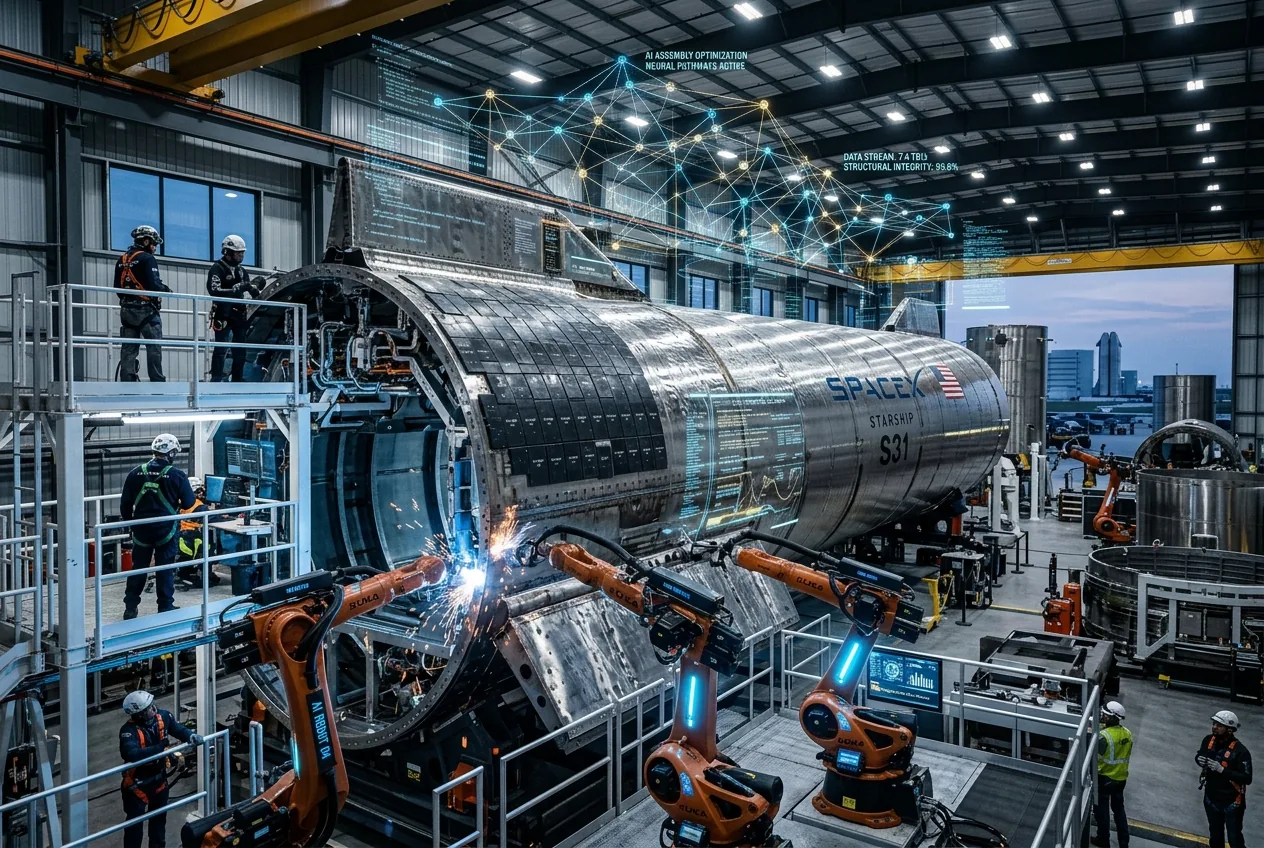
In a move that fundamentally redraws the map of the aerospace and artificial intelligence industries, SpaceX has announced the acquisition of xAI for an estimated $60 billion. This consolidation comes on the heels of SpaceX’s highly anticipated initial public offering, which provided the capital necessary to bring Elon Musk’s disparate ventures under a single, unified engineering banner. For those of us tracking the intersection of heavy industrial hardware and high-order computation, this is not merely a financial transaction; it is the formal integration of the physical world with the silicon world.
The acquisition marks a pivot for SpaceX from being a launch provider to becoming a vertically integrated autonomous intelligence company. While the public often focuses on the conversational capabilities of models like Grok, the industrial utility of xAI’s architecture for SpaceX lies in its ability to manage the staggering complexity of multi-planetary logistics, high-cadence manufacturing, and real-time telemetry processing. By bringing xAI in-house, SpaceX is essentially building a centralized nervous system for its hardware fleet.
The Engineering Logic of Integrated Intelligence
To understand why a rocket company would spend $60 billion on an AI startup, one must look at the sheer data density of modern aerospace engineering. A single flight of a Starship vehicle generates petabytes of sensor data, ranging from cryo-tank pressure fluctuations to the vibrational frequencies of the Raptor engines. Traditionally, this data is analyzed post-flight, with engineers looking for anomalies in the telemetry to inform the next design iteration. This is a linear, time-intensive process.
Furthermore, the design of the Raptor engine itself stands to benefit from xAI’s generative design capabilities. Fluid dynamics within a staged-combustion cycle engine are notoriously difficult to model. By leveraging xAI’s compute clusters, SpaceX can iterate on the internal geometry of engine components—optimizing for heat dissipation and weight—at a speed that traditional CAD software cannot match. We are seeing the transition from human-led design to AI-augmented mechanical optimization.
Autonomous Manufacturing and the Starbase Production Line
The real bottleneck for SpaceX’s vision of a Mars colony is not just building a rocket that works, but building hundreds of them. This requires an unprecedented level of automation in the manufacturing process. At Starbase in Boca Chica, the production line is already a marvel of assembly-line robotics, but it still requires significant human intervention for quality control and precision welding.
The acquisition of xAI provides SpaceX with the software stack necessary to drive the next generation of industrial robotics. Unlike the rigid, pre-programmed robots of the 20th century, the robots SpaceX intends to deploy will utilize xAI’s vision models and reinforcement learning to adapt to variations in the manufacturing environment. If a stainless steel sheet is slightly out of spec or a weld requires a different thermal profile due to ambient conditions, the AI-driven robotics can adjust on the fly.
Starlink and the Edge Computing Frontier
Another critical component of this deal is the Starlink constellation. With thousands of satellites currently in low Earth orbit (LEO), SpaceX operates the world’s largest satellite network. However, as the user base grows and the demand for low-latency data increases, the challenge shifts from launching satellites to managing the network’s traffic. xAI’s expertise in large-scale transformer models and data routing is perfectly suited for this task.
The Economic Viability of a $60 Billion Bet
Critics will argue that a $60 billion price tag is an overvaluation, especially for an AI firm that has yet to see significant commercial revenue outside of a few consumer-facing tools. However, from an industrial standpoint, the valuation must be viewed through the lens of SpaceX’s long-term market dominance. If xAI’s technology allows SpaceX to reduce the cost of a Starship launch by even 10% through better design and manufacturing, or if it doubles the efficiency of the Starlink network, the return on investment will be measured in the hundreds of billions over the next decade.
Post-IPO, SpaceX is no longer just a high-growth startup; it is a blue-chip industrial powerhouse with a fiduciary responsibility to its shareholders. This acquisition suggests that the board views AI as a core competency rather than an auxiliary service. By owning the AI stack, SpaceX avoids the risks associated with third-party dependencies—like OpenAI or Google—and ensures that its proprietary engineering data remains within its own secure ecosystem.
Is This the Foundation of a Multi-Planetary Economy?
The ultimate goal of SpaceX has always been the colonization of Mars. Achieving this requires more than just rockets; it requires the ability to build self-sustaining habitats, manage life support systems, and operate mining equipment in environments where human presence is limited. These are all tasks that require advanced, autonomous intelligence. A Mars colony cannot wait minutes for a signal to reach Earth to solve a technical crisis. The systems must be capable of local reasoning and problem-solving.
The acquisition of xAI is the first concrete step toward building that autonomous framework. We are moving toward a future where the distinction between "aerospace" and "AI" ceases to exist. In the harsh environment of deep space, the hardware and the software must be a singular, integrated unit. SpaceX’s $60 billion purchase is a declaration that the future of space exploration will be built on silicon as much as it is on steel and methane.
As we watch the integration process unfold over the coming months, the focus should remain on the technical milestones. Watch for improvements in Starship’s flight control software, the expansion of Starlink’s edge computing capabilities, and the deployment of more sophisticated robotics at the Starfactory. This is the new baseline for the industry: if you aren't an AI company, you won't be a space company for long.




Comments
No comments yet. Be the first!