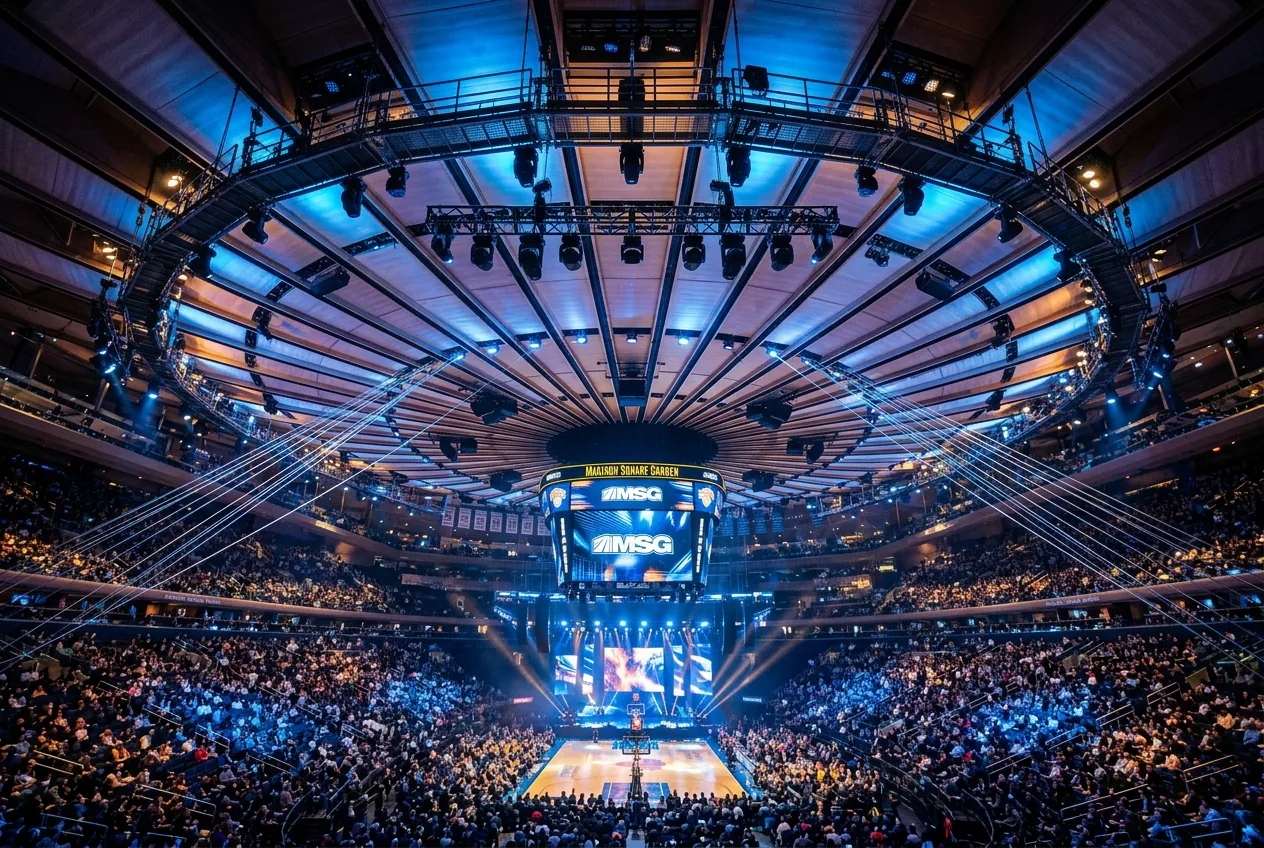
When the world’s most recognized public figures choose a venue like Madison Square Garden (MSG) for a high-density, high-security gathering, the conversation typically revolves around the spectacle. However, from the perspective of mechanical engineering and industrial automation, an event involving 1,200 high-profile guests in the heart of Manhattan is less a social milestone and more a masterclass in large-scale human-system integration. To execute a ceremony of this magnitude requires a synergy of structural engineering, vertical logistics, and advanced crowd dynamics that few other facilities on Earth can accommodate.
Madison Square Garden is not merely an arena; it is a complex mechanical organism sitting atop a major transit hub. The technical challenges of hosting a massive private event there—rumored to be the site for the union of Taylor Swift and Travis Kelce—extend far beyond seating charts and catering. It involves the precise orchestration of supply chains, the deployment of sophisticated security robotics, and the management of structural loads that would overwhelm standard event spaces. To understand how such an event functions, one must look at the bones of the building and the algorithms that govern its operation.
Structural Engineering and the Suspended Roof
For an event requiring bespoke staging—perhaps incorporating thousands of pounds of floral installations, high-fidelity audio arrays, and automated lighting—engineers must calculate the precise distribution of weight across these cables. In a scenario with 1,200 guests localized in the arena bowl, the dead load (the weight of the structure) and the live load (the guests and equipment) must be balanced to ensure structural integrity. Mechanical engineers utilize finite element analysis (FEA) software to simulate how the tension in the roof cables shifts as equipment is hoisted, ensuring that the lateral forces do not exceed the tolerances of the outer compression ring.
The Logistics of the Vertical Supply Chain
The facility utilizes a massive "elephant elevator" capable of lifting fully loaded 53-foot semi-trailers from the street-level loading docks up to the arena floor. Coordinating the arrival of dozens of trailers for a 1,200-guest event requires a JIT (Just-In-Time) inventory management system. Each truck must be scheduled within a narrow window to prevent gridlock on 31st and 33rd Streets. The throughput of the elevator becomes the primary bottleneck of the entire setup. Industrial engineers must map out the "load-in" sequence with surgical precision, ensuring that flooring is laid before the stage is built, and that the catering infrastructure is powered before the perishable goods arrive.
Crowd Dynamics and Biometric Security Systems
Managing 1,200 high-profile individuals requires more than just human guards; it necessitates a sophisticated network of sensors and automated surveillance. In recent years, Madison Square Garden Entertainment has been a pioneer—and a subject of debate—in the use of facial recognition technology and biometric security. For an event with high-net-worth individuals and global icons, the security architecture would likely leverage these systems to monitor entry points in real-time.
From a technical standpoint, this involves a multi-layered sensor fusion approach. Computer vision algorithms track the flow of people through the concourses to identify "hot spots" or potential bottlenecks before they occur. This is an application of fluid dynamics applied to human movement. By modeling the guests as particles in a confined space, engineers can predict how long it will take for 1,200 people to move from a cocktail reception to the main ceremony area. This data is critical for ensuring that safety protocols are met and that the experience remains seamless. Furthermore, in the age of drone technology, the arena’s "roof-top" security must include radio-frequency (RF) jamming and signal detection to prevent unauthorized aerial surveillance, creating a localized "no-fly zone" through electronic warfare suites.
Acoustic Calibration in a Cavernous Space
MSG is designed for the roar of a crowd, not necessarily the intimacy of a wedding vow. Transforming a 20,000-seat sports arena into an acoustically appropriate venue for a smaller gathering of 1,200 requires significant audio engineering. The primary challenge is the reverberation time. Hard surfaces like the concrete floors and plastic seating cause sound waves to bounce, creating an echo that can muddy speech and music.
Redundant Systems and Energy Demand
The energy requirements for an event of this scale are immense. Beyond the standard HVAC (heating, ventilation, and air conditioning) needs for a 1,200-person gathering, the addition of high-definition broadcast equipment, specialized lighting, and catering kitchens places a significant strain on the building’s electrical grid. Industrial automation systems at MSG manage this load through a series of redundant power supplies and Uninterruptible Power Supply (UPS) units.
For high-stakes events, rely on localized power generation or dedicated transformers to isolate the event’s critical systems from the city’s main grid. This ensures that even in the event of a municipal power failure, the lighting, security, and life-safety systems remains operational. The HVAC system itself must be recalibrated; 1,200 people generate approximately 420,000 BTUs of heat per hour. The building’s automated climate control system must use predictive modeling to begin pre-cooling the space hours before the guests arrive, accounting for the heat load of the lighting rigs and the humans themselves to maintain a constant, comfortable temperature.
The Economic Viability of Event Automation
While the focus of the public remains on the glamour of the attendees, the underlying story is the massive economic engine of event automation. The ability to flip a venue like Madison Square Garden from a basketball configuration to a private event layout within a 24-hour window is a testament to modern industrial efficiency. This "changeover" is a highly choreographed ritual involving hundreds of technicians and automated floor systems. The hardwood of the Knicks' court or the ice of the Rangers' rink is covered with insulated, high-density polyethylene panels, providing a stable foundation for the event’s flooring.




Comments
No comments yet. Be the first!