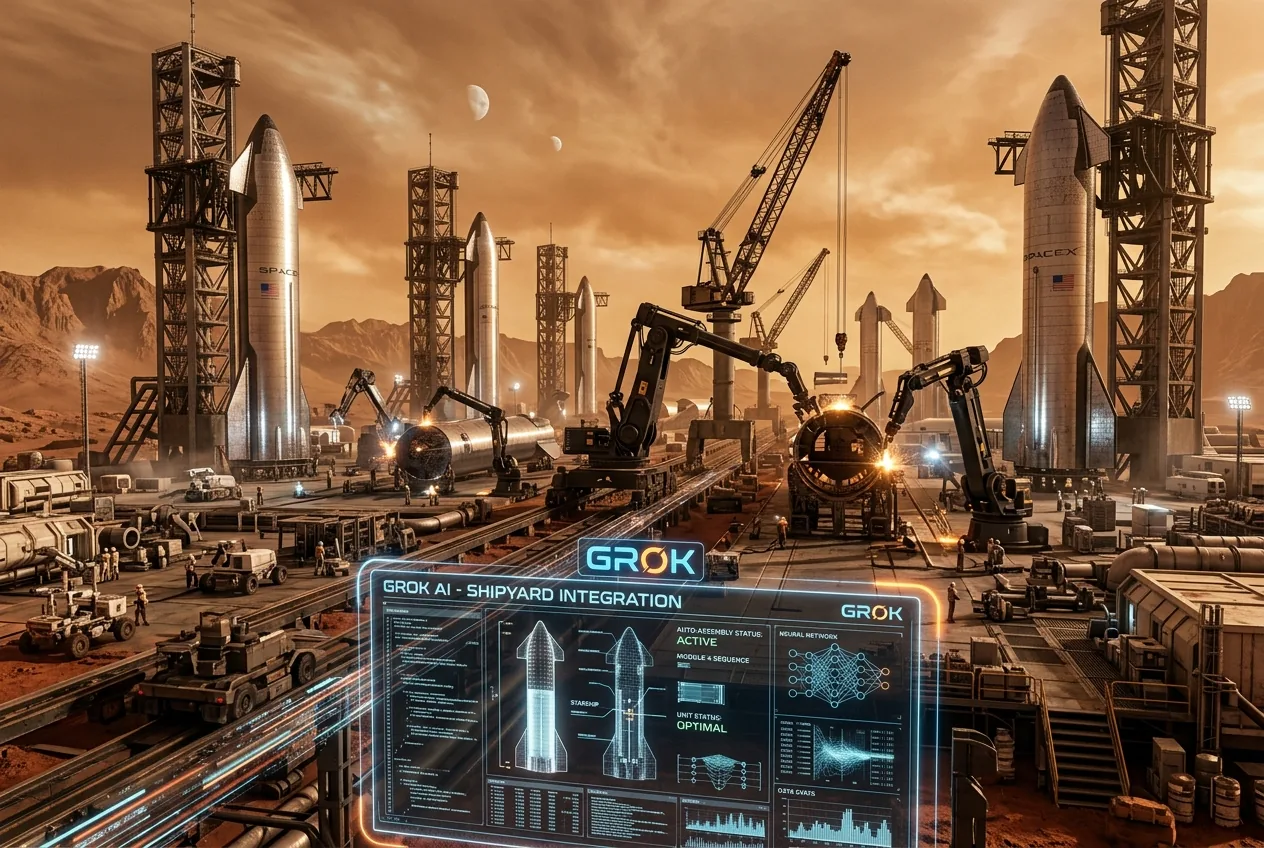
In a move that marks the most significant shift in the history of the aerospace industry, SpaceX has formally filed an investor prospectus for an initial public offering (IPO) targeting a valuation of $1.75 trillion. This filing represents more than just a financial milestone; it is a comprehensive industrial manifesto for the colonization of Mars. The document, which synthesizes years of iterative engineering into a fiscal roadmap, positions SpaceX not as a mere satellite launch provider, but as the foundational infrastructure company for a multi-planetary economy. Central to this vision is a deep integration with Grok, the artificial intelligence developed by xAI, which is cited in the prospectus both as a mission-critical asset and a primary source of operational risk.
The Technical Foundation of a $1.75 Trillion Valuation
The sheer scale of the $1.75 trillion valuation is predicated on the operational success of the Starship launch system. From a mechanical engineering perspective, the Starship/Super Heavy stack represents the first attempt at a fully reusable orbital transport system capable of delivering over 100 metric tons to Low Earth Orbit (LEO). The prospectus outlines a transition from the current Falcon 9-dominant revenue model to a high-cadence Starship cycle. To justify the trillion-dollar-plus market cap, SpaceX is forecasting an industrial throughput that has never been seen in rocketry: the mass production of Raptor engines and the deployment of a fleet consisting of hundreds of orbital vehicles.
The financial viability of the Mars colony depends on the drastic reduction of cost-per-kilogram. SpaceX aims to drive these costs down to below $100 per kilogram, a figure that would effectively commoditize space access. This is not merely an exercise in cost-cutting but a fundamental rethinking of the supply chain. By bringing more manufacturing in-house—utilizing advanced robotics for hull welding and 3D printing for complex engine components—SpaceX intends to decouple itself from the traditional aerospace supply chain, which has historically been plagued by delays and cost overruns from external contractors.
Engineering the Mars Colony Architecture
The investor prospectus provides the most detailed look yet at the proposed Mars Base Alpha. It describes an industrial hub focused on In-Situ Resource Utilization (ISRU). The technical challenges of Martian settlement are not primarily about the journey, but about what happens upon arrival. The prospectus highlights the necessity of Sabatier reactors to synthesize methane fuel from the Martian atmosphere and subsurface ice. This chemical engineering hurdle is the linchpin of the entire business model; without the ability to refuel on Mars, Starship remains a one-way expenditure rather than a reusable asset.
Furthermore, the filing details the deployment of modular robotic units designed for autonomous construction. These units, which will precede human arrival, are tasked with building landing pads, pressurized habitats, and solar arrays. The prospectus emphasizes that the first decade of Mars colonization will be a purely industrial endeavor. The focus will be on the "machine that builds the colony," mirroring the vertical integration philosophy seen in Tesla’s Gigafactories. This involves a heavy reliance on automated heavy machinery capable of operating in the high-radiation, low-pressure environment of the Martian surface.
Why Grok is Central to the Mission Architecture
Grok is intended to serve as an edge-computing solution, providing autonomous decision-making capabilities for the Starship fleet. The AI will monitor telemetry across thousands of sensors, predicting mechanical failures before they occur and optimizing fuel consumption in real-time. However, the prospectus includes significant warnings regarding this integration. It notes that the reliance on unproven AI models for life-critical systems introduces a new category of risk. The "Grok Warnings" section of the filing highlights the potential for algorithmic bias in resource allocation and the catastrophic consequences of a software-driven failure in an environment where no rescue is possible.
The Economic Viability of Off-World Logistics
Investors are being asked to bet on a logistical network that spans 140 million miles. To maintain the $1.75 trillion valuation, SpaceX must prove that Mars is not just a scientific outpost but an economic destination. The prospectus suggests that the early Martian economy will be driven by intellectual property and resource surveying. Initial revenue streams are expected to come from government contracts for deep-space research, followed by private enterprises interested in asteroid mining logistics, for which Mars will serve as a vital refueling and repair station.
Noah Brooks, our lead analyst, notes that the prospectus reads more like a blueprint for a global supply chain expansion than a typical stock offering. The focus is on the "how" of logistics—the specific cadence of launch windows, the tonnage of life support consumables required per person, and the kilojoules of energy needed for atmospheric processing. This pragmatic approach to colonization is what distinguishes this IPO from previous speculative space ventures. SpaceX is selling the tools of the trade, not just the dream of exploration.
Navigating the Risk Landscape
No venture of this scale is without profound risk, and the SpaceX prospectus is candid about the hurdles ahead. Beyond the technical challenges of Starship’s re-entry and Martian landing, the regulatory environment poses a significant threat. The Federal Aviation Administration (FAA) and international space treaties currently lack the framework for private ownership of Martian territory or the governance of a multi-planetary corporate entity. The filing explicitly states that changes in international space law could jeopardize the company's long-term land-use plans on Mars.
There is also the matter of financial sustainability. A $1.75 trillion IPO requires a massive influx of capital from institutional investors who are traditionally risk-averse. While the Starlink satellite constellation provides a steady stream of cash flow—projected to be the primary engine for funding Mars development in the near term—any significant failure in the Starlink network or a prolonged grounding of the Starship fleet could lead to a liquidity crisis. The prospectus warns that the capital expenditures required for Mars are "unprecedented in the history of private enterprise," and that the timeline for a return on investment could span decades.
The Industrialization of the Final Frontier
The integration of Grok AI, the reliance on high-frequency Starship launches, and the ambitious ISRU goals all point toward a future where space is an extension of the terrestrial industrial landscape. As SpaceX prepares to enter the public markets, it is clear that the $1.75 trillion valuation is a price tag on the future of humanity as a multi-planetary species. It is a bold, technically rigorous, and inherently dangerous bet on the intersection of robotics, AI, and heavy engineering.




Comments
No comments yet. Be the first!