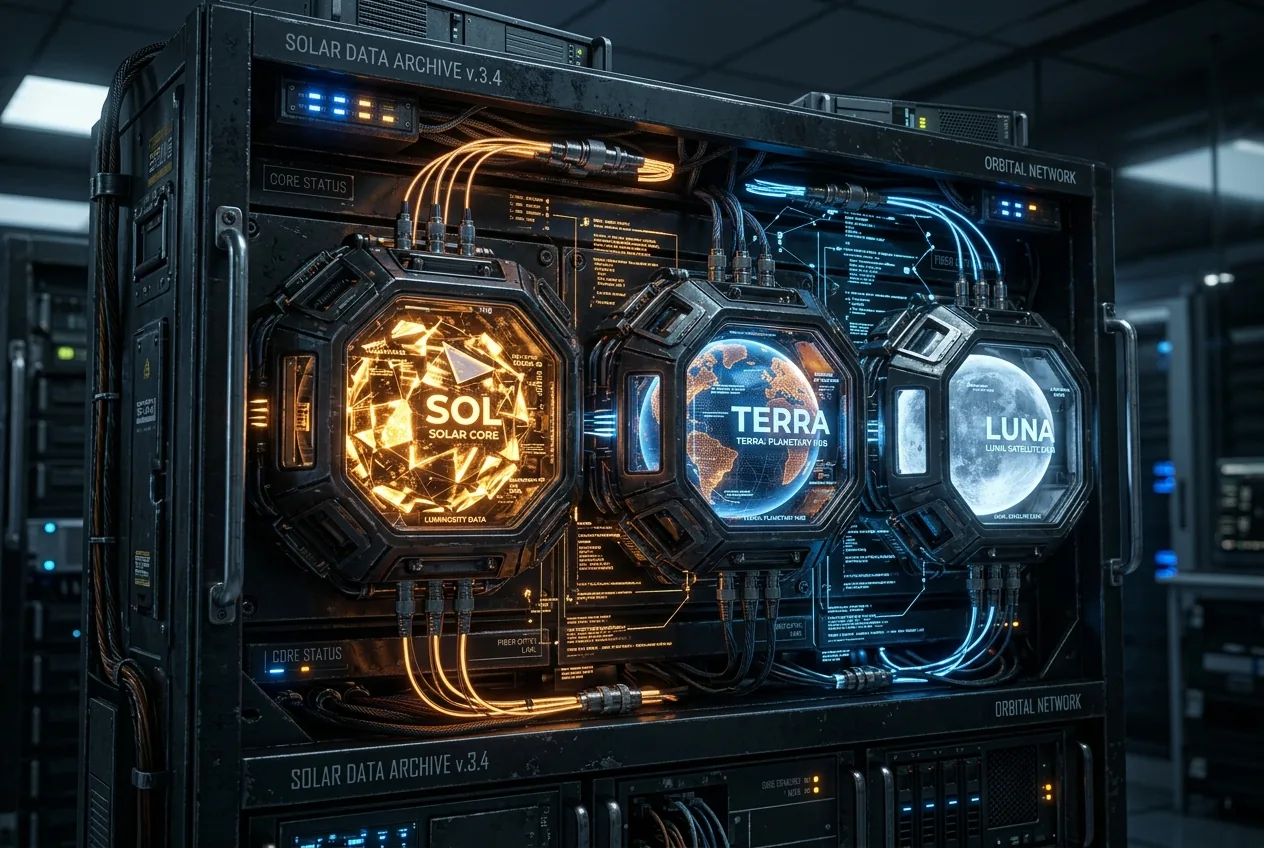
GPT-5.6 Sol, the new flagship, is engineered to address the fundamental bottleneck in AI-driven industry: the cost-to-performance ratio. While previous iterations focused on general-purpose reasoning, Sol is optimized for "frontier intelligence," specifically targeting coding, scientific modeling, and cybersecurity. The technical standout of this release is not just the model’s internal weights, but the orchestration layer that allows it to scale its reasoning dynamically based on the complexity of the task at hand. This is a modular approach to intelligence that treats compute as a flexible resource rather than a fixed cost.
The Three-Tiered Engine: Sol, Terra, and Luna
To understand the utility of GPT-5.6, one must look at the specific roles assigned to its three distinct variants. Sol represents the peak of current reasoning capabilities, designed for tasks that OpenAI describes as "your hardest work." In technical terms, this means Sol is the model of choice for long-horizon engineering in real codebases and complex command-line workflows. It isn't just generating text; it is navigating environments. Terra, the mid-tier model, is positioned as a balanced worker for everyday enterprise tasks, providing a middle ground between the high-compute requirements of Sol and the lean operational profile of the entry-level variant.
Luna, the third and most cost-efficient model in the lineup, is perhaps the most significant for mass-scale industrial deployment. In high-frequency environments—such as real-time supply chain monitoring or automated quality control—the cost of running a flagship model like Sol is often prohibitive. Luna is designed to outperform previous generation flagships, like GPT-4.8 or Claude Opus, while operating at roughly one-sixteenth of the cost. This economic viability is the "how" behind the next wave of automation; it allows for the embedding of high-level intelligence into edge devices and routine software processes that previously relied on rigid, heuristic-based programming.
One of the most technically compelling features of GPT-5.6 is the introduction of the "ultra" reasoning setting. Moving beyond the linear processing of standard LLMs, the ultra setting utilizes a multi-agent orchestration framework. By default, this setting coordinates four independent agents in parallel workstreams to complete a single complex task. This is a departure from the "Chain of Thought" reasoning we have seen in the past, moving instead toward a "System of Thought" architecture where sub-tasks are delegated, verified, and synthesized in real-time.
In benchmarks like BrowseComp and SEC-Bench Pro, OpenAI demonstrated that adding parallel agents shifts the performance frontier upward and to the left—achieving stronger results in less time. For a mechanical engineer looking at system throughput, this is analogous to moving from a single-core processor to a multi-threaded environment. Instead of a single model struggling to keep the entire context of a 50-page technical manual in its active memory while troubleshooting a mechanical failure, the ultra setting allows one agent to parse the manual, another to simulate the failure, a third to cross-reference spare parts inventories, and a fourth to synthesize the final repair protocol.
Programmatic Tool Calling and Data Filtering
For developers and industrial integrators, the new Programmatic Tool Calling feature in the Responses API is the most pragmatic upgrade in the GPT-5.6 stack. Historically, a significant amount of compute was wasted on the "round trip" between the model and the external tools it was using. A model would request data from a database, the entire dataset would be piped back into the model's context window, and the model would then filter it. This was inefficient, expensive, and introduced significant latency.
GPT-5.6 can now write and execute lightweight programs that act as intermediaries. These programs coordinate tools, process intermediate results, and filter large datasets locally before passing only the essential information back to the core model. This "deterministic filtering" reduces the number of tokens required to complete a task and ensures that the model stays focused on high-level decision-making rather than data parsing. In a robotics context, this means an AI agent can monitor a sensor array and only report back to the central logic when a specific set of physical parameters are met, rather than constantly streaming raw data through the LLM.
Benchmarking the Agentic Frontier
In coding-specific benchmarks, the results are equally stark. On the Artificial Analysis Coding Agent Index, Sol scored an 80, outperforming Fable 5 while using less than half the output tokens. For the engineering sector, this efficiency translates directly to the viability of AI-led code reviews and autonomous software maintenance. If a model can perform 100 code reviews for the price of 30, and do so with higher accuracy and lower latency, the technical debt of large-scale industrial software becomes much more manageable.
Enterprise Integration and Health Intelligence
Furthermore, OpenAI is extending this specialized intelligence into the medical field with GPT-5.5 Instant, a model tailored for health intelligence. This physician-led evaluation process ensures that the model’s reasoning is grounded in medical accuracy rather than just linguistic probability. While my focus remains on the mechanical and industrial side of technology, the cross-pollination of these specialized models suggests that OpenAI is building a library of expert weights that can be hot-swapped depending on the industrial sector being served.
Is the multi-agent approach more reliable than a single, larger model?
The debate between scaling up (larger models) and scaling out (multi-agent systems) is at the heart of GPT-5.6’s design. While a larger model might possess a more expansive latent space of knowledge, it is often prone to "drifting" during long, complex tasks. Multi-agent systems, like those used in the Sol ultra setting, introduce a layer of redundancy and internal peer-review. If one agent produces a hallucination or an error, the coordinating agents act as a verification layer. This architecture mimics human industrial workflows, where a project manager oversees specialists to ensure that the final output meets the required specifications. From a reliability standpoint, the multi-agent approach is far superior for high-stakes industrial applications where a single error can have cascading physical consequences.
OpenAI has also emphasized its most robust safeguards to date, utilizing a combination of human red teaming and large-scale automated testing during a rigorous preview period. For the GPT-5.6 family, security is treated as an engineering challenge. The system layers protections directly into the model’s weights while maintaining real-time checks that monitor for adaptive misuse. This balance of safety and utility is essential for models that are now being given the agency to take actions across apps, files, and physical systems.
Ultimately, GPT-5.6 represents the transition of AI from a generative tool to an agentic partner. For the engineers and developers who build the infrastructure of our world, the arrival of Sol, Terra, and Luna provides a scalable toolkit for embedding intelligence into every facet of industry. The focus is no longer just on what the model knows, but on how effectively it can act on that knowledge within the constraints of time and budget. This is the new baseline for frontier intelligence—a baseline defined by tenacity, efficiency, and the ability to scale with the ambition of the user.




Comments
No comments yet. Be the first!