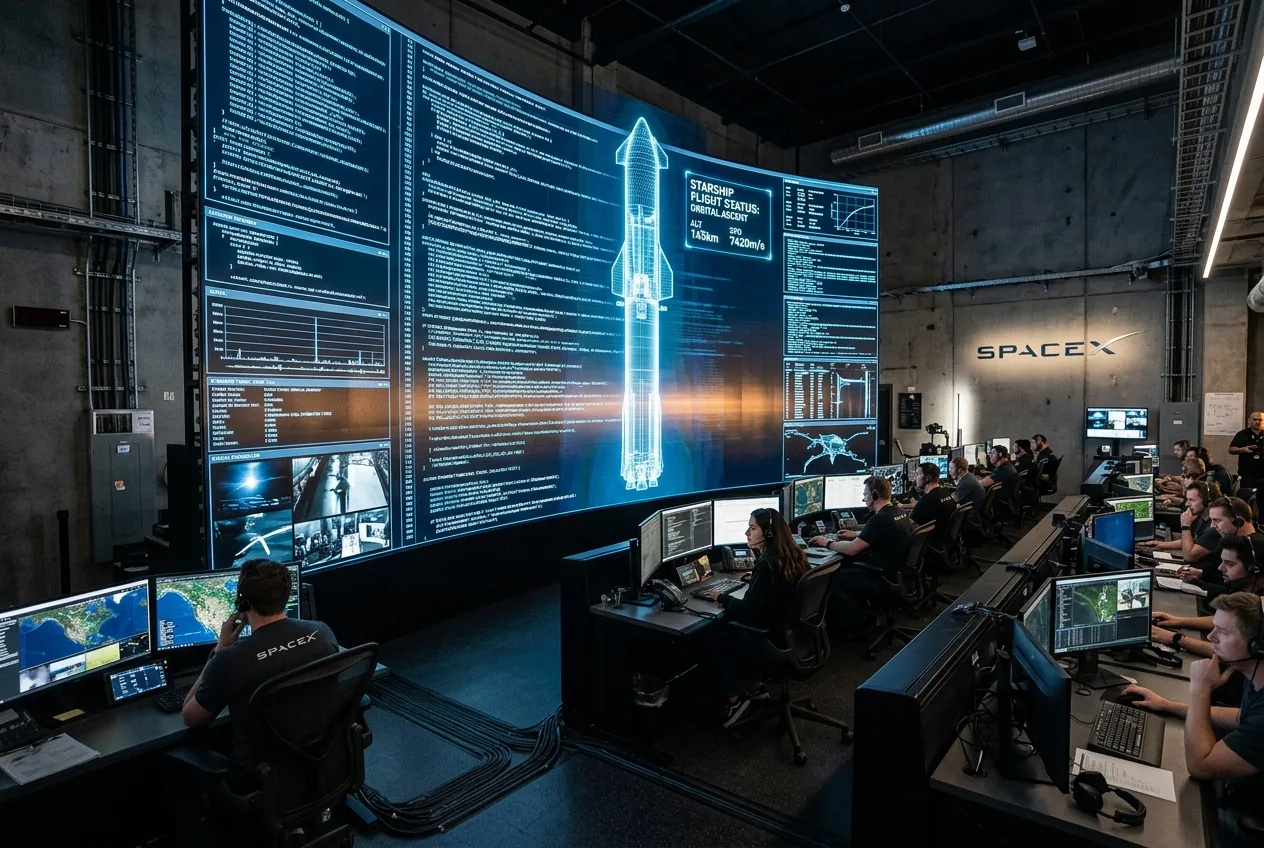
In a move that solidifies its transition from a pure aerospace manufacturer to a vertically integrated technology conglomerate, SpaceX has announced the acquisition of Anysphere, the startup behind the widely adopted AI code editor Cursor. The transaction, valued at approximately $60 billion, is an all-stock deal that utilizes SpaceX’s surging post-IPO market capitalization to absorb one of the most significant players in the generative AI space. The announcement, made on June 16, 2026, follows SpaceX’s record-breaking debut on the Nasdaq, where the company’s valuation recently eclipsed $2.5 trillion.
For those tracking the intersection of industrial automation and software infrastructure, this acquisition is not merely a diversification play. It represents a fundamental shift in how complex engineering firms view the production of code. By bringing Cursor’s proprietary AI-assisted development tools under the same roof as its Starship and Starlink programs—and its recently integrated xAI division—Elon Musk is positioning SpaceX to lead the "industrialization" of software development. The goal is clear: to accelerate the iteration cycles of hardware through the automated refinement of the software that controls it.
The mechanics of a $60 billion all-stock trade
From a purely financial perspective, the deal is a masterclass in leveraging equity as a primary currency. Because SpaceX’s shares have rallied more than 56% since its initial public offering, the $60 billion price tag represents only a 3.4% dilution of its Class A common stock. For SpaceX, this is an efficient exchange. They are trading a small percentage of equity for a company that has demonstrated explosive revenue growth, crossing $1 billion in annualized revenue in late 2025 and reaching $2.6 billion by mid-2026.
The acquisition terms also include a significant safety net for the startup. If the deal fails to close due to regulatory hurdles, SpaceX has agreed to a termination fee of $1.5 billion in cash and $8.5 billion in raw computing resources. This "compute-as-collateral" clause underscores the true value of the AI era: the hardware required to train and run models is often as valuable as the liquid capital itself. With SpaceX’s massive investments in data centers to support the Grok LLM and its global Starlink constellation, the company is one of the few entities capable of offering such a guarantee.
Why a rocket company needs a code editor
To understand why a company focused on Mars exploration would spend $60 billion on a code editor, one must look at the technical bottleneck of modern engineering. Every hardware iteration at SpaceX—whether it is a gimbal adjustment on a Raptor engine or a routing update for a Starlink satellite—requires thousands of lines of mission-critical code. Traditionally, this code is written and verified by human engineers, a process that is both slow and prone to error. Cursor’s technology, which uses large language models to predict, generate, and debug code in real-time, offers a path to automating the software stack at the same speed at which SpaceX builds physical prototypes.
Cursor is built on the premise that the barrier between a developer’s intent and the resulting machine code should be as thin as possible. Within the engineering community, this has been colloquially dubbed "vibe coding"—the ability to describe a functional requirement in natural language and have the AI handle the syntactic heavy lifting. While the term sounds informal, the underlying utility for a firm like SpaceX is rigorous. By integrating Cursor’s "Composer" feature directly into its internal development environments, SpaceX can theoretically enable its mechanical and aerospace engineers to write and deploy control software without the typical lag associated with traditional software engineering departments.
Integrating Grok and the xAI ecosystem
The synergy between Cursor and SpaceX’s existing AI assets is a critical component of this deal. Earlier in 2026, SpaceX merged with xAI, the developer of the Grok large language model. Reports indicate that SpaceX and Cursor have already spent several months jointly training a new coding-specific model known as "Grok Build." This agent is designed to live within the Cursor IDE, providing developers with context-aware suggestions that are informed by SpaceX’s vast internal library of aerospace telemetry and engineering data.
Furthermore, Cursor provides SpaceX with a massive data advantage. As an AI-native editor, Cursor has access to granular data on how developers interact with code, including the design decisions and debugging paths taken by thousands of users. When integrated with xAI’s compute clusters, this data can be used to fine-tune future models, creating a feedback loop where the AI becomes increasingly adept at solving the specific types of technical debt and architectural challenges found in large-scale industrial projects.
Competition and market share dynamics
The acquisition comes at a time of significant flux in the AI coding market. While Cursor was an early leader, it has faced intense pressure from established giants and nimble rivals alike. Data from Ramp recently showed that while Cursor held a 41% market share in mid-2025, that figure had slipped to approximately 26% by May 2026, with Anthropic’s coding tools capturing nearly half of the category. Microsoft’s GitHub Copilot remains a formidable incumbent, leveraging its deep integration with the VS Code ecosystem.
Strategic implications for the broader industry
What does it mean when the world’s leading aerospace company becomes a dominant force in software development tools? It suggests that the boundary between "software companies" and "industrial companies" is dissolving. In the 20th century, a car manufacturer might own its own steel mills to ensure supply chain stability. In the 21st century, SpaceX is owning its own AI development pipeline to ensure its software supply chain remains unhindered by third-party limitations or high licensing costs.
The deal is expected to close in the third quarter of 2026, pending regulatory approvals. While antitrust regulators have recently scrutinized large tech acquisitions, the unique nature of this deal—a space company buying a software tool—may provide a smoother path than a traditional horizontal merger. For the engineers at the Cape or at Starbase, the arrival of Cursor signifies a new era where the code that guides a rocket is as much a product of machine intelligence as the rocket itself is a product of advanced robotics.
Ultimately, the $60 billion valuation of Cursor is a bet on the future of labor. If SpaceX can successfully utilize AI to do for software what it has done for rocket reusability—lowering the cost and increasing the frequency of success—the price of this acquisition will seem like a bargain. As we move closer to the goal of multi-planetary life, the efficiency of our digital tools will be just as important as the thrust of our engines.




Comments
No comments yet. Be the first!