When Nvidia Chief Executive Jensen Huang steps up to a podium or appears in industry dispatches, the global technology sector adjusts its balance sheet. When aggregated news alerts and financial feeds light up with claims that artificial general intelligence has finally arrived—hailing bleeding-edge multimodal leaps and speculative frontier models—the line between disciplined mechanical engineering and speculative market euphoria blurs. For those building physical infrastructure, these proclamations demand a rigorous audit rather than blind celebration.
The discourse surrounding next-generation foundation models, often amplified across speculative financial channels and crypto-trading tickers, routinely heralds human-level synthetic cognition. Declarations that AGI is already in our midst, catalyzed by hyper-scaled multimodal systems like Google’s Project Astra or prospective frontier releases from OpenAI, generate massive liquidity and capture executive imagination. Yet beneath the breathless headlines lies a fundamental disconnect between benchmark-driven software intelligence and the deterministic constraints of physical computing, power distribution, and mechanical actuation.
The Rhetoric of Arrival and the Architecture of Compute
Jensen Huang has never been shy about predicting that AGI will arrive within a five-year horizon. However, the operational utility of that statement depends entirely on how an engineer defines the term. In corporate keynotes, the threshold for general intelligence is frequently pegged to computational metrics: the ability of a neural network to pass professional legal examinations, achieve competitive software programming ratings, or synthesize medical diagnoses across disparate modalities in sub-second inference intervals.
From the vantage point of a semiconductor manufacturer, declaring AGI's arrival is both an engineering milestone and an economic imperative. The modern frontier training cluster is an industrial wonder, consuming tens of megawatts and demanding thousands of interconnected tensor-processing dies linked via high-bandwidth optical interconnects. By framing every iterative jump in model parameterization as a transition into artificial general intelligence, compute vendors validate the staggering capital expenditures being sunk into silicon supply chains worldwide.
Token Prediction Versus Deterministic Mechanical Control
The core dilemma facing frontier multimodal architectures—whether labeled under speculative monikers like GPT-6 or demonstrated through real-time camera-feed agents—is the persistent gulf between token generation and physical grounding. A model can analyze a high-resolution video feed, recognize an obstructed conveyor belt, and generate an articulate explanation of the mechanical failure in human prose. Yet translating that comprehension into the millisecond-latency, high-torque control loops required by a six-axis industrial manipulator remains an entirely separate discipline.
Bridging this divide requires deep integration with physics engines and real-time deterministic operating systems. Foundation models trained on static visual corpora lack the intuitive understanding of material strain, friction coefficients, and mechanical wear that a mechanical engineer acquires through direct physical empirical testing. While multimodal agents demonstrate astonishing spatial comprehension on static screens, they operate without the kinesthetic feedback loops that define actual embodied work.
The Thermodynamics of the Modern Frontier Run
Behind every bold executive declaration lies an unprecedented logistics chain that spans planetary resource extraction, silicon wafer purification, and municipal-scale utility contracts. The computational infrastructure required to support continuous real-time multimodal inference is straining regional power architectures. Data center operators are no longer merely procuring racks; they are building dedicated high-voltage substations and negotiating directly with nuclear power utilities to maintain baseline operations.
The transition from FP16 down to FP8 and FP4 numerical precision has allowed chipmakers to extract staggering FLOP counts from each silicon die. Yet this arithmetic compression comes with distinct engineering trade-offs in model fidelity and training stability. When models attempt to synthesize complex physical interactions, quantization noise can accumulate, leading to subtle reasoning drifts that are difficult to isolate within a trillion-parameter neural fabric.
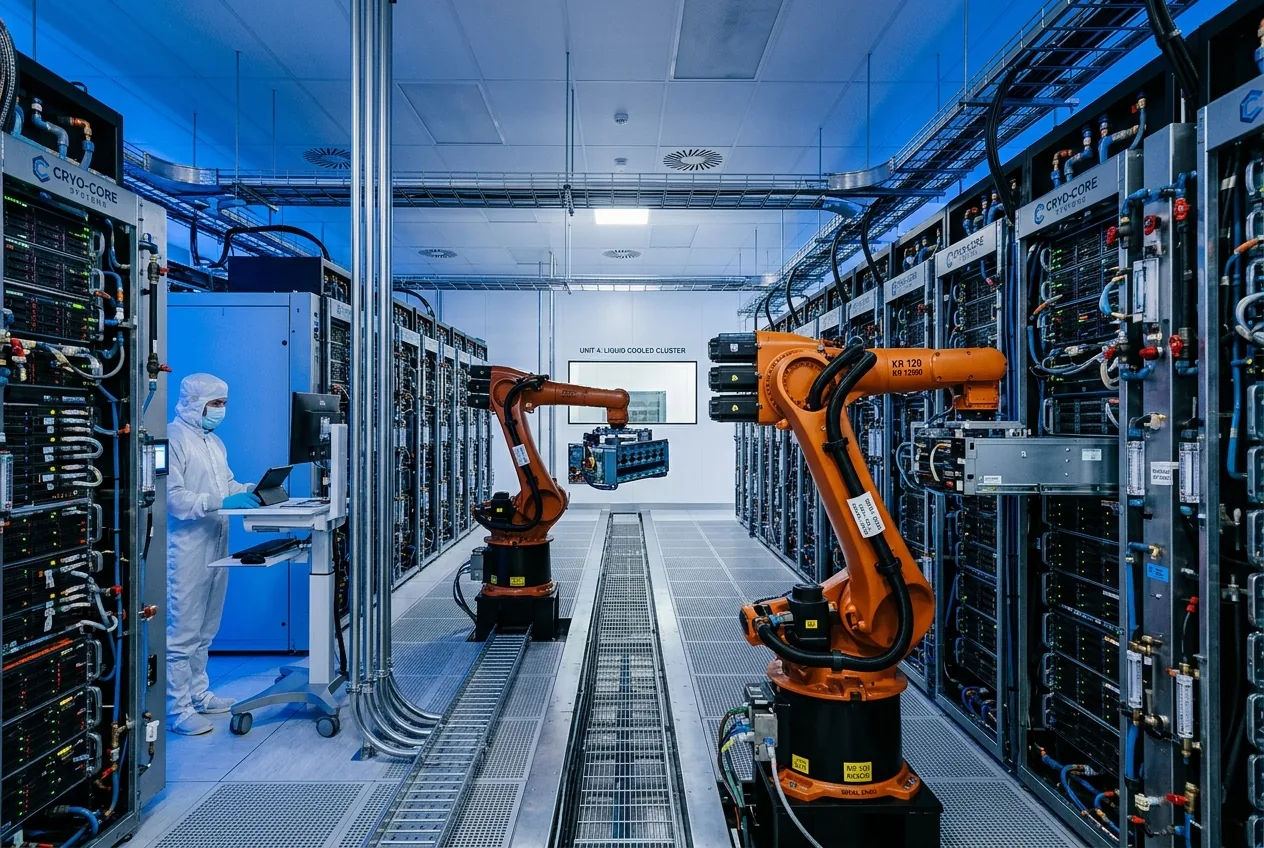
Furthermore, the physical logistics of cooling these clusters have eliminated traditional forced-air architectures from the frontier envelope. Liquid-to-chip direct cooling, closed-loop coolant distribution units, and dual-phase immersion tanks are now mandatory design parameters. To speak of AGI as an abstract software entity is to ignore the thousands of gallons of treated water, specialized copper cold plates, and manifold pressure regulators required to keep these synthetic networks from literally melting their own silicon substrates.
What Industrial Engineering Demands from General Intelligence
If artificial general intelligence is to have measurable economic viability outside of software interfaces and digital concierge services, it must be measured against industrial throughput, supply chain resilience, and physical assembly precision. An algorithm that cannot adapt to an unmodeled vibration in a CNC milling spindle or troubleshoot a jammed hydraulic valve in a distribution facility has not achieved operational generality.
Until multimodal foundation models can reliably generate verifiable, mathematically sound motion profiles that respect the torque limits of brushless DC motors and the thermal limits of planetary gearboxes, human intervention will remain the structural backbone of physical production. The true milestone of operational AGI will not be an executive declaration on an investor stage or an explosive headline on a financial trading feed; it will be the quiet, autonomous reconfiguration of an entire automated manufacturing plant operating without human supervision across a fiscal quarter.
The Divide Between Market Momentum and Factory Floors
Jensen Huang's celebration of frontier software breakthroughs highlights an undeniable truth: the pace of algorithm optimization and computational density is advancing faster than any technological curve in human history. The tools emerging from these research pipelines are transforming code synthesis, computational biology, and structural optimization in profound ways.
However, treating high-parameter multimodal transformers as the ultimate manifestation of AGI conflates communicative fluency with physical agency. As mechanical engineers, roboticists, and plant operators evaluate these tools, the metric of success must remain tethered to reality. True intelligence is not merely the ability to generate a plausible description of the world—it is the capacity to interact with, endure, and transform the physical constraints of reality without breaking the machine.




Comments
No comments yet. Be the first!