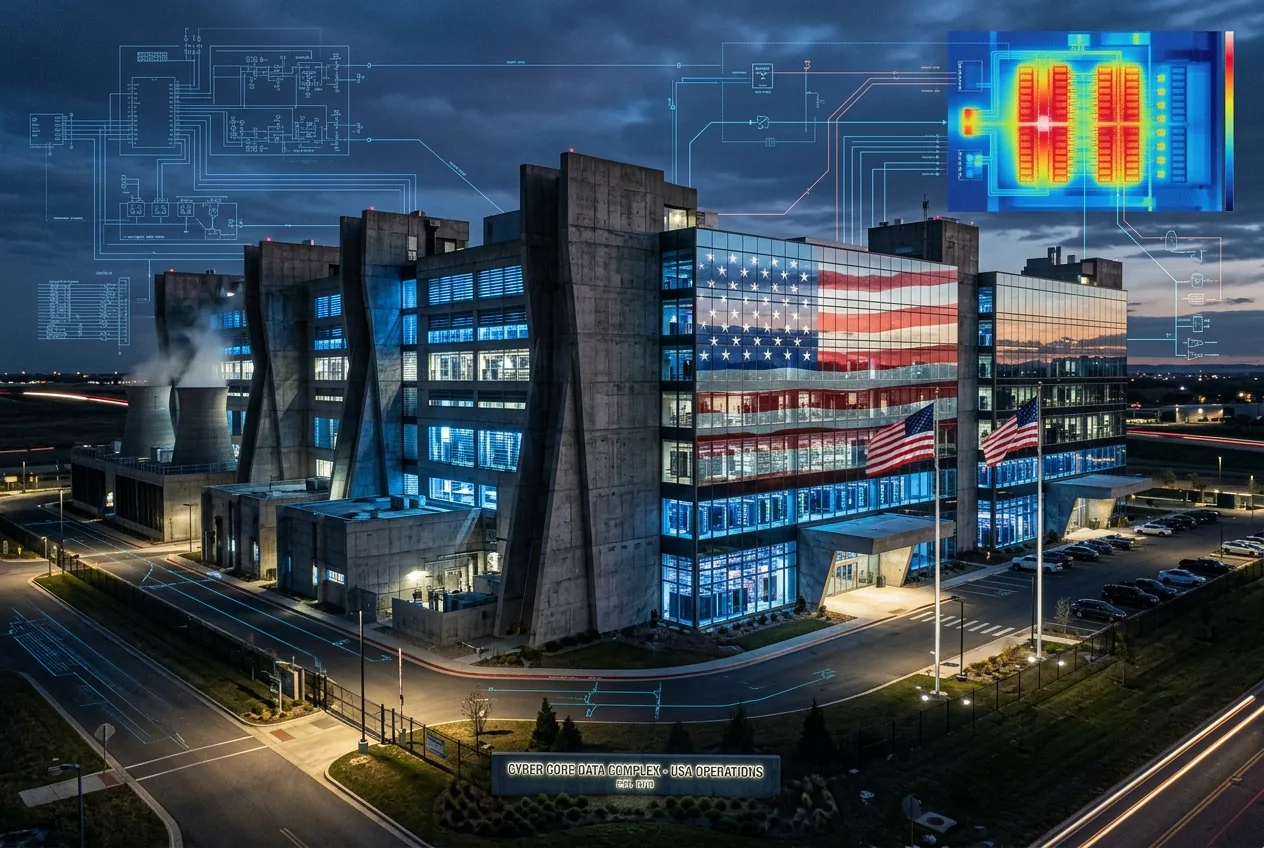
In a maneuver that blurs the lines between private enterprise and national infrastructure, OpenAI has reportedly proposed a deal to the incoming Trump administration that would grant the United States government a 5% stake in the company. At a valuation recently pegged near $840 billion, this stake represents a $42 billion hedge on the future of artificial intelligence. For the global technology sector, and specifically for a trailing Europe, this is not merely a corporate restructuring; it is the formalization of AI as an instrument of industrial statecraft. This is the moment where the 'soft power' of Silicon Valley converts into the 'hard power' of national strategic assets.
From a mechanical and systems engineering perspective, the logic behind such a proposal is as transparent as it is ambitious. OpenAI is no longer just a software company; it is an infrastructure project of unprecedented scale. To maintain its lead in the generative AI race, the firm requires an astronomical amount of capital, land, and, most crucially, energy. By offering the U.S. government a direct equity interest, OpenAI isn't just seeking regulatory favor—it is seeking to integrate itself into the very fabric of American national security and domestic industrial policy. This alignment allows OpenAI to bypass traditional bureaucratic hurdles that have historically slowed the rollout of large-scale hardware projects, such as the rumored 'Stargate' supercomputer cluster.
The Calculus of a $42 Billion Sovereign Stake
To understand the 'why' behind this offer, one must look at the capital expenditure (CAPEX) requirements for the next generation of large language models (LLMs). We are moving out of the era of multi-billion dollar clusters and into the era of trillion-dollar compute. Reports suggest that OpenAI and Microsoft are envisioning data centers that require upwards of 5 to 10 gigawatts of power. To put that in perspective, a single gigawatt can power roughly 750,000 homes. Building such a facility requires not just money, but sovereign-level intervention to secure power grids, water rights for cooling, and expedited environmental clearances.
Industrial Statecraft and the Death of Neutrality
For decades, Silicon Valley operated under the ethos of 'globalism,' where code was borderless and platforms were neutral. That era is definitively over. The OpenAI proposal marks the transition to a 'national champion' model, similar to the aerospace and defense sectors. In this paradigm, the primary goal of the company is to ensure that its sovereign patron maintains a technological edge over geopolitical rivals. This has profound implications for the technical specifications of the models themselves. If a government owns 5% of the entity producing the world’s most advanced reasoning engines, the guardrails, safety protocols, and even the training data of those engines will inevitably reflect the strategic priorities of that state.
This shift places European regulators and businesses in an extremely precarious position. While the European Union has focused on the AI Act and regulatory frameworks designed to protect consumer rights and privacy, the United States is pivoting toward a strategy of pure industrial acceleration. If OpenAI becomes a quasi-state entity, the 'Brussels Effect'—where EU regulations set the global standard—will lose its teeth. You cannot easily regulate a foreign strategic asset that is backed by the full weight of the U.S. Treasury and the Department of Energy.
Europe's Sovereignty Crisis and the E3 Levy
The European response to this American consolidation has been fragmented and largely defensive. One recent attempt to reclaim digital value is the proposed 'E3 levy'—a €3 import charge on non-European parcels slated for 2026. While ostensibly about consumer goods and logistics, the underlying anxiety is the same: Europe is becoming a consumer market for foreign technology rather than a producer. The digital advertising market, which funds much of the internet's current AI research, is already dominated by U.S. platforms, leaving European media and tech firms to fight for the crumbs of the value chain.
The tragedy for Europe is that it lacks a single entity with the technical or financial 'gravity' of an OpenAI. While firms like Mistral AI in France represent a significant technical achievement, they lack the integrated hardware-software-energy ecosystem that the U.S. is currently building. Without a sovereign-level investment in compute infrastructure—equivalent to the scale of the Large Hadron Collider or the Galileo satellite system—Europe will find itself paying a 'tech tax' to a U.S.-government-backed OpenAI for the fundamental tools of 21st-century industry.
Will AI Become Too Strategic to Fail?
Integrating a 5% stake into the Trump administration’s portfolio would effectively make OpenAI 'Too Strategic to Fail.' This has historical precedents in the automotive and banking sectors, where the technical and economic collapse of a key player was deemed a national security risk. However, applying this to AI introduces a new variable: the speed of obsolescence. In mechanical engineering, a bridge or a turbine has a lifecycle of decades. In AI, a state-of-the-art model can be rendered obsolete in eighteen months.
How does a government manage an equity stake in a field with such high volatility? The answer likely lies in the infrastructure. Even if OpenAI’s current GPT architecture is eventually surpassed, the massive data centers, the proprietary cooling systems, and the custom silicon (such as the rumored collaboration with Broadcom and TSMC) remain valuable physical assets. The U.S. government isn't just buying into an algorithm; it is buying into the most advanced industrial platform ever constructed. This platform is the foundation upon which future robotics, pharmaceutical research, and materials science will be built.
The Engineering Challenges of the Stargate Era
If we look at the 'how' of this transition, the engineering requirements are the true bottleneck. The proposed $100 billion 'Stargate' project is a massive exercise in thermal management and electrical distribution. To build a cluster of that size, you cannot simply plug it into the existing grid. You need a dedicated energy strategy. This is where the political stake becomes a technical necessity. Federal lands, expedited permitting for high-voltage transmission lines, and the potential for on-site nuclear generation are all on the table when the state is a shareholder.
Europe, meanwhile, is grappling with some of the highest energy costs in the developed world and a regulatory environment that is notoriously slow to approve new infrastructure. This creates a 'Compute Gap' that is widening by the day. If the U.S. government can help OpenAI solve the energy-density problem through political leverage, the technical lead of American AI will become insurmountable for any private European competitor operating under standard market conditions.
Why This Deal Changes the Global Market Logic
Until now, the 'AI Bubble' debate has centered on whether the revenue from LLMs will ever justify the massive CAPEX. But if AI is viewed as a national security asset, the traditional ROI (Return on Investment) calculations change. A government doesn't necessarily need its 5% stake to yield a quarterly dividend; it needs the company to ensure that the nation’s defense, economy, and intelligence agencies have access to the best tools before anyone else does. This 'Strategic ROI' allows OpenAI to continue spending at a rate that would be suicidal for a purely commercial entity.
As the U.S. prepares to potentially accept this role as a primary stakeholder in AI, the rest of the world must decide whether to build their own sovereign stacks or become permanent vassals to a foreign intelligence infrastructure. For those of us in the engineering and industrial automation sectors, the message is clear: the bridge between hardware and software is no longer just a technical challenge; it is the new frontline of global politics. The specs of the next supercomputer are being written in the halls of government, not just the labs of Silicon Valley.




Comments
No comments yet. Be the first!