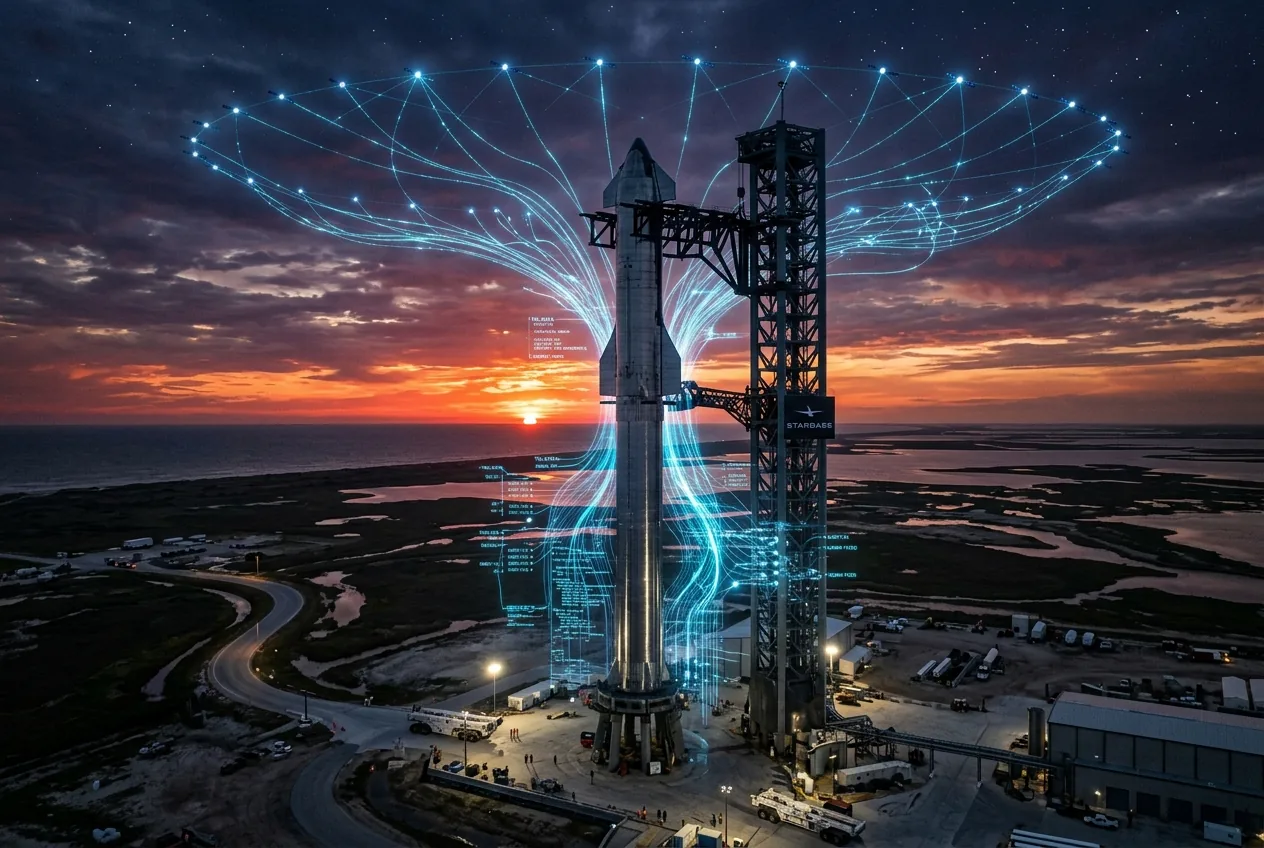
In a move that signals the beginning of a new era for both the aerospace and artificial intelligence industries, Elon Musk’s SpaceX has reportedly filed confidentially with the Securities and Exchange Commission (SEC) to go public. This anticipated initial public offering (IPO), slated for as early as this summer, is not merely a financial milestone; it represents a fundamental shift in how the world’s most dominant private space company intends to leverage its hardware to fuel the next generation of machine intelligence. With a target raise of $75 billion, the listing is poised to become the largest IPO in history, eclipsing the record-breaking debuts of Saudi Aramco and Alibaba.
The timing of the filing is particularly significant following the recent internal restructuring that saw SpaceX acquire xAI, Musk’s artificial intelligence startup. This merger has effectively created a vertically integrated powerhouse valued at approximately $1.25 trillion. By combining the heavy-lift capabilities of the Starship program and the global reach of the Starlink satellite constellation with the large language models (LLMs) and compute power of xAI, Musk is positioning the newly unified entity as a unique player in the race for Artificial General Intelligence (AGI). From a mechanical and industrial perspective, this is not just a company that builds rockets; it is a company building the physical and digital infrastructure for a planetary-scale compute network.
The Mechanics of a Confidential Filing
The decision to file confidentially is a strategic maneuver permitted under the Jumpstart Our Business Startups (JOBS) Act of 2012. Originally designed to assist smaller “emerging growth companies” with less than $1 billion in annual revenue, the SEC expanded these provisions in 2017 to allow all companies, regardless of size, to submit draft registration statements for non-public review. For SpaceX, this provides a critical window to resolve regulatory queries and refine financial disclosures without exposing sensitive technical or competitive data to rivals like Blue Origin or traditional aerospace giants.
Under these rules, SpaceX can keep its financial health, launch margins, and internal valuations under wraps until just 15 days before the “road show”—the period when executives pitch the stock to institutional investors. This opacity is vital for a company that operates at the cutting edge of reusable rocket technology, where proprietary manufacturing processes and cost-saving measures are the primary moats against competition. However, when the public filing eventually drops, it will offer the first comprehensive look at the profitability of Starlink and the capital expenditure requirements of the Starbase facility in Boca Chica, Texas.
How Does the xAI Merger Change the Valuation?
The integration also suggests a shift in the mission of the Starship rocket. Musk recently noted that the immediate focus for the massive launch vehicle is the deployment of “AI satellites.” These units are likely high-performance data centers designed to operate in a vacuum, utilizing the cold of space for thermal management and solar arrays for constant power. By removing the latency of ground-to-satellite-to-ground communication, SpaceX aims to create a closed-loop AI environment that is physically independent of traditional internet service providers.
Starship and the Industrial Scale of Launch
For those focused on the mechanical reality of the company, the IPO provides the necessary capital to move Starship from the prototype phase to a high-cadence operational state. The sheer scale of Starship—standing nearly 400 feet tall with a lift capacity of over 100 tons to low Earth orbit—is the industrial engine that makes the $1.75 trillion valuation plausible. To sustain a global AI network, the company needs to launch thousands of next-generation satellites annually, a feat that is only economically viable with the total reusability promised by Starship.
The manufacturing process at Starbase has been optimized for rapid iteration, utilizing stainless steel alloys and automated welding techniques that more closely resemble automotive assembly lines than traditional clean-room aerospace manufacturing. This shift from “boutique” engineering to mass-scale industrial production is what allows SpaceX to dominate the commercial launch market. In 2023, SpaceX was responsible for the vast majority of all mass sent into orbit globally. The IPO proceeds will likely be funneled into expanding this manufacturing capacity, potentially building a fleet of Starships that can launch weekly, if not daily.
The Economic Impact of the World’s First Trillionaire
The financial implications of the IPO extend beyond the company itself to the personal net worth of Elon Musk. Currently owning approximately 42% of SpaceX, Musk’s net worth—already estimated at $823 billion—is expected to surpass the $1 trillion mark shortly after the public listing. This would make him the first person in history to achieve trillionaire status, a milestone that underscores the massive concentration of capital within the private space and AI sectors.
Furthermore, a successful SpaceX IPO would make Musk the first individual to lead two companies with trillion-dollar valuations simultaneously, the other being Tesla. There is already significant speculation regarding whether Tesla will eventually join this mega-company structure. Tesla’s focus on autonomous robotics and FSD (Full Self-Driving) technology shares a technical lineage with the autonomous navigation systems used in SpaceX’s Falcon 9 boosters and Starlink satellites. A future consolidation of Tesla, SpaceX, and xAI could result in a conglomerate with unprecedented control over the physical and digital infrastructure of modern society.
Is the Competition Left Behind?
The move to go public now may be a pre-emptive strike against other AI leaders. While companies like OpenAI and Anthropic are reportedly considering public listings, they lack the physical infrastructure that SpaceX possesses. Anthropic has recently strengthened its board by appointing Chris Liddell, the former GM CFO who oversaw a $23 billion IPO in 2010, signaling its own public market ambitions. OpenAI is also working with firms like ARK Invest to bridge the gap between private and public equity.
As the summer deadline approaches, the global financial community will be watching for the mandatory public filing. This document will finally reveal the raw data behind the SpaceX phenomenon: the actual cost of a Starlink terminal, the profit margins of the Falcon 9, and the true burn rate of the Starship program. For a company that has defined itself by its ability to achieve the “impossible,” the transition to a public entity will be the ultimate test of its industrial and economic viability.




Comments
No comments yet. Be the first!