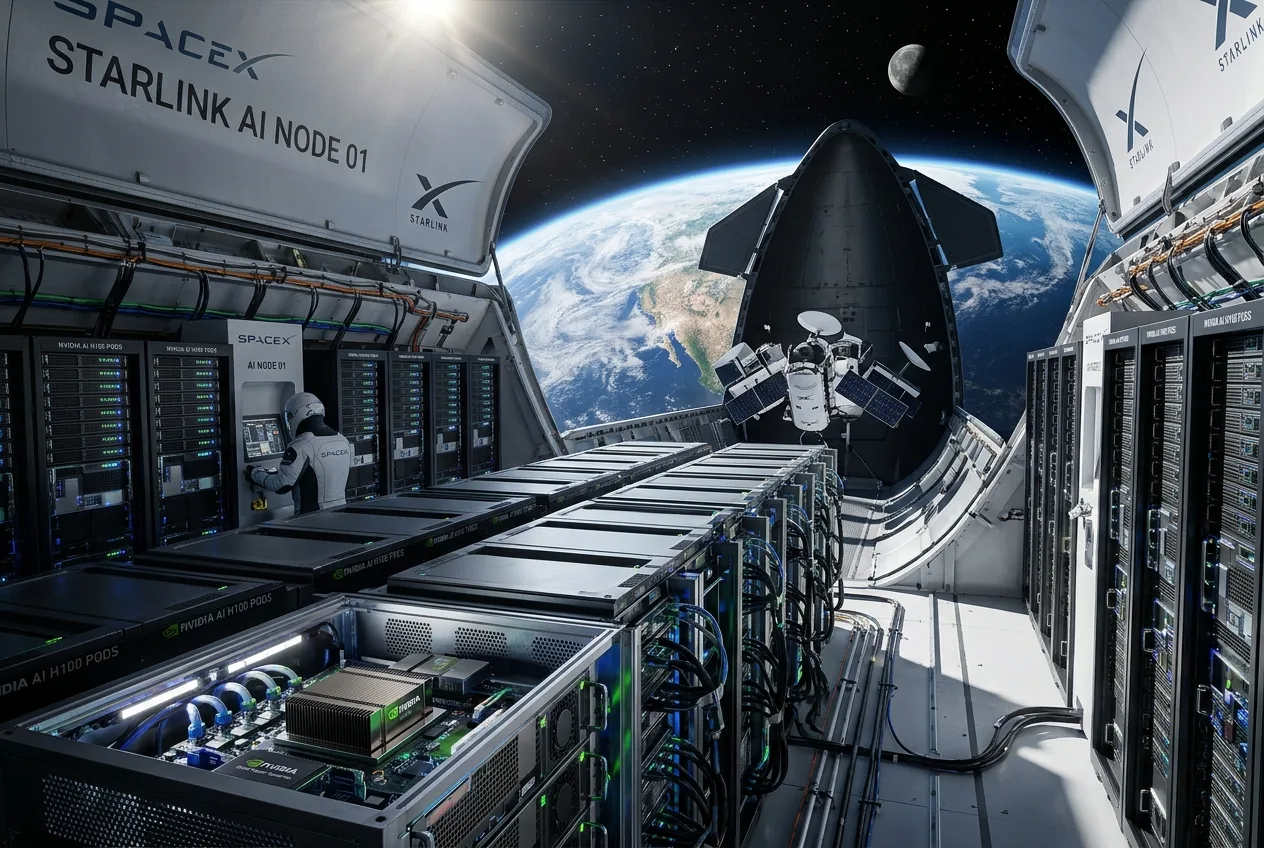
The physical constraints of terrestrial computing—power grid saturation, water availability for cooling, and local land availability—are driving high-performance computing into increasingly unconventional environments. In a bid that bridges deep compute with orbital mechanics, SpaceX has entered an architectural partnership with NVIDIA to deploy Vera Rubin-class silicon across a proposed megaconstellation dubbed Starmind. The filing, seeking approval from the Federal Communications Commission for up to one million low-Earth orbit satellites, outlines an unprecedented vision: shifting distributed artificial intelligence processing from terrestrial hyperscale facilities directly into the vacuum of space.
For systems engineers and hardware architects, the announcement marks a radical departure from conventional aerospace computing. Traditionally, space-rated computing relies on hardened, legacy silicon fabricated on older, radiation-tolerant nodes capable of surviving single-event upsets at the cost of processing speed. The Starmind deployment, however, commits to NVIDIA’s upcoming Vera Rubin architecture packaged within the chipmaker’s Space-1 platform. Attempting to run bleeding-edge, high-wattage accelerator clusters in orbit introduces severe mechanical, thermodynamic, and logistical hurdles that will test the limits of modern industrial engineering.
The Thermal Dilemma of Radiative Cooling in Vacuum
Terrestrial data centers dissipate heat primarily through convection and phase-change systems, circulating chilled liquid or ambient air across finned copper heat sinks before exhausting thermal energy into the atmosphere. In low-Earth orbit, convection does not exist. Space is an insulating vacuum, meaning that any thermal energy generated by silicon operating at hundreds of watts per chip must be conducted to surface radiators and shed purely through radiative heat transfer.
Radiative dissipation follows the Stefan-Boltzmann law, scaling with the fourth power of the absolute temperature. Because silicon must remain below its maximum junction threshold—typically between 85 and 105 degrees Celsius to prevent thermal runaway and electromigration—the delta between the radiator surface and deep space is constrained. To reject the tens of kilowatts required by a high-density compute shelf like an orbital variant of NVIDIA's NVL72 architecture, each Starmind bus must deploy massive deployable heat pipes, loop heat pipes (LHPs), and expansive radiating panels shielded from direct solar illumination. The mechanical complexity of these thermal management systems introduces numerous points of mechanical failure, from deployment actuators to fluid joint fatigue.
Silicon Architecture and the Space-1 Module
NVIDIA’s Space-1 platform integrates Vera CPUs and Rubin GPUs over advanced packaging engineered to mitigate the specific hazards of the space environment. While terrestrial variants prioritize raw FLOP density and ultra-wide memory buses, an orbital compute unit must survive cosmic rays, solar energetic particles, and trapped radiation in the Van Allen belts without catastrophic latch-up.
Rather than relying solely on physical shielding, which adds prohibitive launch mass, modern space-edge compute employs a hybrid approach. This combines localized tantalum or tungsten shielding around core logic dies with architectural radiation mitigation, such as triple-modular redundancy at the register level, error-correcting code across high-bandwidth memory stacks, and aggressive real-time telemetry monitoring. NVIDIA claims the Space-1 Rubin platform yields up to 25 times the compute performance of prior-generation Hopper architectures per unit of payload, a metric essential for staying within the structural mass envelopes of small-to-medium satellite chassis.
The strategic intent behind Starmind is not solely general-purpose cloud inference for terrestrial consumers, but orbital edge reduction. In-orbit data generation—from synthetic aperture radar, hyperspectral imaging, and multi-sensor defense arrays—currently produces vastly more raw telemetry than existing RF and optical downlinks can route back to ground stations. By processing, tokenizing, and synthesizing raw data in orbit using on-board language and vision models, Starmind satellites can compress raw observational feeds by orders of magnitude before downlinking high-value actionable intelligence.
Laser Meshes and the Physics of Distributed Compute
Connecting a distributed network of up to one million satellites requires a communication fabric capable of matching the internal latency of a localized data center. SpaceX intends to link the Starmind constellation via high-throughput optical inter-satellite links. While free-space optical communications offer multi-gigabit throughput and operate at the speed of light—roughly 30 percent faster through a vacuum than through terrestrial glass fiber-optic cables—they introduce complex pointing, acquisition, and tracking challenges.
A distributed AI cluster relies heavily on low-latency, all-to-all communication primitives during both model training and agentic workflow orchestration. Synchronizing memory states across satellites traveling at 7.5 kilometers per second requires beam-steering mirrors capable of sub-micro-radian precision amidst internal momentum wheel vibrations. If a link drops mid-tensor reduction, the distributed compute graph fractures. Consequently, the network topology of Starmind must favor loosely coupled, asynchronous agentic workloads or federated processing models rather than monolithic, synchronously trained large language models.
Orbital Congestion and the Economics of Starship Scale
Even if the thermal and architectural hurdles are overcome, the industrial scale of launching hundreds of thousands—let alone one million—computing satellites introduces unprecedented logistical strain. The proposed deployment orbits, situated between 500 and 2,000 kilometers, are already densely populated zones. Adding an order of magnitude more active platforms to low-Earth orbit significantly raises the probability of orbital conjunctions and compounds the operational overhead of automated collision avoidance.
At the operational level, Starmind relies completely on the cadence and payload capacity of SpaceX’s Starship launch vehicle. Falcon 9, while reliable, lacks the fairing volume and mass-to-orbit economics required to deploy orbital data centers at scale. Each satellite requires significant power capture surfaces: high-efficiency solar arrays spanning dozens of square meters to provide continuous power during daylight operations, coupled with high-density battery storage for eclipse phases. Only a super-heavy lift system operating at high frequency can make the mass-to-orbit cost equation viable.
The financial scale is equally formidable. SpaceX’s rapid acceleration of capital expenditure—having crossed the $15 billion threshold in recent cycles with reports indicating a desire for tens of billions in dedicated silicon procurement—signals a massive gamble on the future of infrastructure. Terrestrial data center development is currently choked by 5- to 7-year timelines for utility-scale electrical grid interconnects. If the buildout time for terrestrial power generation exceeds the cost and cadence curve of launch, orbital computing ceases to be an eccentric concept and instead becomes an economically viable bypass for global power grid stagnation.
The Long-Term Trajectory of In-Orbit Automation
The convergence of NVIDIA’s silicon roadmap and SpaceX’s heavy-lift cadence indicates that orbital infrastructure is transitioning from static communications relay points to dynamic, reconfigurable robotic nodes. A satellite equipped with high-performance compute is no longer a fixed-function appliance; it is an autonomous robotic agent capable of re-tasking sensors, recalculating orbital trajectories to optimize solar exposure, and executing onboard inference without human intervention.



Comments
No comments yet. Be the first!