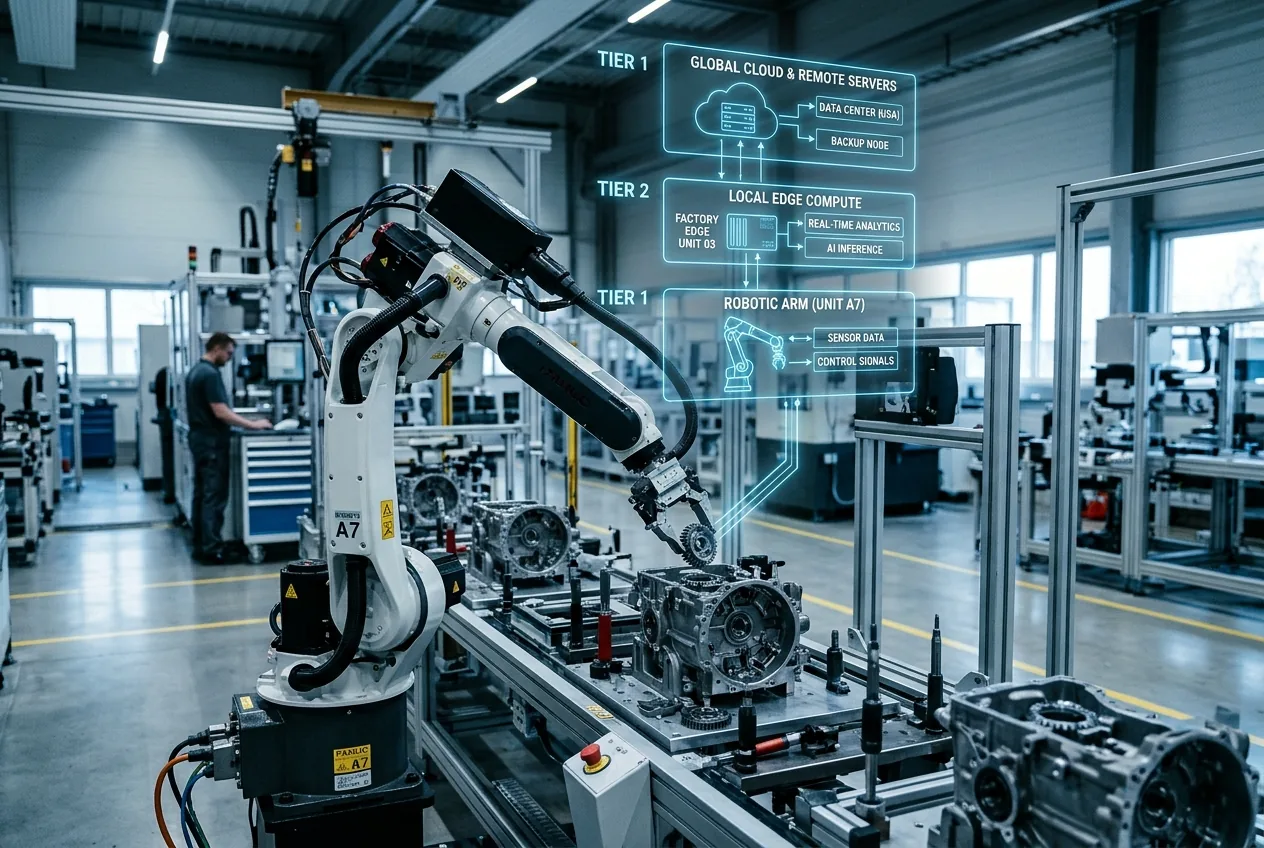
The release of the GPT-5.6 model generation marks a formal structural pivot away from the homogenous monolith toward an explicit three-tiered hierarchy: Sol, Terra, and Luna. Rather than treating parameter scale as a universal solution, the new release partitions intelligence across distinct computational envelopes. Sol occupies the high-compute frontier of deep causal reasoning and physics simulation; Terra serves as an intermediate, high-throughput enterprise engine; and Luna delivers low-latency, quantized execution directly to the edge. For engineers working at the intersection of machine learning and physical machinery, this structural shift addresses the long-standing bottlenecks of bandwidth, deterministic execution, and inference economics.
Deconstructing the Triad: Architecture Across Compute Tiers
To understand why this architecture matters to hardware systems, one must look at how parameter allocation and attention mechanisms have been bifurcated across the family. Sol functions as the heavy reasoning anchor. Built on an advanced sparse Mixture of Experts (MoE) backbone running on clustered enterprise infrastructure, Sol prioritizes planning depth, long-horizon tool orchestration, and synthetic physics modeling. It is designed to ingest multimodal teleoperation streams, structural CAD files, and multi-sensor telemetry, synthesizing operational workflows that would previously require weeks of human systems integration.
Terra represents the pragmatic center of gravity for industrial workflows. Operating with a compressed active parameter count and specialized linear-attention hybrid layers, Terra is optimized for high-volume deterministic processing. It is engineered to oversee factory-floor logic, ingest streaming telemetry from programmable logic controllers (PLCs), and maintain state management across shifts without suffering the memory degradation typical of unbounded context windows. Its primary objective is consistent, low-variance execution at manageable cost per million tokens.
Bridging the Latency Ceiling from Cloud to Actuator
In mechanical systems, latency is not merely an inconvenience; it dictates system stability. A robotic gripper executing tactile feedback requires sensor-to-actuator loop frequencies running between 100 Hz and 1 kHz. Historically, integrating large language or vision-language models into physical control loops required a brittle dual-architecture: a distant, powerful model generating high-level planning waypoints, coupled with classical PID (Proportional-Integral-Derivative) controllers or small reinforcement learning policies executing the physical movement. The gap between those layers has consistently been a failure point.
The Sol-Terra-Luna hierarchy formalizes this multi-rate control structure within a single architectural framework. Under this operational model, Sol operates at the strategic tier (0.1 Hz to 1 Hz), parsing global operational objectives, diagnosing system-wide anomalies, and simulating complex dynamic interactions. Terra acts as the tactical supervisor (5 Hz to 20 Hz), translating those strategic directives into sequential trajectory parameters, verifying safety boundaries, and parsing local workstation state. Luna operates at the local execution layer (50 Hz or higher), processing raw camera inputs and tactile sensor arrays to directly output joint velocities or operational corrections.
This dynamic synchronization relies on continuous state-cache distillation. As Terra evaluates factory floor operations, it streams compressed attention vectors down to Luna. If Luna encounters a physical obstruction or visual occlusion that exceeds its onboard uncertainty threshold, it can trigger an asynchronous fallback to Terra, maintaining safe local operation while the upstream model resolves the ambiguity. This hierarchical decoupling prevents total system halts while insulating safety-critical loops from cloud network jitter.
The Inference Balance Sheet and Token Economics
Beyond kinematics and hardware control, the economic reality of deploying artificial intelligence across high-throughput industrial environments has made monolithic deployment untenable. Running a continuous 100-camera optical inspection line using a flagship model would exhaust an operational technology budget within days. The inference compute requirements of continuous video ingestion scale linearly with frame rates and resolution, turning token costs into an existential barrier for automated manufacturing.
The GPT-5.6 family addresses this through native speculative routing and continuous parameter gating. Instead of routing an incoming multi-sensor telemetry stream directly to a flagship cluster, Luna acts as an intelligent edge filter. It processes visual frames and vibrational time-series data locally, discarding redundant nominal states and running local anomaly detection. Only frames containing out-of-tolerance deviations, mechanical wear signatures, or procedural ambiguities are packaged and routed upward to Terra or Sol for root-cause analysis.
Can Probabilistic Reasoning Guarantee Industrial Safety?
Despite these architectural improvements, integrating transformer-derived neural networks into physical safety domains remains contentious. Determinism is the bedrock of industrial automation. Safety standards such as ISO 13849 and IEC 61508 demand quantifiable failure rates, verifiable mean time between failures (MTBF), and deterministic responses to emergency conditions. Purely probabilistic architectures, regardless of how tightly distilled or quantized, struggle to offer the formal mathematical verification required for Performance Level e (PLe) safety certification.
In the GPT-5.6 deployment guidelines, the models do not supersede deterministic safety PLCs or certified hardware interlocks. Instead, Luna and Terra are designed to sit behind hardware-enforced safety envelopes. If Luna misinterprets a point cloud and attempts to route an autonomous pallet truck into an excluded safety boundary, hardware-level light curtains and physical safety relays override the tokenized trajectory instantaneously.
The broader debate within industrial automation focuses on whether these models will remain confined to non-critical advisory roles, or if tiered models can achieve the formal behavioral guarantees necessary to manage mission-critical motion directly. Proponents argue that the multimodal synthesis delivered by Luna—such as anticipating human motion trajectories based on subtle postural cues—can prevent collisions that blind hardware sensors fail to anticipate. Critics maintain that until transformer architectures can be formally mathematically bounded against hallucinations in motion planning, they must remain isolated from primary safety channels.
The Practical Frontier of Physical Artificial Intelligence
The arrival of Sol, Terra, and Luna crystallizes a crucial evolutionary step for machine learning: the recognition that raw scale without deployment pragmatism yields diminishing industrial returns. By segmenting GPT-5.6 across three distinct computational tiers, developers are finally being provided with a toolset that reflects the heterogeneous reality of modern infrastructure.
Factories, distribution centers, and offshore facilities are not uniform data centers; they are complex patchworks of high-bandwidth fiber, spotty wireless relays, legacy fieldbuses, and compact embedded processors. Bridging the digital realm of large-scale reasoning with the physical reality of torque, friction, and inertia requires models that can adapt to their operational envelope. As the GPT-5.6 family enters initial pilot deployments across robotics labs and industrial logistics networks, its ultimate success will not be measured by benchmark leaderboards, but by uptime, cycle time, and its ability to reliably navigate the physical world.



Comments
No comments yet. Be the first!