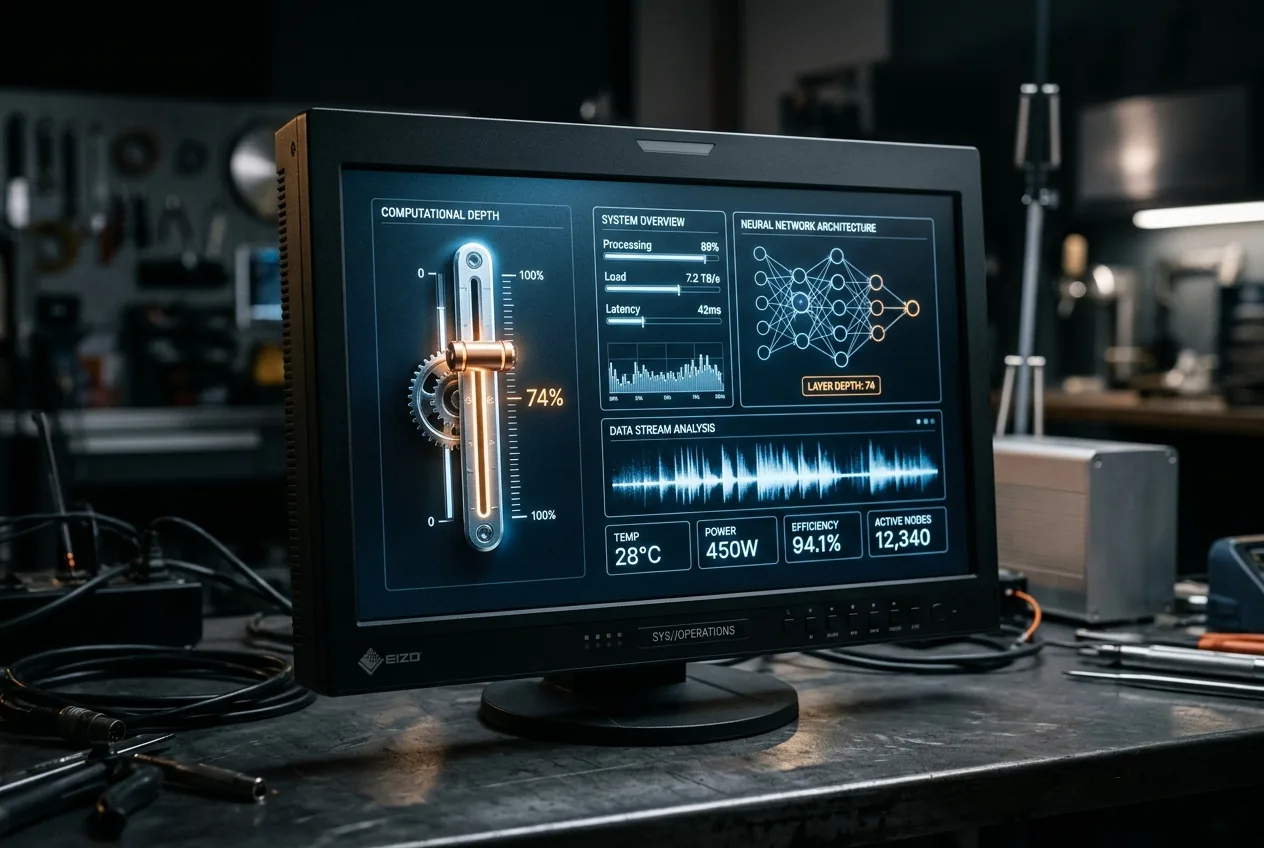
A quiet transformation is taking place across the infrastructure that powers global digital interaction. OpenAI has initiated a sweeping architecture overhaul across ChatGPT’s consumer and professional tiers, fundamentally realigning how compute is distributed across its estimated one billion weekly active users. Free users have been migrated to a newly optimized model dubbed GPT-5.6 Luna, unlocking uncapped text conversations without artificial throttling. Simultaneously, paid Plus and Pro tiers are receiving GPT-5.6 Sol, paired with a physical-style interface mechanism that lets operators directly govern the model's test-time reasoning compute.
The deployment represents a major strategic pivot from rigid, discrete model switching toward continuous, demand-driven inference scaling. For years, consumer-facing conversational AI forced users to make an upfront binary choice: route a prompt to a lightweight, low-latency model designed for simple inquiries, or dispatch it to an expensive, multi-stage reasoning engine capable of complex deduction. With the GPT-5.6 family rollout, OpenAI is replacing that fragmented approach with unified parameter weights and variable compute allocations, fundamentally altering the economics of consumer-facing artificial intelligence.
The Architecture Behind Unlimited Free Access
Providing unfettered, unlimited text chat to a user base numbering in the hundreds of millions is primarily a hardware and efficiency challenge rather than a mathematical novelty. The operational expenses associated with continuous token generation at global scale have historically required artificial rate limits, cooldown timers, or mandatory model downgrades during peak data-center load. To eliminate these barriers for free users, OpenAI developed GPT-5.6 Luna as an ultra-efficient, highly distilled inference engine built explicitly to maximize throughput per watt.
Luna departs from raw parameter expansion, leaning instead on dense architectural pruning, specialized speculative decoding pipelines, and heavily optimized key-value caching across the hosting cluster. While Luna removes text conversation caps entirely, the broader system maintains guardrails on bandwidth-heavy multimodal workloads. File ingestions, structured data parsing, and image generation routines remain bound by strict consumption caps. For text, however, Luna operates as a persistent, low-latency utility layer.
To prevent Luna from stumbling when confronted with ambiguous or highly nested prompts, the interface introduces a dedicated processing toggle. Because Luna is not an expansive, brute-force foundation model, this mechanism allows the user to explicitly command the network to run secondary verification steps. In internal benchmarks evaluated across heavily regulated domains such as finance, healthcare, and administrative law, GPT-5.6 Luna demonstrated a 62 percent reduction in factual error rates compared to the outgoing GPT-5.5 Instant baseline, illustrating how much structural stability can be engineered into a smaller runtime footprint.
The Mechanics of Test-Time Inference and the Thinking Slider
While the free tier benefits from ruthless model distillation, the paid subscription tier is introducing a more granular mechanism for technical operators: the dynamic reasoning slider. Borrowed from the specialized Codex engineering environment, this interface control grants Plus and Pro users direct governance over GPT-5.6 Sol’s internal search depth. Rather than interacting with the model as a static black box that outputs an unchangeable token stream, users can mechanically scale the computational budget allocated to deliberate before generating a single visible character.
In standard auto-regressive text models, inference cost is essentially fixed per output token. The network predicts the next token in the sequence based solely on the prior context window, providing minimal space to evaluate alternative paths or correct erroneous assumptions mid-stride. In contrast, reasoning architectures rely on test-time compute, generating hidden search graphs, self-critique loops, and chain-of-thought verification paths behind the scenes. The newly deployed slider translates high-level user intent into low-level token budgets, altering the branching factor of the search tree dynamically.
- Low Position (Direct Response): The model suppresses hidden search tokens, prioritizing rapid time-to-first-token responses for programmatic syntax lookups, quick translations, and basic factual retrievals.
- Balanced Position (Contextual Planning): The model initiates moderate self-consistency checks, filtering conversational noise, identifying implicit user objectives, and structuring complex outlines without unnecessary cognitive latency.
- High Position (Deep Inference): The system allocates an expansive reasoning budget, exploring competing analytical pathways, conducting multi-pass counterfactual analysis, and rigorously stress-testing complex engineering or legal logic before delivering a synthesized output.
This dynamic adjustment solves a persistent frustration among technical users: cognitive bloat. Previously, advanced reasoning models frequently over-thought simple transactional queries, wrapping straightforward answers in convoluted preambles and nested justifications. Under the new GPT-5.6 Sol implementation, an inquiry regarding local atmospheric variables for cycling no longer yields an indiscriminate dump of barometric pressure and precipitation metrics. The model evaluates the functional objective, isolates wind shear and convective velocity as the primary performance constraints, and suppresses irrelevant variables to deliver an actionable, mission-specific assessment.
Tackling the Hallucination Deficit in Production
Beyond ergonomic improvements, the primary performance metric governing the 5.6 generation is empirical factual reliability. In high-stakes enterprise applications, robotic tool calling, and automated operational pipelines, statistical language generation has historically been crippled by subtle hallucinations—plausible-sounding assertions with no factual basis. OpenAI’s internal audits indicate that GPT-5.6 Sol curtails these incidents by approximately 68 percent when matched against GPT-5.5 Instant across rigorous multi-domain evaluation sets.
This reduction is not merely the byproduct of a larger training corpus. The performance leap stems from refined reinforcement learning from verifier feedback, where auxiliary evaluation models score intermediate reasoning steps based on ground-truth algorithmic proofs rather than subjective human preference. By punishing incorrect deductive steps early in the hidden token generation phase, Sol prunes corrupt logical paths before they propagate downstream into the final response text. The model also exhibits a heightened propensity for active refutation; rather than passively accepting flawed premises posed by the operator, Sol is trained to issue technical corrections when baseline parameters conflict with empirical physical or mathematical realities.
It is important to emphasize that this implementation of GPT-5.6 Sol is currently restricted to the native ChatGPT conversational interface. The enterprise Work platforms and dedicated programmatic endpoints governing Codex retain their bespoke pipeline configurations to prevent breaking structural changes in existing industrial automation and code-generation environments. Maintaining this separation ensures that mission-critical API consumers remain insulated from front-end consumer tuning.
Consumer Flywheels and the Realpolitik of Compute Distribution
The strategic rationale behind providing free, unlimited access to Luna while refining Sol’s inference economics highlights the evolving competitive reality of artificial intelligence. As frontier developer mindshare has tilted heavily toward automated software development and programmatic code generation, consumer-tier dialogue platforms remain the ultimate data flywheel. By offering unlimited, highly accurate text interactions to a billion users, OpenAI captures an unprecedented stream of real-time human intent, corrective feedback, and operational edge cases.
Furthermore, running Luna at scale provides critical stress testing for next-generation silicon and cooling infrastructure within modern AI data centers. Amortizing these massive capital expenditures requires continuous, high-efficiency baseload operations. Distilling high-performing parameters into Luna allows the provider to maintain optimal cluster saturation during non-peak hours, transforming consumer engagement into an operational telemetry asset.
For the broader technology ecosystem, this dual-tier deployment signals a maturation phase in generative computing. The era of undifferentiated chatbots competing purely on raw parameter scale is drawing to a close. In its place emerges an era defined by systems engineering: rigorous distillation for high-throughput public utilities, and finely tuned, operator-controlled inference depth for mission-critical problem-solving.



Comments
No comments yet. Be the first!