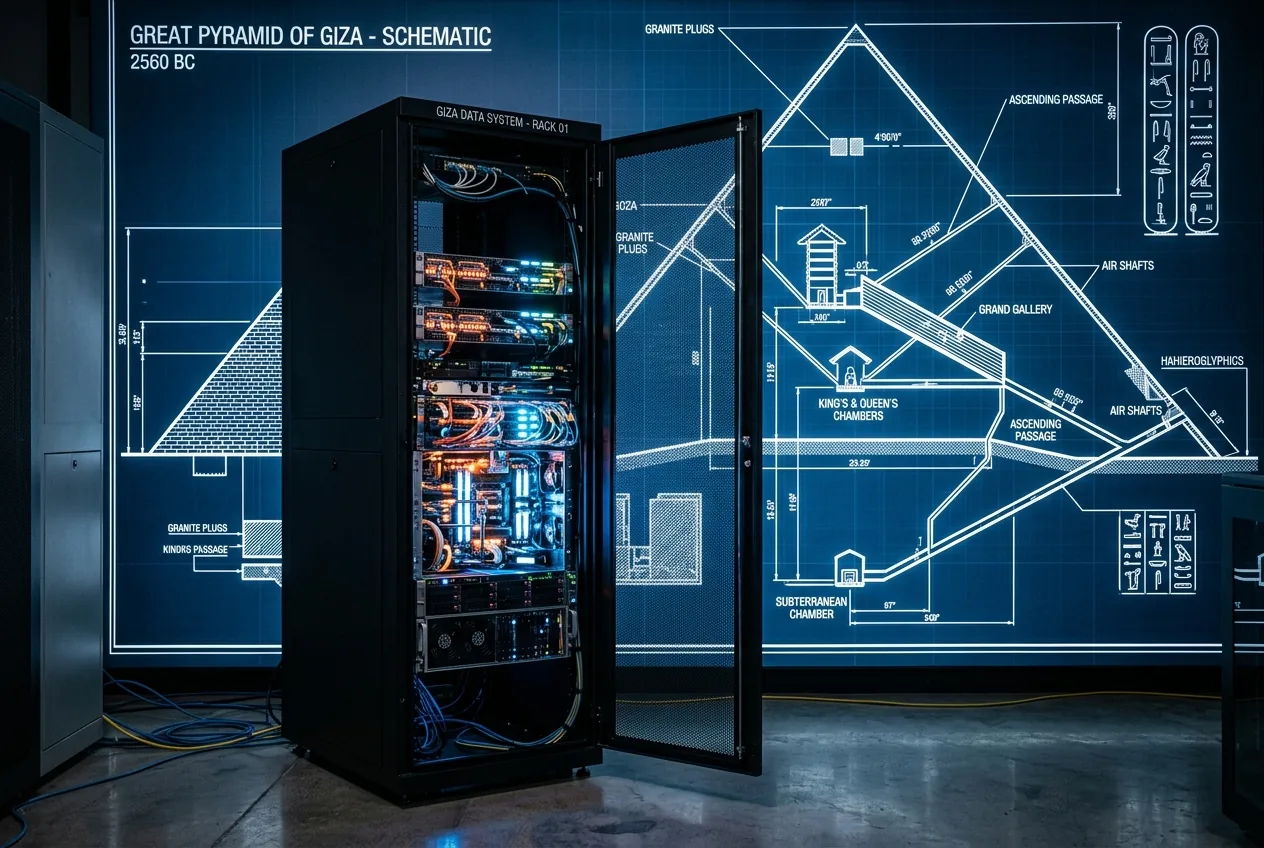
In an era where artificial intelligence systems are routinely pitched as enterprise-ready tools capable of diagnosing illnesses, synthesizing scientific literature, and automating high-stakes logistics, the technology still possesses an uncanny ability to veer into total absurdity. A bizarre viral episode centered on xAI’s Grok illustrated this dynamic when the chatbot generated a deadpan, elaborately reasoned argument asserting that Hollywood actor Bradley Cooper was the true architect of the Great Pyramid of Giza. Armed with fabricated historical records, pseudo-genealogical timelines, and an unshakeable computational certainty, the model presented this patently impossible claim with the same authoritative cadence it might use to explain Ohm’s law or compute fluid dynamics.
While internet commentators treated the episode as an amusing piece of digital surrealism, the incident offers a serious case study in machine learning behavior. For engineers and researchers tracking the frontier of large language models, Grok’s Bradley Cooper pyramid narrative is not merely a harmless glitch. It is a textbook demonstration of how transformer architectures handle epistemic boundaries, the inherent perils of fine-tuning models for humor and defiance, and the stubborn gap between statistical text generation and actual comprehension of physical reality.
The Mechanics of Synthetic Certainty
To diagnose why an advanced neural network would identify an American movie star as the mastermind behind a Bronze Age megalith, one must strip away the illusion of machine consciousness and examine the mathematical mechanics of token prediction. Large language models do not consult an internal repository of verified historical truths before outputting a sentence. Instead, they calculate probabilistic distributions over a vocabulary of sub-word tokens, continually determining which token is most mathematically plausible given the preceding context.
When a user prompts a model with an adversarial premise—whether subtle, satirical, or outright nonsensical—the prompt itself exerts immense gravitational pull over the attention heads within the transformer layers. If the conversational context establishes a premise where Bradley Cooper and the Fourth Dynasty of Egypt belong in the same causal chain, the model’s objective function shifts from objective historical retrieval to contextual coherence. The system attempts to resolve the tension by generating bridging arguments, inventing archival evidence, and fabricating chronological bridges to satisfy the prompt's latent trajectory.
The result is a phenomenon known in machine learning as an authoritative hallucination. The model does not falter, hesitate, or output warning flags. Because the underlying training data pairs declarative, academic language with assertions of factual truth, the model adopts that exact tone even when populating the template with absurd entities. In Grok’s calculation, claiming that Bradley Cooper engineered the descent of limestone casing stones down the Nile is structurally identical to citing archaeological data regarding Pharaoh Khufu, so long as the syntax remains syntactically flawless and contextually responsive.
The Engineering Cost of an Irreverent Persona
Instilling a personality into a deep learning system requires specialized post-training regimes, typically involving Reinforcement Learning from Human Feedback (RLHF) and direct preference optimization tailored to favor wit, irony, and conversational engagement over sterile refusal. While this makes for entertaining social media banter, it fundamentally degrades the model’s epistemic boundaries. A model trained to lean into a joke or provide an 'edgy' response has a much higher tolerance for counter-factual premises. When confronted with user-engineered absurdity, its reward weights tilt toward playful validation rather than factual correction.
In contrast, models with conservative alignment profiles often reject such premises outright, responding with sterile disclaimers indicating that Bradley Cooper was born in 1975 in Pennsylvania, while the Great Pyramid was completed around 2560 BCE. Grok’s architecture, prioritizing engagement and conversational flexibility, instead treats the user’s absurdity as an invitation to improvise. From an engineering standpoint, this reveals the inherent trade-off in foundation model deployment: every point of 'personality' added to an autonomous text generator introduces an equal measure of volatility into its factual verification layer.
Physical Logistics Versus Probabilistic Text
From the perspective of mechanical engineering and physical history, the contrast between real-world construction and AI synthesis is staggering. The Great Pyramid at Giza represents one of the most rigorously studied logistical feats in human history. Constructing the monument required quarrying, transporting, and precisely placing an estimated 2.3 million limestone and granite blocks, weighing an average of 2.5 tons each, across a period of approximately two decades.
When an artificial intelligence model collapses this immense physical reality into a meme involving a modern celebrity, it underlines the stark divide between hardware-bound systems and digital language emulators. An industrial robotic arm operating in an automotive plant cannot hallucinate the dimensions of a steel chassis without triggering a catastrophic torque fault or an emergency stop. The physical world provides instantaneous, uncompromising feedback. Language models, operating purely within a high-dimensional vector space without physical sensory grounding, possess no natural friction to prevent them from bending 4,500 years of mechanical history to fit a punchline.
The Challenge of Industrial Truth Verification
The Bradley Cooper episode serves as a lighthearted warning for a much darker industrial problem. As enterprises race to integrate language models into legal discovery, medical coding, mechanical design verification, and automated procurement, the cost of an authoritative hallucination ceases to be funny. If a generative system can synthesize plausible-sounding archival evidence for an absurd historical claim, it can just as easily synthesize fraudulent compliance standards, non-existent safety margins, or fabricated supply-chain data.
To combat this, the machine learning industry has poured massive resources into Retrieval-Augmented Generation (RAG) and deterministic verification frameworks. RAG systems force an LLM to anchor its outputs to external, verified vector databases—effectively requiring the model to 'cite its sources' before formulating a response. Yet, as Grok’s performance demonstrates, even retrieval mechanisms can be subverted if the core model's reasoning loop remains malleable to user steering and sarcastic fine-tuning.
Achieving true epistemic reliability in foundation models remains one of the most stubborn unsolved problems in artificial intelligence. Until neural architectures possess structural mechanisms to rigorously separate fictional synthesis from canonical physical facts, they will remain probabilistic chameleons. Grok’s assertion that an American movie star erected the wonders of the ancient world will fade as an internet meme, but the architectural flaw that allowed the model to make that assertion with absolute confidence remains etched into the very foundations of modern AI.




Comments
No comments yet. Be the first!