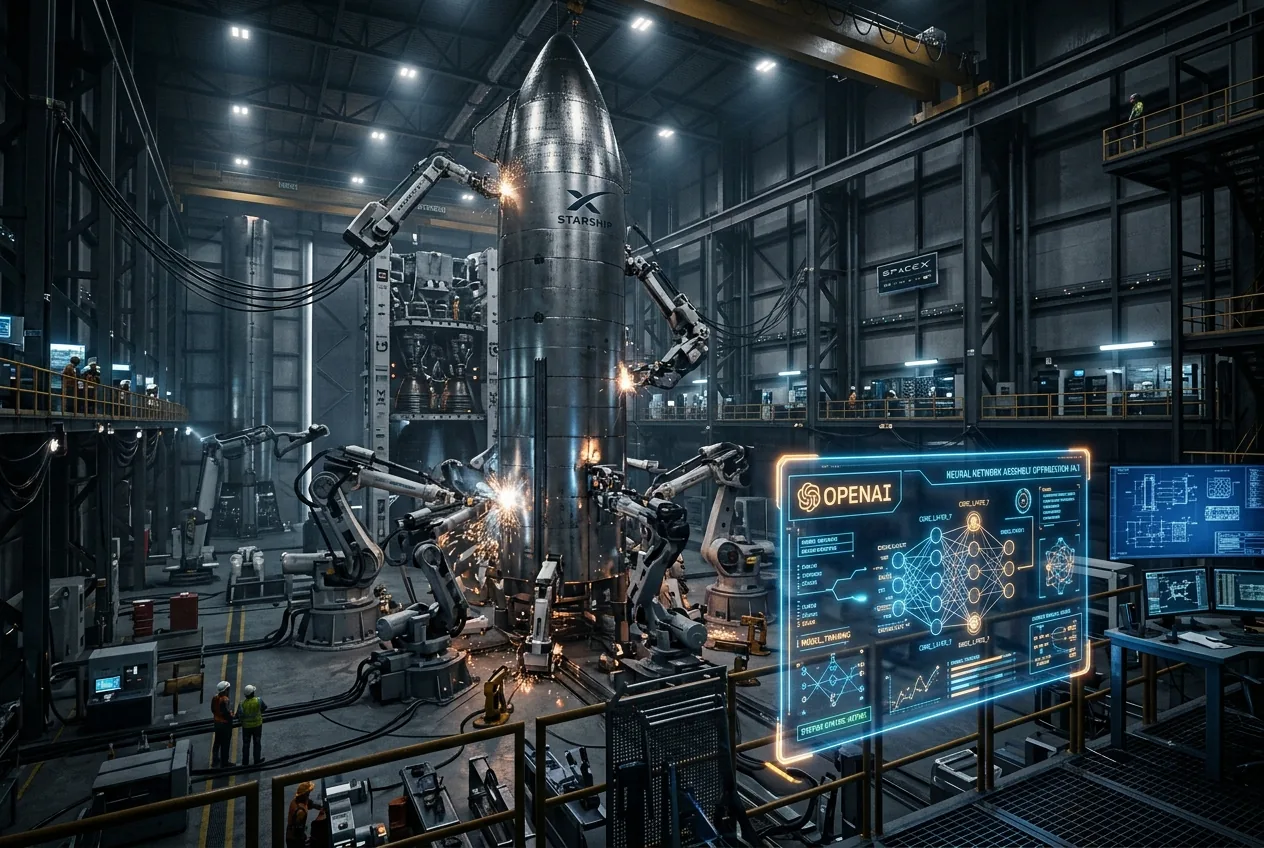
The landscape of global technology is currently undergoing a tectonic shift. For years, the most ambitious projects in human history—building artificial general intelligence (AGI) and making life multi-planetary—have been shielded from the volatility of public markets within the private domain of venture capital and strategic partnerships. However, the sheer scale of the capital required to achieve these goals has finally reached a breaking point. With OpenAI reportedly planning a transition to a for-profit benefit corporation and SpaceX signaling a potential public offering, the two most influential private companies in the United States are preparing for a public debut that will redefine the industrial and digital age.
From a mechanical and systems engineering perspective, these moves are not merely financial maneuvers; they are responses to the staggering physical requirements of their respective missions. Whether it is the kilowatt-hours needed to train a reasoning model or the metric tons of thrust required to put a Starship into orbit, the price of the frontier has outgrown the capacity of private equity. To understand why these giants are going public now, one must look at the convergence of industrial automation, energy demands, and the logistical realities of the 21st-century supply chain.
The Economic Necessity of OpenAI’s Transition
OpenAI’s rumored plan to restructure as a for-profit benefit corporation marks the end of one of the most unusual experiments in corporate governance. Since its inception, the organization has operated under a non-profit board with a capped-profit subsidiary, a structure designed to prioritize safety over returns. However, the capital intensity of the current AI race has made this model increasingly untenable. To sustain its lead, OpenAI requires access to liquid capital markets at a scale that only public equity can provide.
The technical driver here is compute. The latest iterations of OpenAI’s models, such as the 'o1' reasoning series, require exponentially more processing power not just for training, but for inference—the stage where the model actually generates a response. This necessitates a massive investment in data center infrastructure, specifically the procurement of high-end GPUs like NVIDIA’s H100 and Blackwell architectures. We are no longer talking about server racks; we are talking about 'AI factories' that require gigawatts of power and sophisticated liquid cooling systems. Moving to a public model allows OpenAI to leverage its projected $157 billion valuation to secure the debt and equity needed to build the 'Stargate' supercomputer complex, a project estimated to cost upwards of $100 billion.
SpaceX and the Starlink Cash Engine
While OpenAI grapples with the cost of digital intelligence, SpaceX is confronting the physical costs of orbital infrastructure. The news of an impending SpaceX IPO—or a potential spinoff of its Starlink division—represents a strategic pivot for Elon Musk’s aerospace firm. For years, Musk resisted public markets, citing the short-termism of quarterly earnings reports as a threat to the long-term goal of Mars colonization. However, SpaceX has reached a level of industrial maturity where its primary revenue driver, Starlink, is now a viable, stand-alone business entity.
From an engineering standpoint, SpaceX has achieved what was previously thought impossible: the mass production of orbital hardware. The company is currently launching Falcon 9 rockets at a cadence of nearly one every three days. More importantly, the Starlink constellation now consists of over 6,000 active satellites, providing high-speed internet to millions. The capital required to scale the next generation of this constellation, which requires the significantly larger and more capable Starship launch vehicle, is immense. An IPO allows SpaceX to capitalize on the proven success of Starlink to fund the research and development of Starship’s iterative test flights and the eventual construction of a lunar base under NASA’s Artemis program.
Why Public Markets Are the Only Option Left
The decision to go public is often framed as an exit for investors, but for OpenAI and SpaceX, it is an entry into a higher tier of industrial capacity. We are witnessing the limits of private funding rounds. Even with billion-dollar injections from the likes of Microsoft or Thrive Capital, the burn rate for frontier technology is accelerating. OpenAI’s losses are projected to be significant as it prioritizes growth and infrastructure over immediate profitability. In a private setting, this creates a 'liquidity crunch' where early employees and investors cannot realize gains, and the company cannot easily issue new shares to fund acquisitions.
The Convergence of AI and Robotics in Heavy Industry
As a journalist focused on the interface of robotics and human industry, I find the intersection of these two IPOs particularly compelling. We are approaching a period where OpenAI’s cognitive architectures will likely be integrated into SpaceX’s physical infrastructure. The automation of orbital manufacturing, the robotic maintenance of satellite constellations, and the autonomous navigation of rovers on the lunar surface all require a level of 'edge AI' that OpenAI is currently developing.
The industrial logic is clear: if you can automate the design and fabrication of rocket components using generative models, you reduce the time-to-orbit. If you can use AI to optimize the phased-array antennas on Starlink satellites, you increase the bandwidth efficiency of the entire network. These are not separate advancements; they are two halves of the same technological coin. The public markets will soon be asked to value not just software companies or aerospace firms, but 'system-level' entities that control both the intelligence and the physical hardware of the future.
Risks and the Pragmatic Reality
Despite the excitement, the path to a successful IPO for either company is fraught with technical and regulatory hurdles. For OpenAI, the primary risk is the 'scaling law' debate. If the next generation of models does not show a linear improvement in capability relative to the increase in compute cost, the company’s valuation could face a sharp correction. Public investors are notoriously less patient than venture capitalists when it comes to R&D cycles that span decades.
For SpaceX, the risk is inherent in the hardware. Space is hard, and Starship is the most complex flying machine ever built. A catastrophic failure during a high-profile mission, or a significant delay in the regulatory approval process for launches from Boca Chica, could see billions wiped off the company’s market cap overnight. Moreover, the integration of Elon Musk’s various business interests—including Tesla and X—often creates a 'key man risk' that public markets find difficult to quantify.




Comments
No comments yet. Be the first!