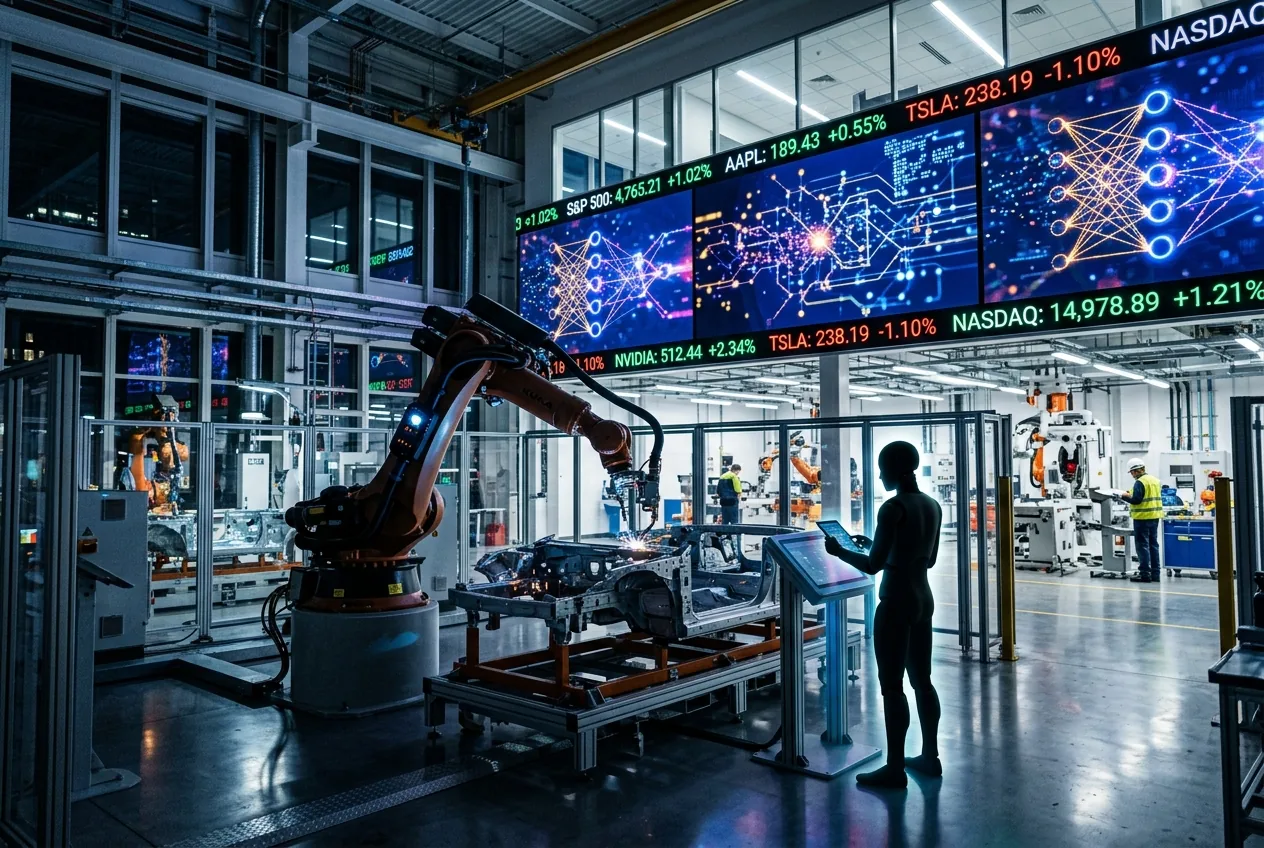
From the perspective of mechanical engineering and industrial automation, an IPO is the only logical conclusion to the current trajectory of model development. We are no longer discussing the cost of training a model on a cluster of ten thousand GPUs. We are discussing the construction of 'Stargate' class data centers—facilities requiring nuclear-grade power infrastructure and capital expenditures (CapEx) exceeding $100 billion. To sustain this, OpenAI and Anthropic must move beyond the constraints of their current corporate structures and tap into the deep liquidity of the public markets.
The Capital Intensity of Embodied AI
The transition from generative text to physical action is the most significant technical hurdle currently facing the industry. While LLMs excel at token prediction, the next frontier—robotic manipulation and industrial autonomy—requires a different kind of data and a vastly more complex inference architecture. To make a humanoid robot function on a factory floor with the same reliability as a traditional Fanuc or Kuka arm, but with the flexibility of human reasoning, the computational overhead is staggering.
OpenAI’s recent moves to re-establish its internal robotics team and its strategic investment in Figure AI highlight this pivot. This is no longer about software; it is about the integration of neural networks with high-torque actuators, haptic sensors, and real-time computer vision. The hardware-software bridge requires a level of R&D spending that makes the early days of the internet look inexpensive. By filing for an IPO, OpenAI is signaling that the 'scaling laws' of AI—the principle that more compute and more data lead to more capability—now require the kind of funding historically reserved for national infrastructure projects.
Restructuring the Non-Profit Foundation
One of the primary technical and legal obstacles for an OpenAI IPO is its unique corporate architecture. Founded as a non-profit, OpenAI transitioned to a 'capped-profit' model to attract capital while ostensibly remaining tethered to a mission of safety and broad benefit. However, the 'capped-profit' structure is fundamentally incompatible with the expectations of public market investors who demand uncapped growth and fiduciary clarity. A transition to a traditional for-profit corporation is likely a prerequisite for any public filing.
Anthropic, similarly, operates as a Public Benefit Corporation (PBC). While this structure is more aligned with public markets than a non-profit-controlled subsidiary, it still introduces a layer of complexity regarding how the company balances shareholder value with its 'Constitutional AI' safety mandates. For the industrial sector, the stability of these corporate structures is paramount. If a logistics giant like GXO or a manufacturer like Siemens is to integrate these models into their core supply chain, they need the assurance that the provider is a stable, transparent, and permanent fixture of the market.
The Move Toward Custom Silicon and Supply Chain Control
In the context of robotics, this is even more critical. Standard GPUs are not optimized for the low-latency, high-reliability requirements of a mobile robotic platform operating in a dynamic warehouse environment. We are seeing a move toward 'edge-intelligence' where the model is distilled and run locally on the machine. Designing the chips that facilitate this transition is a multi-billion dollar endeavor. The IPO isn't just about paying the cloud bill; it’s about owning the entire stack from the silicon to the solenoid.
The Anthropic Alternative: Safety as a Technical Moat
While OpenAI has pursued a strategy of rapid deployment and iterative feedback, Anthropic has positioned itself around 'Constitutional AI'—a method of training models to follow a specific set of internal rules or 'constitutions' to ensure safety and predictability. In an industrial setting, predictability is the single most valuable metric. A robot that is 99% efficient but 1% unpredictable is a liability on a factory floor.
The Economic Viability of Public AI Companies
Critics of the AI boom often point to the high 'inference cost'—the price of running the model once it is trained. For a public company, margins are king. If OpenAI and Anthropic are to succeed as public entities, they must prove that they can drive down the cost of intelligence until it is a commodity, similar to electricity or bandwidth. This requires massive advancements in algorithmic efficiency and hardware optimization.
We are currently observing a trend toward 'small language models' and 'distillation,' where the knowledge of a massive 1.7-trillion parameter model is compressed into a 7-billion parameter model that can run on a fraction of the hardware. This technical efficiency is the key to economic viability. The capital raised in an IPO will fund the transition from 'research breakthroughs' to 'operational efficiencies.' For the first time, we will see these companies' balance sheets scrutinized not by venture capitalists looking for a 100x return, but by institutional investors looking for steady, predictable growth in the industrial AI sector.
Why the Industrial Sector Should Care
The convergence of OpenAI and Anthropic on the public markets marks the beginning of the 'Industrial AI' era. When these companies have access to the public markets, their ability to sign long-term, multi-decade contracts with global manufacturers increases. We will likely see a wave of acquisitions where AI companies begin buying robotics hardware firms to create truly integrated solutions. For the worker on the floor or the engineer designing the next automated sorting facility, the result will be a new class of machines that are no longer programmed with rigid 'if-then' logic, but are instead taught through demonstration and natural language.
This transition is not without risk. The pressure of quarterly earnings calls can sometimes stifle long-term R&D. However, given the sheer scale of the hardware and energy infrastructure required to reach the next level of artificial general intelligence (AGI), the public markets are the only engine capable of providing the necessary thrust. The race between OpenAI and Anthropic is no longer just about who has the smartest chatbot; it is about who will build the operating system for the next century of human industry.




Comments
No comments yet. Be the first!