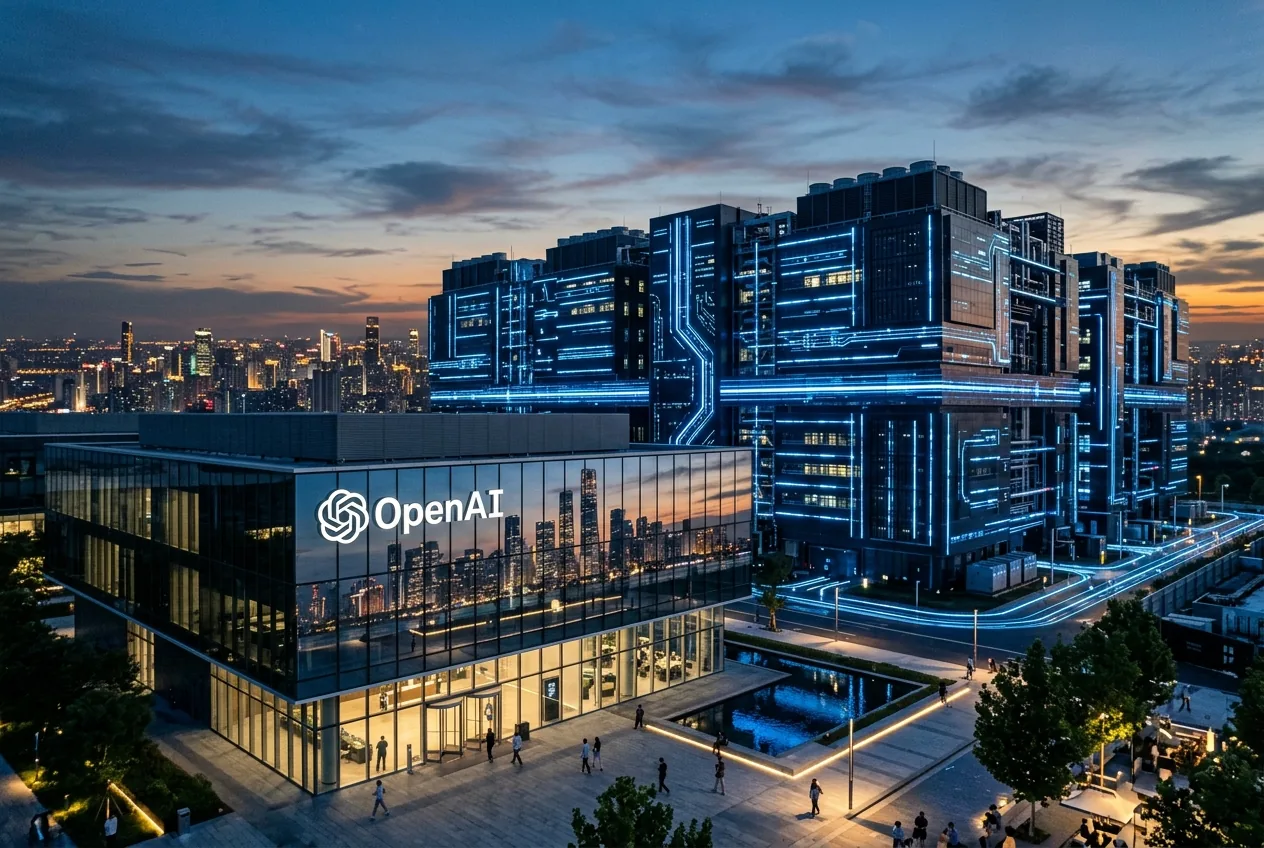
In the short history of Silicon Valley, few companies have transitioned from an idealistic research collective to a global industrial powerhouse as rapidly as OpenAI. Recent reports, including those from Fox Business, suggest that the organization is now laying the groundwork for a transition that would have seemed unthinkable just three years ago: a formal restructuring into a for-profit entity and a potential public offering targeting a staggering $1 trillion valuation. This move represents more than just a financial milestone; it is a fundamental shift in the mechanical and economic infrastructure of the artificial intelligence sector.
For those of us tracking the intersection of high-level software and physical compute infrastructure, the $1 trillion figure is not merely a vanity metric. It is a reflection of the capital intensity required to build the next generation of intelligence. As OpenAI moves to shed its non-profit board’s control over its core business, the company is positioning itself to compete not just as a software provider, but as a primary architect of the world’s digital and industrial future. The shift signals that the era of AI experimentation is over, and the era of AI industrialization has begun.
The Architecture of a For-Profit Transition
The primary hurdle between OpenAI and a public market debut has always been its unique, and often friction-heavy, corporate structure. Originally founded as a non-profit, OpenAI transitioned to a "capped-profit" model in 2019 to attract the billions in capital required for compute power. However, that structure—where a non-profit board had the power to fire the CEO and prioritize safety over shareholder returns—is increasingly viewed as an obstacle by the massive institutional investors needed to reach a thirteen-figure valuation.
Reports indicate that the proposed restructuring would see OpenAI become a benefit corporation, similar to its rival Anthropic. This move would likely remove the profit caps for investors and simplify the governance structure, making it more palatable for the public markets. From a technical and pragmatic standpoint, this change is a prerequisite for the scale of operations Sam Altman envisions. The existing structure was designed for a research lab; the new structure is being designed for a global utility. For an organization that reportedly expects to lose billions annually in the short term as it builds out its infrastructure, the ability to tap into public equity markets is a matter of survival and scale.
The Compute Arms Race and Project Stargate
Why does a software company need a trillion-dollar valuation? The answer lies in the physical reality of modern AI development. We are no longer in a phase where clever algorithms alone can yield breakthrough performance. We have entered the era of the "scaling laws," where progress is inextricably linked to the amount of compute and energy one can harness. To lead in this space, OpenAI requires a level of capital expenditure usually reserved for sovereign nations or the world’s largest oil and gas conglomerates.
Does the Revenue Support the Hype?
From an analytical perspective, the most pressing question for any investor is whether OpenAI’s revenue growth can eventually justify a trillion-dollar market cap. Currently, the company has seen explosive growth in its annualized revenue, largely driven by ChatGPT Enterprise and API usage. However, the costs associated with training models like the rumored GPT-5 and the recently released o1 "Strawberry" series are astronomical. The o1 model, in particular, signals a shift toward "inference-time compute," where the model spends more time thinking before it speaks. This is a breakthrough in reasoning, but it is also significantly more expensive to run on a per-query basis.
To reach and sustain a trillion-dollar valuation, OpenAI must move beyond being a productivity tool for white-collar workers. It must become the operating system for autonomous industry. This includes the integration of AI into robotics, supply chain management, and automated manufacturing. If OpenAI can successfully position its models as the "brain" for the millions of humanoid robots expected to enter the workforce over the next decade, the valuation becomes much more grounded in reality. The real-world utility of a model that can perform complex mechanical reasoning—understanding the physics of a warehouse or the tolerances of a machine part—is where the multi-trillion dollar market actually exists.
Regulatory Hurdles and Market Sentiment
The path to an IPO is rarely a straight line, especially for a company that sits at the center of a global debate over safety and existential risk. Regulators in the US and EU are closely watching OpenAI’s moves. A move to a for-profit structure will undoubtedly trigger intense scrutiny regarding how the company intends to balance its original mission of "benefiting all of humanity" with the fiduciary duties owed to shareholders. There is a non-trivial risk that the very changes required to go public could alienate the core research talent that made OpenAI successful in the first place.
Furthermore, the market's appetite for AI stocks has shown signs of volatility. While NVIDIA has seen unprecedented gains, software-centric AI companies have faced more skepticism regarding their margins. OpenAI will have to prove that it can maintain a "moat" in an environment where open-source models from Meta and others are rapidly closing the gap. The technical lead OpenAI currently enjoys must be converted into a structural lead—proprietary data, deeply integrated enterprise partnerships, and perhaps most importantly, a physical infrastructure that others simply cannot afford to replicate.
The Industrial Future of OpenAI
Whether they can achieve the $1 trillion mark will depend on more than just code. It will depend on their ability to manage the massive mechanical and electrical demands of their data centers, their ability to navigate the complex geopolitical landscape of chip manufacturing, and their ability to convince the world that AGI is not just a research goal, but a viable, profitable commodity. For the engineering community, this is the ultimate stress test of whether digital intelligence can be scaled into a physical and economic force of nature. The paperwork may be about finance, but the success of the venture will be determined by the sheer physics of the compute power they can bring to bear.




Comments
No comments yet. Be the first!