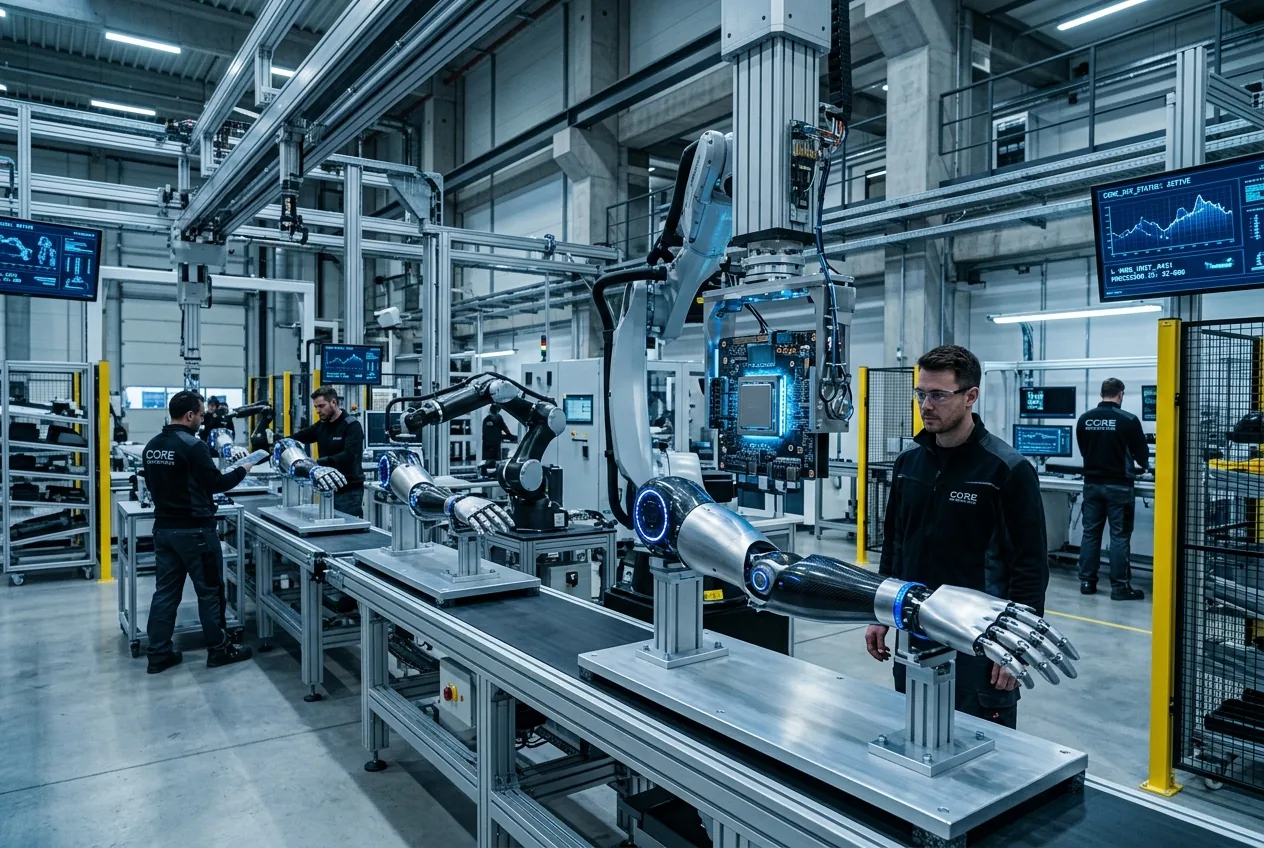
To understand the $852 billion figure, one must look beyond the user interface of ChatGPT. From a technical and mechanical perspective, OpenAI is no longer competing with search engines; it is positioning itself as the foundational layer for the next century of physical labor, logistics, and resource management. The sheer volume of capital raised—exceeding the market cap of most legacy aerospace and automotive giants—suggests that the company’s roadmap is heavily weighted toward the massive capital expenditures required to bridge the gap between bits and atoms.
The Mechanics of Embodied Intelligence
For a robotics engineer, the most compelling aspect of OpenAI’s recent trajectory is the development of "World Models." Traditionally, industrial robots have operated on rigid, pre-programmed paths. A robotic arm in an automotive plant follows a precise coordinate system with little to no deviation. However, OpenAI’s recent investments in embodied AI—exemplified by their collaborations with humanoid robotics firms—indicate a shift toward probabilistic, adaptive motion. By applying transformer architectures to sensorimotor data, they are attempting to solve the "Moravec’s Paradox," where high-level reasoning is easy for computers, but low-level sensorimotor skills are incredibly difficult.
The $122 billion in new capital provides the necessary runway to solve the hardware-software integration problem. We are seeing a move toward end-to-end neural networks where the AI doesn't just process text; it processes torque, tension, and spatial orientation. In an industrial setting, this translates to machines that can operate in unstructured environments, such as a warehouse where objects are not in fixed positions or a construction site where the terrain changes daily. The valuation reflects the market's belief that OpenAI can provide the "brain" for millions of mechanical units, effectively commoditizing complex physical labor.
The Energy Requirements of a Trillion-Dollar Intelligence
From an engineering standpoint, the biggest bottleneck to OpenAI’s growth is not algorithmic efficiency, but thermodynamic reality. The S-1 filing hints at significant allocations for energy infrastructure. To sustain the inference loads required for a global workforce of autonomous agents, the company requires power on a scale typically reserved for small nations. This is where the physics of the IPO becomes clear: you cannot have AGI (Artificial General Intelligence) without a massive increase in megawatt-scale compute clusters.
The heat dissipation requirements alone for the next generation of GPU/NPU clusters are forcing a rethink of data center design. We are moving away from traditional air-cooling toward liquid-immersion systems and direct-to-chip cooling architectures. For OpenAI to justify its $852 billion valuation, it must solve the energy-to-intelligence conversion ratio. If the cost of inference remains high due to energy inefficiencies, the economic viability of replacing human labor with robotic labor collapses. Thus, a significant portion of that $122 billion is likely earmarked for vertical integration into power generation—potentially including small modular reactors (SMRs) and advanced grid management systems.
Scaling the Industrial Supply Chain
The economic viability of OpenAI’s model depends on the ability of the global supply chain to produce the sensors, actuators, and semiconductors required to host their models. As a journalist focused on industrial automation, I see this IPO as a massive signal to the manufacturing sector. We are entering an era of "hardware-defined software," where the limitations of the silicon and the precision of the servo-motor define the capabilities of the AI. The filing suggests that OpenAI will need to secure long-term agreements with foundries and rare-earth mineral suppliers to ensure their roadmap isn't throttled by material shortages.
The scale of the $122 billion raise allows OpenAI to act as a sovereign-level economic entity. They can effectively subsidize the development of specialized hardware that is optimized for their specific model architectures. In the past, software companies were at the mercy of hardware cycles. OpenAI is flipping the script, using its massive capital reserve to dictate the specifications of the next generation of industrial chips. This is a pragmatic necessity; the latency requirements for a humanoid robot to catch a falling object or react to a safety hazard require compute to happen at the "edge," not just in a centralized cloud. This shift to edge-AI at scale is a massive mechanical and electrical challenge that OpenAI is now funded to tackle.
The skepticism surrounding an $852 billion valuation usually centers on the "AI bubble" narrative. However, if we analyze the total addressable market for physical labor, the numbers begin to look different. The global manufacturing, logistics, and maintenance sectors represent tens of trillions of dollars in annual spend. If OpenAI’s models can automate even 5% of these tasks with a high degree of reliability, the revenue potential exceeds that of current SaaS (Software as a Service) models by an order of magnitude.
The real question is one of reliability and safety. In a digital environment, a hallucination results in a wrong answer in a chat window. In an industrial environment, a "hallucination" in a multi-ton robotic system can result in catastrophic structural failure or loss of life. Therefore, a large portion of OpenAI’s R&D must now pivot toward formal verification and deterministic safety layers that wrap around their probabilistic models. This is the "how" behind the IPO: they are moving from a research lab to a mission-critical infrastructure provider. The market is betting that they can successfully implement the rigorous safety standards required by OSHA and other global regulatory bodies while maintaining the flexibility of their generative models.
The Impact on the Global Workforce
As we look toward the listing date, the focus will remain on the numbers, but the real story is in the engineering. The transition from $122 billion in cash to a functioning, AI-driven industrial economy involves solving some of the hardest problems in physics, from battery energy density to the high-speed processing of multimodal data. OpenAI is no longer just a software company; it is a massive engineering project aimed at rewriting the rules of production. The S-1 is not just a financial document; it is the first chapter of a new industrial revolution, one where the bottleneck is no longer human intelligence, but the speed at which we can build the machines to house it.




Comments
No comments yet. Be the first!