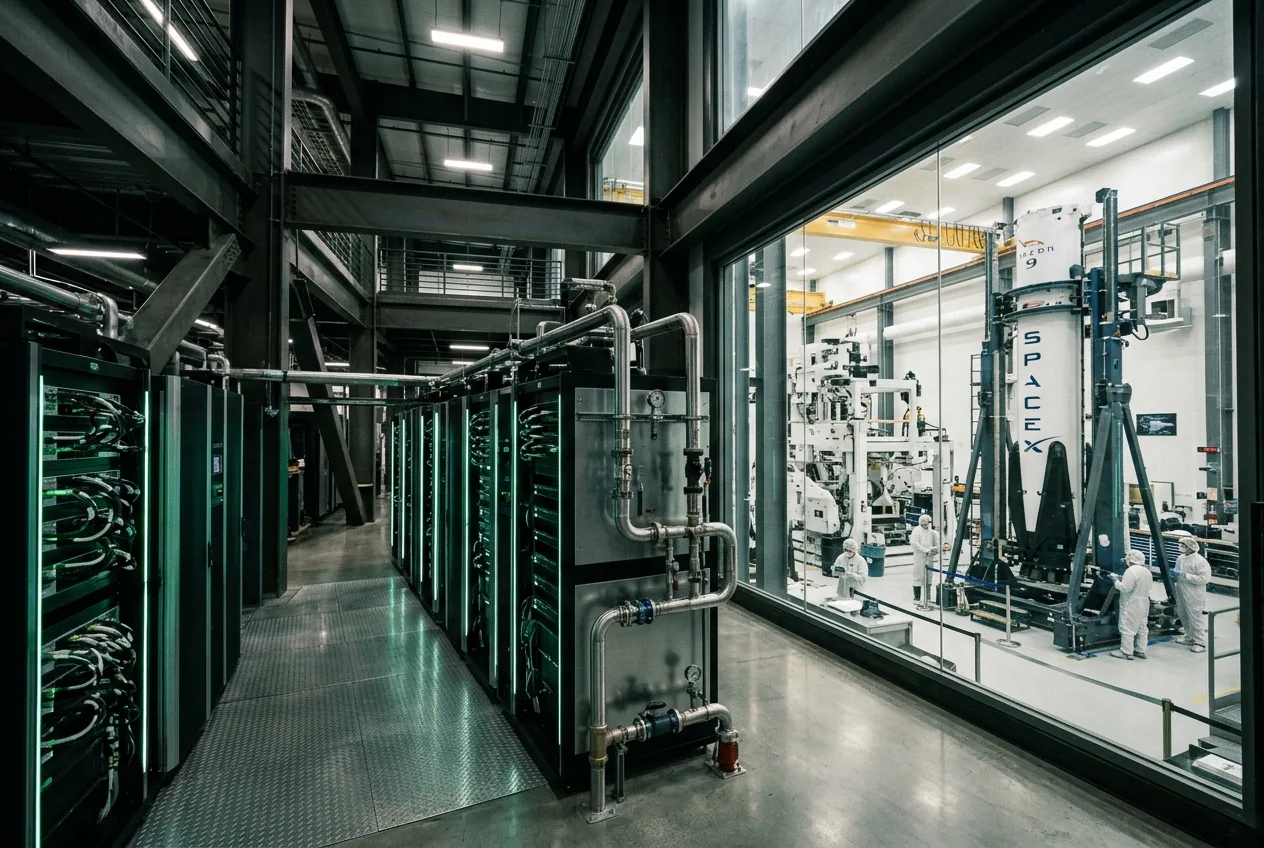
Regulatory disclosures often clarify structural shifts in technology long after boardrooms have finalized them. In its latest quarterly filings with the U.S. Securities and Exchange Commission, Nvidia Corporation revealed that it holds approximately 122.8 million Class A shares of Space Exploration Technologies Corp., a position valued at nearly $21 billion at the close of the second quarter. The equity disclosure illuminates how deeply the world’s leading computing architecture has woven itself into the fabric of aerospace manufacturing, global communications, and autonomous infrastructure.
The position makes SpaceX Nvidia’s second-largest balance-sheet equity holding, sitting alongside a newly detailed $30 billion stake in Intel Corporation. While market movements following SpaceX’s recent public debut have moderated the paper value of the holding to roughly $17 billion, the underlying mechanics of the alliance demonstrate a deliberate convergence: enterprise-scale silicon manufacturing pairing directly with heavy industrial operations and orbital deployment platforms.
From xAI Venture to Aerospace Equity
The origin of Nvidia’s massive SpaceX position stems directly from the capital restructuring of Elon Musk’s artificial intelligence enterprise. In January, Nvidia completed a landmark investment into xAI, providing both capital and priority access to accelerated computing clusters. Shortly thereafter, Musk folded xAI into SpaceX, consolidating his frontier AI development, Starlink’s planetary data routing, and launch telemetry into a single corporate structure.
When that merger closed ahead of SpaceX’s initial public offering, Nvidia’s venture convertible notes and direct equity in xAI migrated into common and preferred holdings in the parent aerospace entity. For Nvidia, the transaction transformed what began as a strategic bet on a foundation-model lab into a multi-billion-dollar position in the world’s dominant launch provider and satellite internet operator.
This corporate consolidation reflects a broader shift across the advanced automation sector. Artificial intelligence models are no longer treated as pure cloud-hosted software products; they are increasingly deployed as control planes for real-world mechanical assets. By rolling the model-building arm directly into the company manufacturing Starship launch vehicles and Starlink satellite constellations, the organizational boundaries between software model training and physical aerospace engineering have been functionally erased.
The Vera Rubin Hardware Architecture Lock-in
The equity stake provides crucial financial context to operational announcements made during SpaceX’s inaugural earnings call. Musk explicitly stated that SpaceX had committed to an exclusive infrastructure agreement with Nvidia, bypassing alternative custom silicon and competing merchant accelerators to build out its computational backbones entirely on Nvidia’s upcoming Vera Rubin architecture.
The Vera Rubin platform, succeeding the Blackwell generation, introduces tight mechanical and thermal integration between central processors, graphics compute dies, and ultra-high-bandwidth optical interconnects. In a high-density compute cluster, latency and power dissipation across the interconnect fabric represent the fundamental physical bottlenecks. By committing exclusively to Rubin, SpaceX is prioritizing architectural cohesion over multi-vendor redundancy, aiming to maximize floating-point operations per watt across massive contiguous data nodes.
Musk’s decision to lock into a single silicon provider underscores the brutal engineering trade-offs required at hyperscale. Heterogeneous compute clusters—running a mix of internal application-specific integrated circuits (ASICs) alongside merchant hardware—introduce massive software maintenance overhead and complex routing layers. For an enterprise attempting to run physics-informed neural networks alongside real-time orbital routing engines, standardizing on Nvidia’s unified CUDA and NVLink software-hardware stack eliminates integration friction at the expense of vendor dependency.
Engineering the Ten-Gigawatt Threshold
The sheer physical scale of the planned compute deployment dwarfs standard commercial installations. SpaceX revealed plans to expand its operational data center compute capacity from 2 gigawatts at the end of this year to nearly 10 gigawatts by the conclusion of 2027. To put that figure in technical perspective, 10 gigawatts represents roughly the continuous power output of eight to ten standard commercial nuclear reactors, or enough electrical capacity to power millions of modern homes.
Deploying compute at this density shifts the primary engineering challenge from computer science to mechanical and thermal systems engineering. High-density accelerator racks running Rubin hardware can consume upwards of 100 to 120 kilowatts per cabinet. Dissipating that quantity of heat requires direct-to-chip liquid cooling loops, industrial closed-circuit cooling towers, and multi-megawatt pumping sub-assemblies engineered with zero tolerance for fluid leakage or cavitation.
Furthermore, sourcing 10 gigawatts of steady baseload electricity demands entirely new grid-intertie strategies. Facilities of this magnitude cannot rely on traditional municipal utility distribution without triggering severe localized voltage sags. SpaceX’s buildout will increasingly necessitate dedicated high-voltage substations, co-located energy storage arrays, and potentially captive natural gas or next-generation modular nuclear generation. By cementing an exclusive hardware pipeline, Nvidia ensures that every megawatt of heavy power infrastructure deployed across SpaceX’s facilities translates directly into utilization of its silicon.
Vendor Financing and the Silicon Balance Sheet
The SpaceX equity disclosure lands alongside a sweeping reorganization of how mega-scale computational infrastructure is funded. Alongside its direct equity positions in key clients, Nvidia recently outlined a framework to assemble over $500 billion from institutional asset managers—including Apollo Global, Blackstone, BlackRock, Brookfield, Goldman Sachs, and KKR—designed to finance hardware procurements across the AI ecosystem.
Under these financing structures, the high-performance accelerators themselves serve as asset-backed collateral for institutional debt, with Nvidia offering partial guarantees. This approach creates a powerful, self-reinforcing commercial flywheel. Nvidia deploys capital into ecosystem operators, helps arrange private credit facilities secured by its own hardware, and delivers the physical servers that drive client operations. The risk, historically seen in telecommunications equipment buildouts, lies in the depreciation curve of the silicon: hardware assets must deliver economic value before generational architectural advances render them economically obsolete.
The $30 billion Intel stake disclosed in the same SEC filing demonstrates that Nvidia is actively hedging and orchestrating its industrial supply lines. As advanced packaging capacity at Taiwan Semiconductor Manufacturing Company (TSMC) remains constrained by physical lithography and substrate packaging bottlenecks, maintaining deep equity and manufacturing ties across the broader domestic semiconductor landscape gives Nvidia leverage over physical fabrication and packaging logistics going forward.
Computational Aerospace and the Autonomous Loop
The operational imperative driving this unprecedented compute volume centers on the demands of modern mechanical manufacturing and autonomous operations. Modern aerospace development has pivoted from physical wind tunnels and destructive prototype iteration to high-fidelity computational fluid dynamics (CFD) and structural finite element analysis running continuously inside digital twins. Every iteration of SpaceX’s Raptor rocket engines and Starship aerodynamic control surfaces is tested across millions of simulated flight parameters before metal is cut.
Simultaneously, SpaceX’s recent $60 billion acquisition of the AI-powered code-generation platform Cursor reveals an aggressive push to automate the software lifecycle underpinning hardware operations. From avionics flight software and real-time Starlink phased-array beamforming to the autonomous telemetry of factory robotics, SpaceX is using synthetic code models to accelerate development cycles. Running these massive development engines requires round-the-clock inference and training pipelines, creating an insatiable appetite for raw floating-point performance.
What the SEC disclosure ultimately details is the emergence of a vertically integrated industrial-computational complex. Nvidia is no longer operating merely as a fabless semiconductor designer shipping components to commercial vendors. By anchoring billions of dollars of capital inside its largest and most ambitious engineering client, the company is directly driving the physical deployment of power grids, industrial cooling infrastructure, and autonomous manufacturing systems that will define hardware capability for decades to come.



Comments
No comments yet. Be the first!