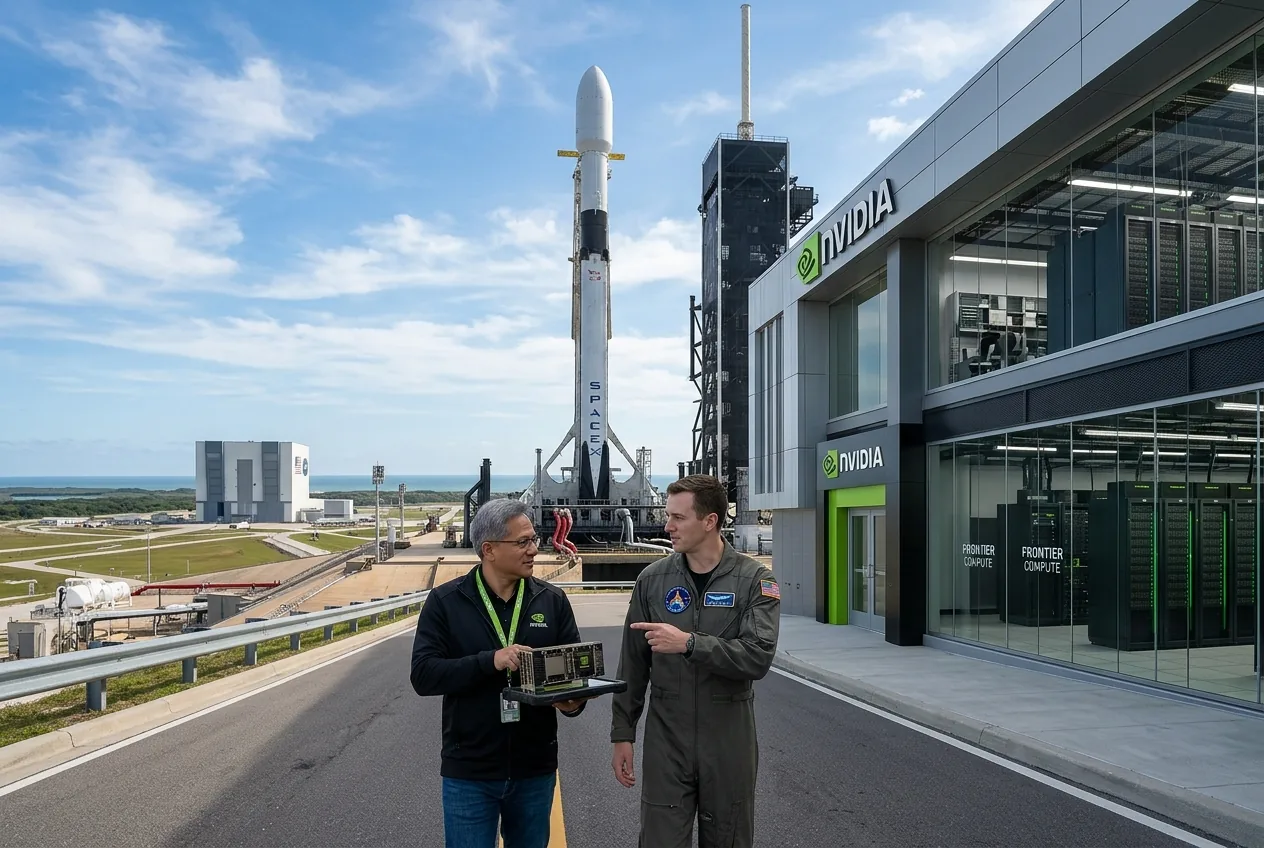
A regulatory disclosure with the Securities and Exchange Commission has revealed that Nvidia holds a $21 billion position in SpaceX, establishing Elon Musk’s aerospace conglomerate as the chipmaker’s second-largest institutional asset. Encompassing 122.8 million Class A shares, the holding trails only Nvidia’s $22 billion position in Intel. The transaction formalizes a monumental industrial marriage: the world’s preeminent designer of parallel compute infrastructure is now fundamentally intertwined with the primary operator of commercial launch systems, orbital satellite broadband, and frontier artificial intelligence.
The mechanics of the transaction trace back to early capital allocation strategies within Musk’s industrial ecosystem. Nvidia originally deployed $10 billion into xAI as part of an aggregate $20 billion financing round. When SpaceX subsequently integrated xAI in an all-stock transaction valued at $1.25 trillion, Nvidia’s position converted directly into equity in the combined entity. While subsequent market price fluctuations have seen the real-time paper value settle around $17.2 billion, the strategic footprint of the deal extends far beyond standard equity accounting. It represents an unprecedented industrial synthesis between high-performance computing pipelines and high-cadence aerospace manufacturing.
The Silicon Pipeline Fueling Orbital Automation
Modern aerospace engineering at the scale of SpaceX is fundamentally a data engineering and computational physics problem. Rocket development historically relied on lengthy iterative test cycles, where physical prototypes were fabricated, pressure-tested, and often destroyed to validate stress margins. Today, the design lifecycle of complex flight articles such as the Starship upper stage and Super Heavy booster relies heavily on multi-physics fluid dynamics simulations, real-time telemetry processing, and neural network-driven autonomous guidance routines.
Simulating the aerothermal loads encountered during atmospheric reentry requires resolving supersonic shock layers, boundary layer turbulence, and localized heating gradients across thousands of active thermal protection tiles. These computational fluid dynamics (CFD) problems map directly onto the tensor-heavy, highly parallel architectures perfected by Nvidia. By operating in-house compute clusters powered by cutting-edge silicon, aerospace engineers can iterate combustion chamber geometries for Raptor engines overnight, running transient combustion instability analyses that previously required supercomputer access reserved for national defense laboratories.
Beyond physical design iteration, the operational overhead of the Starlink megaconstellation demands continuous algorithmic intervention. Managing dynamic inter-satellite optical laser links, phased-array ground beam steering, and real-time orbital collision avoidance across thousands of active low-Earth-orbit satellites requires distributed intelligence across both edge ground stations and centralized processing hubs. Merging these computational needs with the training infrastructure required for frontier AI models establishes an insatiable internal demand for throughput that standard merchant cloud offerings struggle to satisfy economically.
Architecture Details of the Vera Rubin Deployment
During SpaceX’s inaugural earnings call, leadership confirmed that the enterprise had made an architectural determination to build its internal data center capacity exclusively on Nvidia’s upcoming Vera Rubin platform. Furthermore, the company indicated it has secured commitments for a significant allocation of Vera Rubin GPUs as fabrication scales next year. In an era marked by structural supply constraints across leading-edge semiconductor foundries, securing priority wafer allocations represents a formidable operational advantage.
The Vera Rubin architecture succeeds the Blackwell generation, introducing fundamental mechanical and electrical overhauls designed to maximize compute density while mitigating thermal resistance. Rubin integrates next-generation High Bandwidth Memory (HBM4), utilizing wider memory interfaces and monolithic 3D packaging techniques through advanced chiplet-on-wafer substrates. For memory-bound workloads—such as large-scale structural finite element analysis and transformer parameter optimization—the exponential jump in memory bandwidth per socket prevents compute cores from idling during massive matrix read-write cycles.
Interconnect topology represents the other major operational bottleneck in hyperscale compute clusters. The Vera Rubin platform deploys advanced NVLink switches and high-speed optical transceivers capable of scaling node-to-node throughput to multi-terabit bandwidths. This allows tens of thousands of individual processors to behave mechanically as a single coherent compute engine. For SpaceX, this unified memory fabric is critical: whether distributing the parameter weights of multimodal frontier models or processing thousands of simultaneous telemetry channels from orbital hardware, data latency must remain strictly deterministic.
Balance Sheet Diplomacy and Supply Chain Reciprocity
The disclosure illustrates an aggressive evolution in how Nvidia leverages its immense operational cash flows. Rather than simply returning capital through standard equity repurchases or letting cash sit in low-yield sovereign paper, the company has increasingly practiced what industry analysts term balance sheet diplomacy. By taking substantial equity positions in key platform builders—first Intel, and now SpaceX—Nvidia secures multi-generational hardware exclusivity while simultaneously benefiting from the enterprise valuation growth of its largest clients.
This symbiotic loop creates significant reciprocal advantages. For SpaceX, partnering directly with the principal architect of accelerated computing guarantees preferential access to silicon allocations that are heavily contested by cloud hyperscalers. When data center deployments run into physical volume constraints at Taiwan Semiconductor Manufacturing Company (TSMC), priority distribution of packaging capacity can mean the difference between activating an advanced training facility on schedule or facing multi-quarter launch delays. Equity participation aligns the supplier's balance sheet directly with the customer's operational success.
For Nvidia, the arrangement guarantees long-term architecture lock-in. Once an engineering organization standardizes its proprietary simulation pipelines, software drivers, and neural training scripts on CUDA and proprietary NVLink fabrics, the switching costs become prohibitive. By backing SpaceX’s acquisition of xAI with direct equity support, Nvidia neutralized the risk of Musk’s companies pivoting toward custom internal ASIC development, an approach aggressively pursued by peers across the hyperscale technology sector.
Industrial Scale Meets the Power and Cooling Frontier
Translating theoretical computational power into operational hardware requires solving punishing physical constraints on the data center floor. Deploying Vera Rubin clusters at gigawatt scale demands a complete reimagining of power distribution, mechanical packaging, and thermodynamic management. Traditional air-cooled data center racks, which historically maxed out at 15 to 20 kilowatts per cabinet, are entirely incapable of dissipating the thermal output of high-density accelerated compute trays, which now routinely exceed 100 kilowatts per rack.
SpaceX’s facilities utilize industrial direct-to-chip liquid cooling systems, utilizing closed-loop manifolds that circulate dielectric or treated fluids directly across copper cold plates mounted to the GPU packaging. The engineering discipline required to operate massive fluid loops reliably—monitoring for micro-leaks, managing cavitation risks, and sustaining precise flow velocities under varying thermal loads—mirrors the fluid handling systems developed for cryogenic launch vehicles. In many respects, the industrial mechanical engineering required to keep a 100,000-GPU cluster operational shares more DNA with high-pressure rocket plumbing than with traditional software IT infrastructure.
Power delivery presents an equally formidable challenge. Stepping down medium-voltage utility power to the sub-one-volt levels required at the silicon die level incurs severe transmission losses unless managed through ultra-efficient busbar architectures and silicon carbide power conversion stages. SpaceX’s integration of industrial manufacturing expertise enables rapid build-out of localized electrical substations, automated cooling towers, and modular data center halls, accelerating deployment timelines that typically take commercial operators several years to complete.
The Long-Range Synergy of Compute and Launch Capabilities
Looking beyond immediate data center requirements, the consolidation of computing dominance and heavy-lift space transport points toward longer-term industrial convergence. The global demand for computing is rapidly colliding with terrestrial limitations on electrical grid capacity, water cooling availability, and physical land rights. High-density data centers require dedicated access to hundreds of megawatts of continuous baseload power, prompting enterprise operators to investigate unconventional energy solutions ranging from behind-the-meter nuclear plants to off-grid gas generation.
Nvidia’s $21 billion stake confirms that the division between pure software-driven artificial intelligence and heavy industrial machinery has largely dissolved. Autonomous manufacturing, rocket production facilities running digital twin factories, and orbital communication constellations are converging into a unified technical paradigm. By anchoring its silicon roadmap to the most ambitious heavy-industrial enterprise of the modern era, Nvidia is positioning its hardware architecture not merely as the engine of software applications, but as the foundational compute layer for physical aerospace engineering.



Comments
No comments yet. Be the first!